As the leaves turned in the Pontiac in the fall of 1914, so too did the mood of the region. While the initial shock of the war’s outbreak dominated late summer headlines, autumn brought a more settled—if uneasy—sense of purpose. Life in the region marched on, even as war crept into every conversation, every newspaper column, and every household. This season offers a portrait of a community adjusting to war: raising funds, saying goodbye to sons and brothers, and preparing—knowingly or not—for the long haul.
From Headlines to Households
By October, the war was no longer breaking news—it was the backdrop. The front page of The Equity remained filled with war reports, yet readers increasingly found stories of how the conflict was shaping daily life in Shawville, Campbell’s Bay, Chapeau, and other parts of the Pontiac.
The October 1 issue reported the formation of local militia support groups and a renewed interest in patriotic education in area schools. “Mr. Horner, of the Shawville High School, is giving regular talks on the war to his students,” the article noted, underlining how deeply the war had entered everyday instruction.
Families began adapting in their own ways. Local blacksmiths, such as John A. Rennick in Shawville, announced the resumption of operations to serve both civilian and military needs, with advertisements in several October editions promoting the availability of sleighs, cutters, and horseshoeing services (October 22, 1914).
The First Casualties from Home
While enlistment announcements had been frequent since August, Fall 1914 saw the first mentions of local men dying overseas.
The November 5 issue bore grim news: “Word has been received that Private Arthur McCagg, formerly of Clarendon, was killed in action at the front.” Just weeks before, McCagg’s departure had been noted with admiration. Now, his death underscored the real cost of war for Pontiac families.
Another name followed in the November 19 edition: “Sergt. Henry Walker, of Chapeau, is reported missing after the fighting at Ypres.” That single sentence carried a weight that readers would have understood all too well—missing often meant lost.
Mobilization of Community Spirit
Despite the heartbreak, or perhaps because of it, community mobilization only intensified. The Women’s Institute in Shawville hosted multiple fundraising teas and sewing circles, with the October 15 issue describing a “large parcel of knitted socks and scarves” bound for the front. Contributions poured in not just in cash, but in kind—blankets, medical supplies, and even typewriters.
Notably, on November 12, The Equity reported a “Patriotic Supper” held in Campbell’s Bay that raised over $100—a significant sum at the time—for the Soldiers’ Relief Fund. The meal was followed by a community dance, where “a spirit of gratitude and solemn pride filled the hall.”
The Quyon Women’s Auxiliary ran a full-page ad in the December 3 issue, thanking the public for their donations and encouraging further gifts in time for Christmas. The ad emphasized the need for “comforts for our boys overseas,” and included a list of urgently needed items—from tobacco to long underwear.
Religious Leadership and Moral Messaging
Local clergy took an active role in shaping public sentiment. Several issues reprinted excerpts from Sunday sermons, including a forceful reflection by Rev. T. Naylor in the November 26 edition, which called upon citizens to “show our loyalty not just in words, but in the daily sacrifices we make.”
Christmas services, as noted in the December 24 issue, were organized with dual themes of peace and perseverance. A Methodist church in Radford planned to display a roll of honour featuring the names of all local men enlisted to date.
The Economy in Wartime
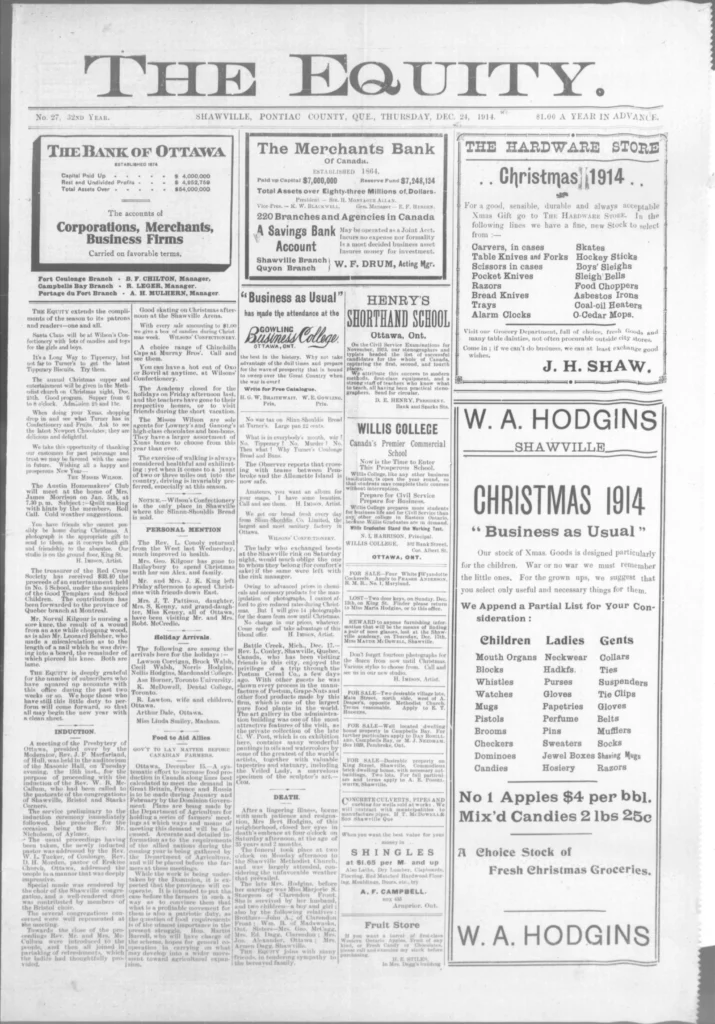
While war had captured the headlines, local business didn’t pause. In fact, it adjusted. Merchants such as W. A. Hodgins and A. Dover reoriented their advertisements to reflect both wartime needs and Christmas giving. Hodgins promoted “sensible and durable gifts” like razors, muffs, and skates (December 10, 1914), while Dover’s Christmas sale featured discounted overcoats and woollen socks, explicitly described as suitable for soldiers and those “preparing for a hard winter.”
The Merchants Bank, in an ad repeated throughout the fall, reminded customers that “War Bonds make both patriotic and practical investments.”
Prices, too, were rising. The Equity published warnings from grocers and bakers that flour costs—already climbing in October—would likely rise again before January due to disrupted trade routes. By December, advertisements increasingly encouraged early ordering of winter staples.
French and English Unity, Quietly Observed
Though rarely overtly discussed, glimpses of French-English cooperation appeared between the lines. In a region like Pontiac—home to both linguistic communities—the war presented both tensions and common cause.
In the November 26 edition, a small blurb mentioned a joint choir performance in Fort Coulonge, with singers from the Anglican, Methodist, and Catholic churches raising money for Belgian relief. “The trilingual carols were a particular delight,” the editor remarked.
In Chapeau, Father Gagnon hosted a town hall in mid-December (reported on December 17), urging “cooperation regardless of tongue” to aid families of enlisted men. That same week, a bilingual petition circulated through Mansfield-et-Pontefract asking the federal government to improve postal service to military families.
Christmas in Wartime
December brought with it a mix of tradition and tension. While stores filled with decorations and gifts, the tone in town was undeniably more subdued than in years past. The Equity ran several holiday-themed ads and stories, but they were often accompanied by somber commentary.
A column in the December 24 issue read:
“Let us enjoy our meals and our music, but not forget that many chairs are empty this year. Our boys sleep under different stars now.”
Still, signs of hope emerged. That same issue listed names of local soldiers who had managed to send letters home in time for Christmas. A poem, submitted anonymously, read in part:
“They’ve gone for King and country’s call,
From Pontiac’s fields and timber tall—
But know, dear lads, whate’er befall,
Your place is here. Your hearts are all.”
Conclusion: The Long Road Ahead
By the end of 1914, the people of the Pontiac had fully entered the era of war—not just in politics or letters from abroad, but in the rhythm of their daily lives. The pages of The Equity tell the story of a region learning to live with conflict—not glorifying it, but grappling with its demands.
As Fall turned to Winter, it was clear that this war would not be over quickly. Yet in every fundraiser, every community gathering, every shop window, and every solemn prayer, the people of the Pontiac showed resilience. They were preparing not just to endure the war—but to face it together.
Listen to our Audio Summary!
- Hay exports rising: Local hay diverted to Europe for war needs.
- Young men depart: Locals leave for Macdonald College.
- War horrors described: Reprinted account details grim battlefield experiences.
- Wartime disruption: Global conflict affects shipping, commerce, daily life.
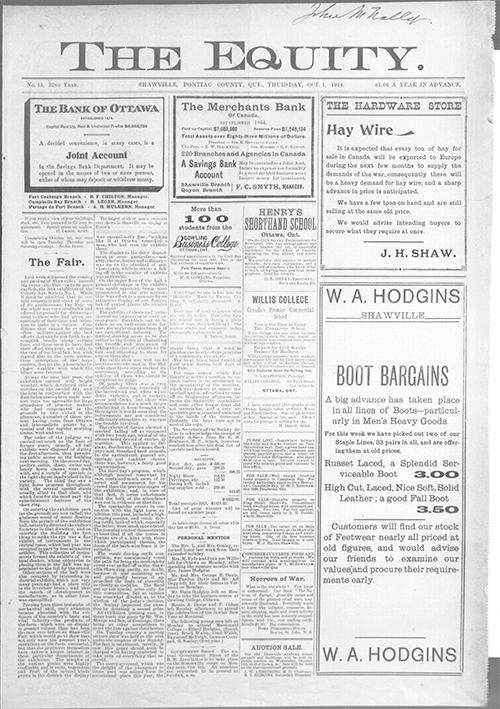
- Local soldier writes: Letter from Pte. H. R. Corrigan describes training in England.
- Enlistment praised: Editorial supports Canada’s response, urges more volunteers.
- Aid efforts grow: Shawville ladies sewing for Red Cross and soldiers.
- War affects jobs: Ottawa firm lays off staff due to conflict.
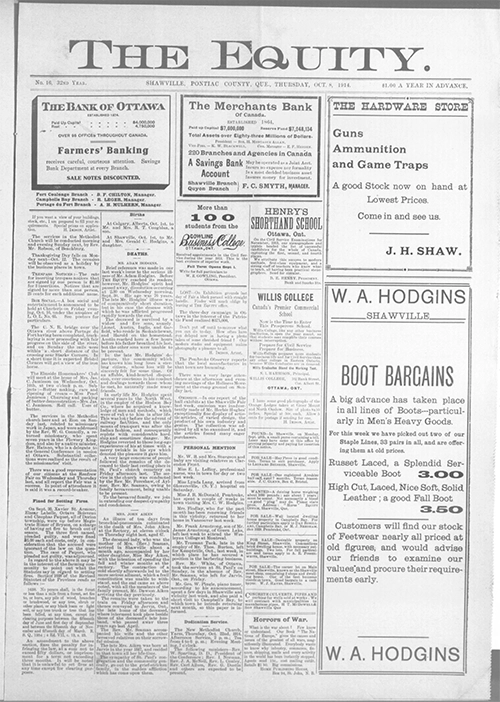
- Shawville Red Cross active: Donations and sewing for soldiers continue.
- British victories noted: Reports of German losses boost local morale.
- Militia training ongoing: Men drilling in Ottawa and Valcartier camps.
- War fund appeals: Public urged to support patriotic and relief funds.
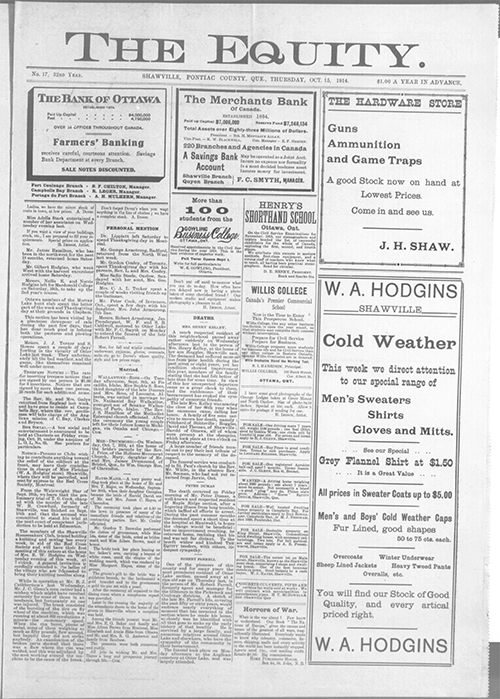
- A French interpreter’s account, written from the front, highlighted the friendship between British and French troops, detailing the British soldier’s calm courage (sang-froid) under fire and his devotion to shaving and tea
- The Canadian troops arrived in Plymouth, England, receiving a grand British reception before moving to Salisbury Plain for additional training
- German spies, described as individuals entering Canada under the advice of their consuls, are suspected of infesting the country, leading to the presence of plainclothes officers in Ottawa to monitor them
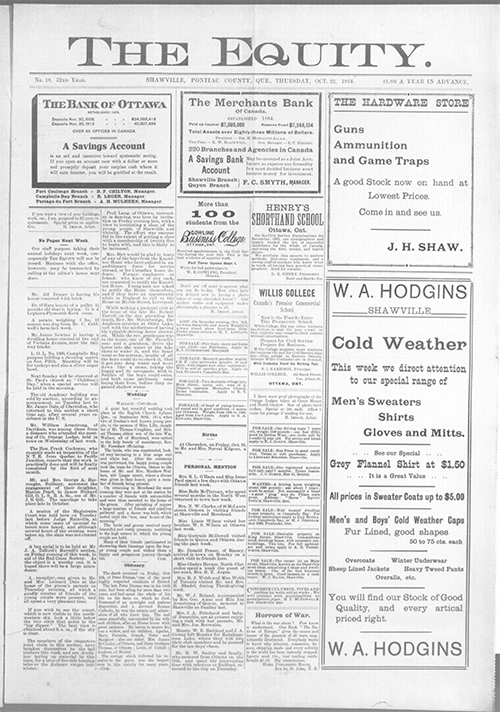
- A knitting and sewing bee was announced to be held at Mrs. Geo. Findley’s, urging every person to assist in the making of garments for the Red Cross
- A patriotic dance held at the Town Hall in Fort Coulonge, Pontiac County, Quebec, successfully raised over one hundred dollars for the Belgian Relief Fund
- The Department of Agriculture announced the distribution of free samples of superior sorts of grain and potatoes from Ottawa to farmers in Ontario and Quebec to increase food production for the war
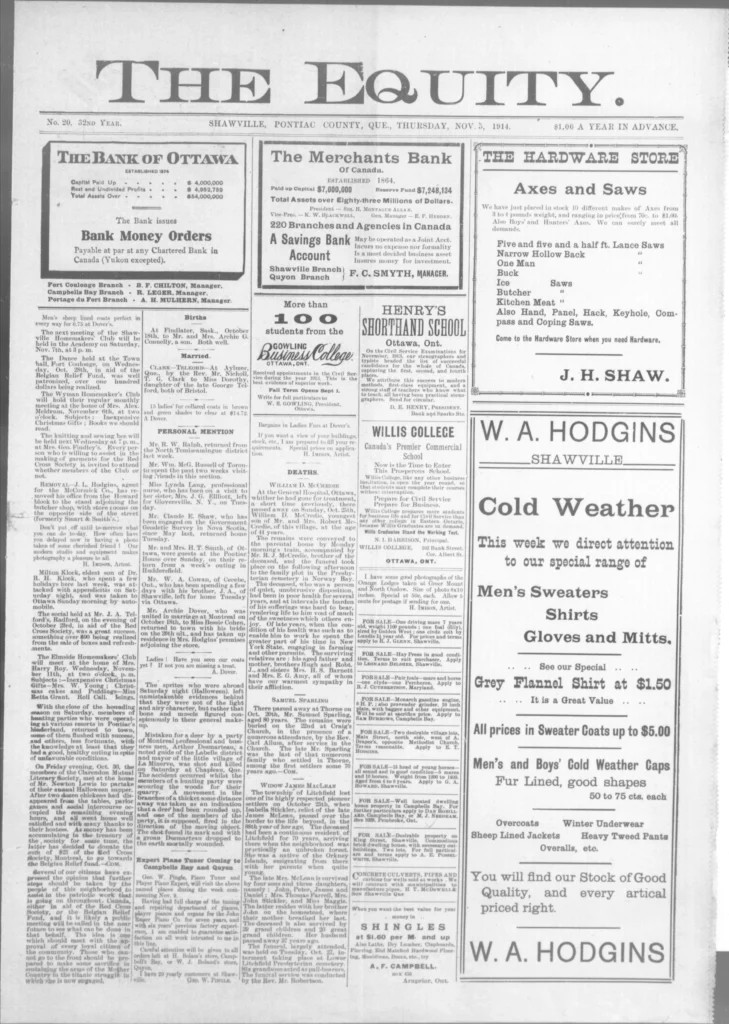
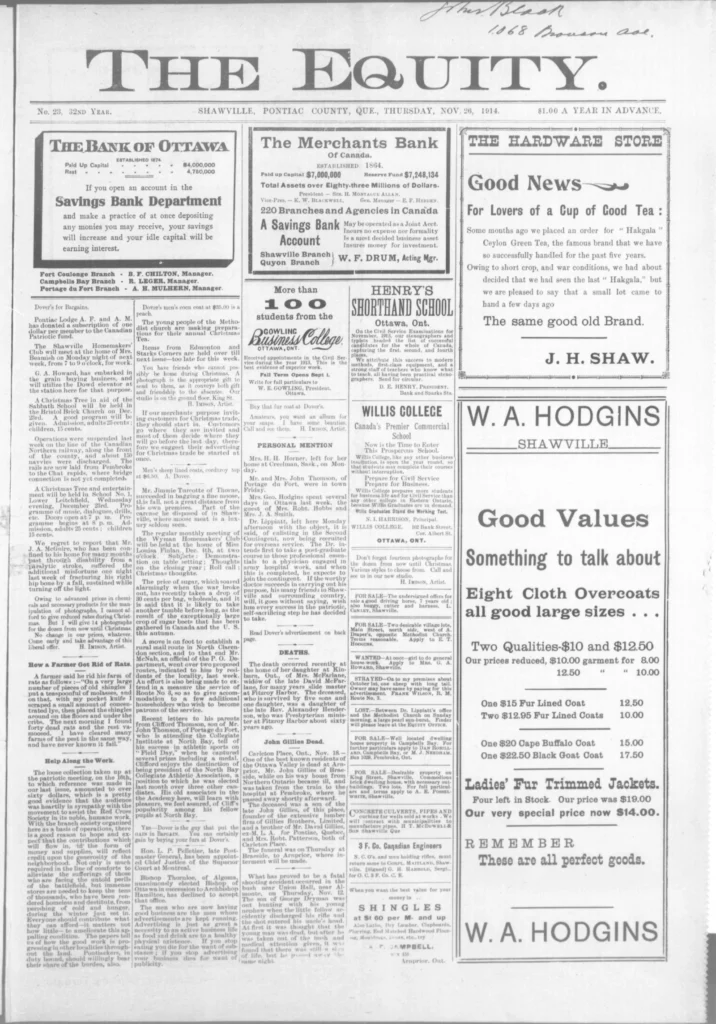
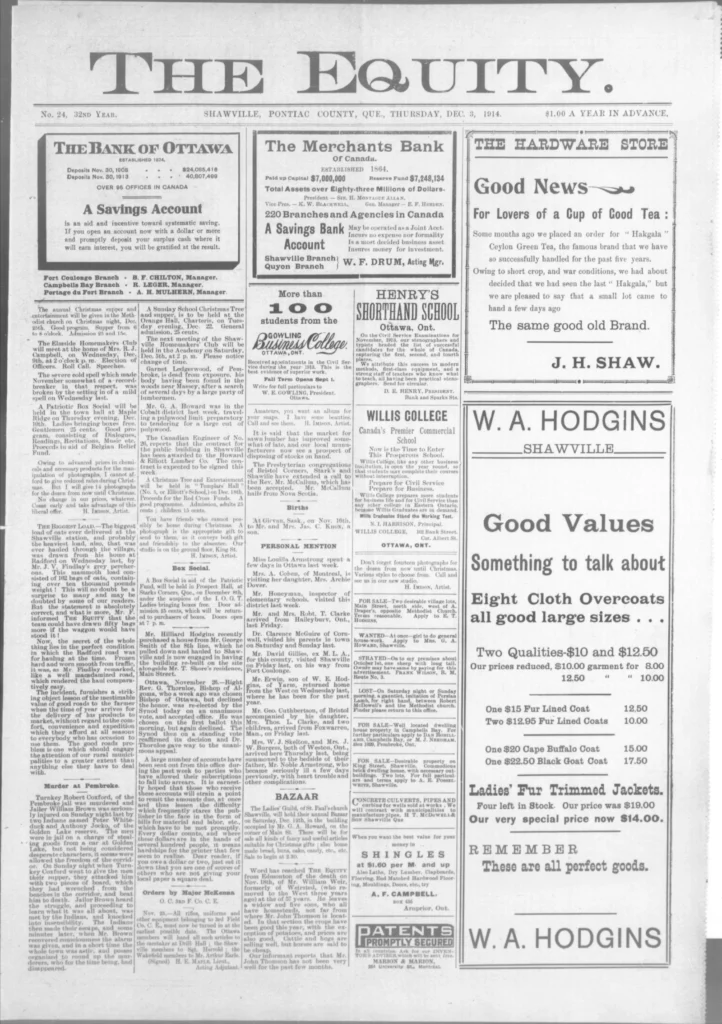
- The local artist, H. Imison, announced that due to advanced prices in chemicals and necessary products for photograph development, he could not afford to offer reduced rates for Christmas, reflecting the economic effects of the war on local supplies
- A local patriotic and social event was held by the brethren of L. O. L. No. 84, Knox, which concluded with the singing of the National Anthem
- The local hardware store (J. H. Shaw) advertised that they stock high-grade Apples and “Made in Canada” goods, suggesting that Canada’s workers should “fight her prominent war… in the market”
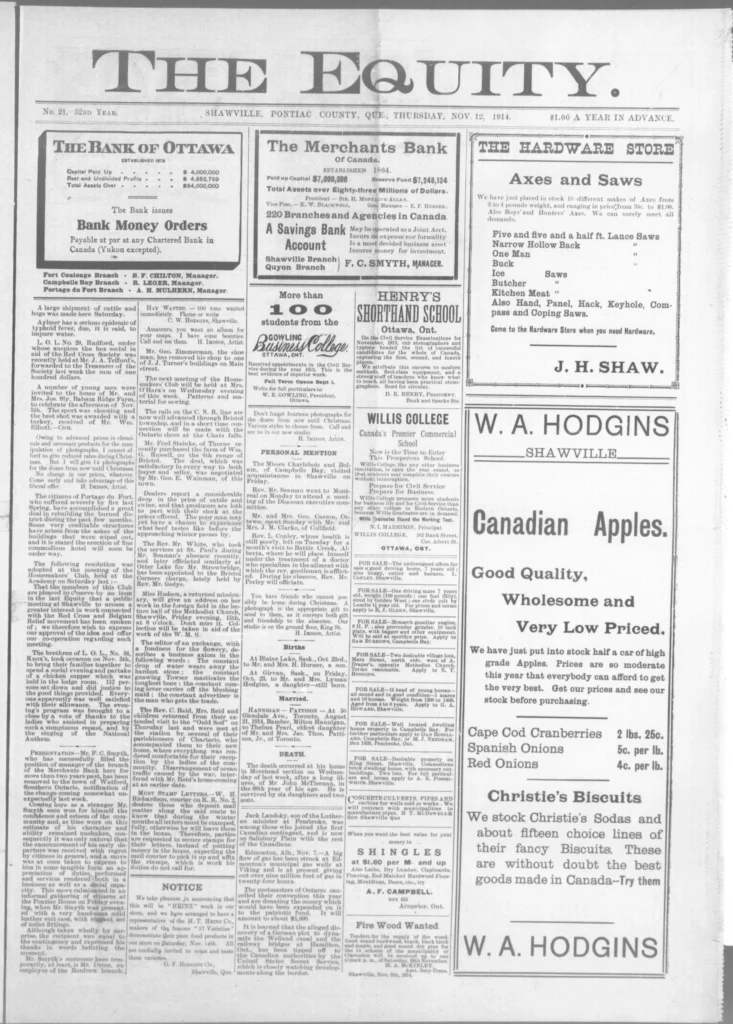
- A Red Cross Branch was successfully organized in Shawville following a patriotic meeting that raised over sixty dollars in collection, reflecting strong local support for the humanitarian work
- The Shawville Red Cross Branch declared that besides comforts for soldiers, they needed immense stores to assist the thousands of homeless and destitute refugees who might perish during the coming winter
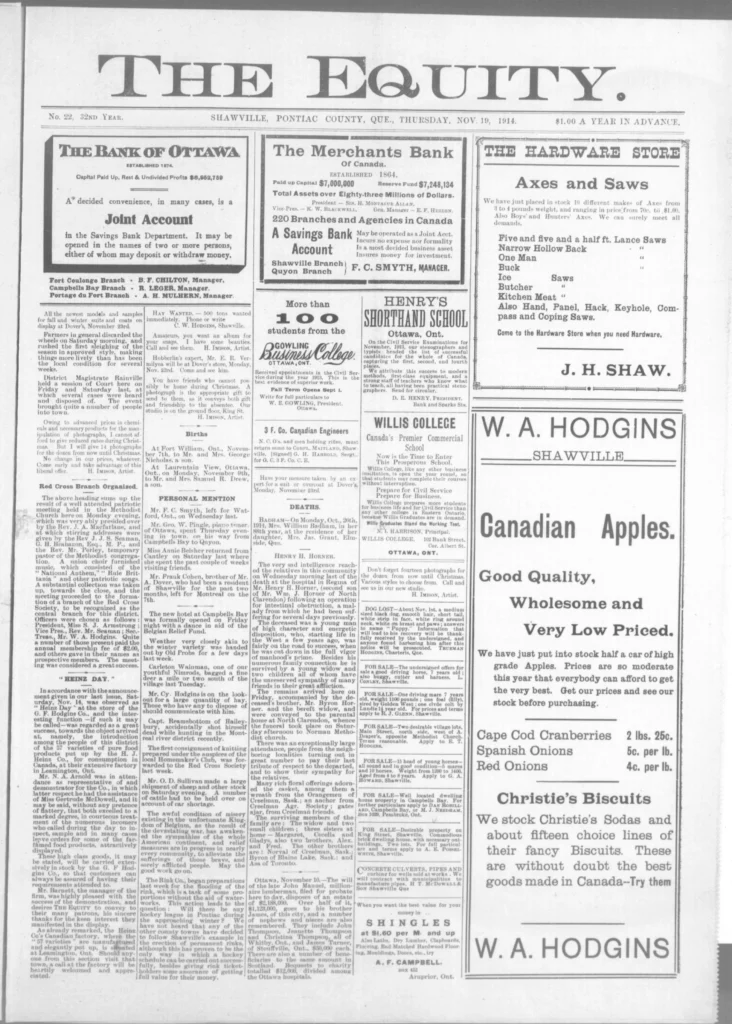
- Dr. Lippiatt left Shawville to enlist in the Second Contingent and planned to take a post-graduate course in army hospital work.
- The Pontiac Lodge A. F. and A. M. donated $1 per member to the Canadian Patriotic Fund.
- A Red Cross social at Elmside raised funds for Belgian Relief and other war charities.
- Clarendon and Shawville residents discussed forming local aid circles to knit and send supplies for soldiers overseas.
- Reports noted several young men from the district departing to join the Canadian Expeditionary Force.
- The paper urged readers to buy war savings stamps and support the Patriotic Fund.
- Local branches of the Women’s Institute and churches organized parcel drives for soldiers and Belgian refugees.
- Shawville schools collected donations for the Red Cross Christmas shipment.
- A notice recorded that a few Pontiac men had arrived safely in England with the first Canadian Contingent.
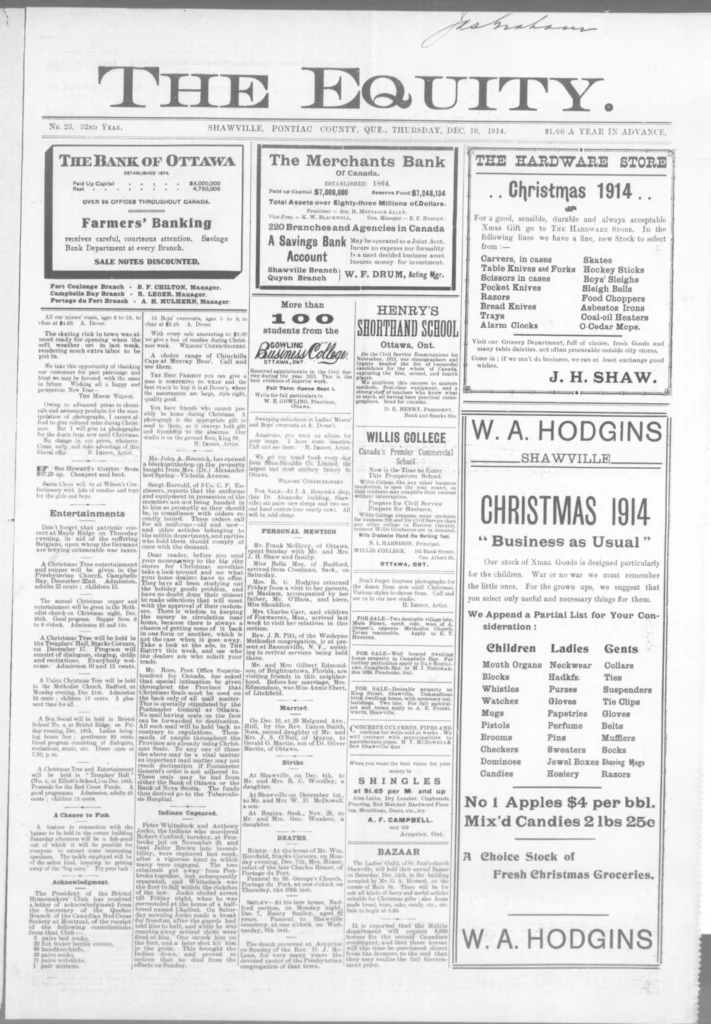
- The treasurer of the Red Cross Society reported receiving $33.40 from a local school entertainment to support Quebec’s branch at Montreal.
- A government initiative was announced to increase food production for the Allies—farm meetings were planned in January–February to boost supplies to Britain, France, and Russia.