The Great War didn’t hit the Pontiac with the sound of gunfire; it arrived through word of mouth and the quiet, steady hum of people getting to work. By the time the first few months had passed, the usual pace of rural life had shifted into something more purposeful. Whether they spoke English or French, people across the county didn’t wait around to be told what to do.
In Shawville, the women of the Homemakers’ Club were already churning out massive amounts of supplies for the Red Cross and Belgian Relief. Over in Fort Coulonge, a dance at the town hall brought in folks from all the neighboring Francophone parishes, raising over a hundred dollars for the cause—a small fortune for a single night. Even the local lodges stepped up, with the Pontiac Lodge A.F. & A.M. pledging a dollar for every member to the Canadian Patriotic Fund. What used to be simple social nights became something bigger, stitching these small villages along the upper Ottawa River together.
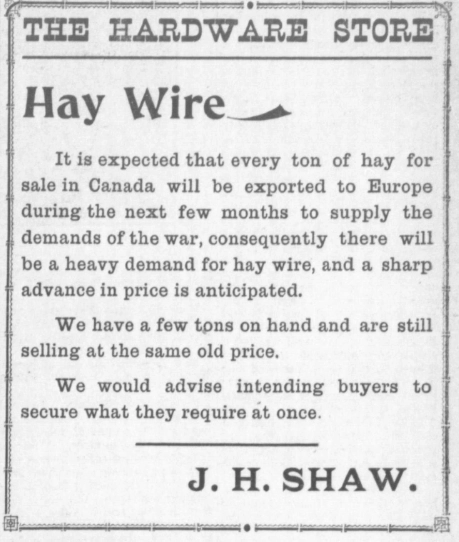
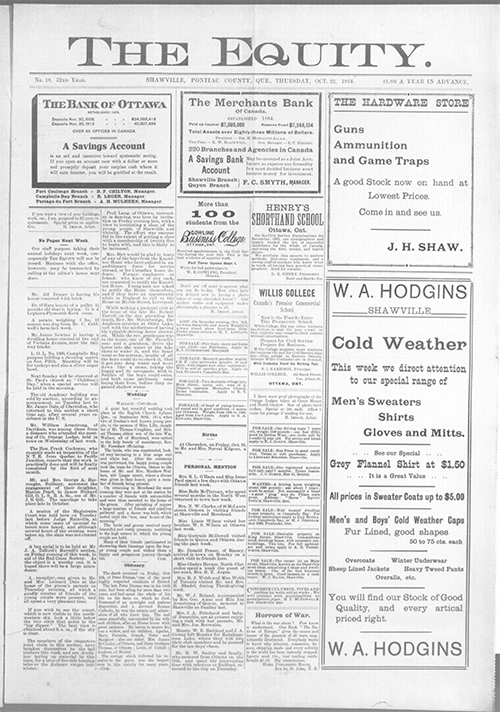
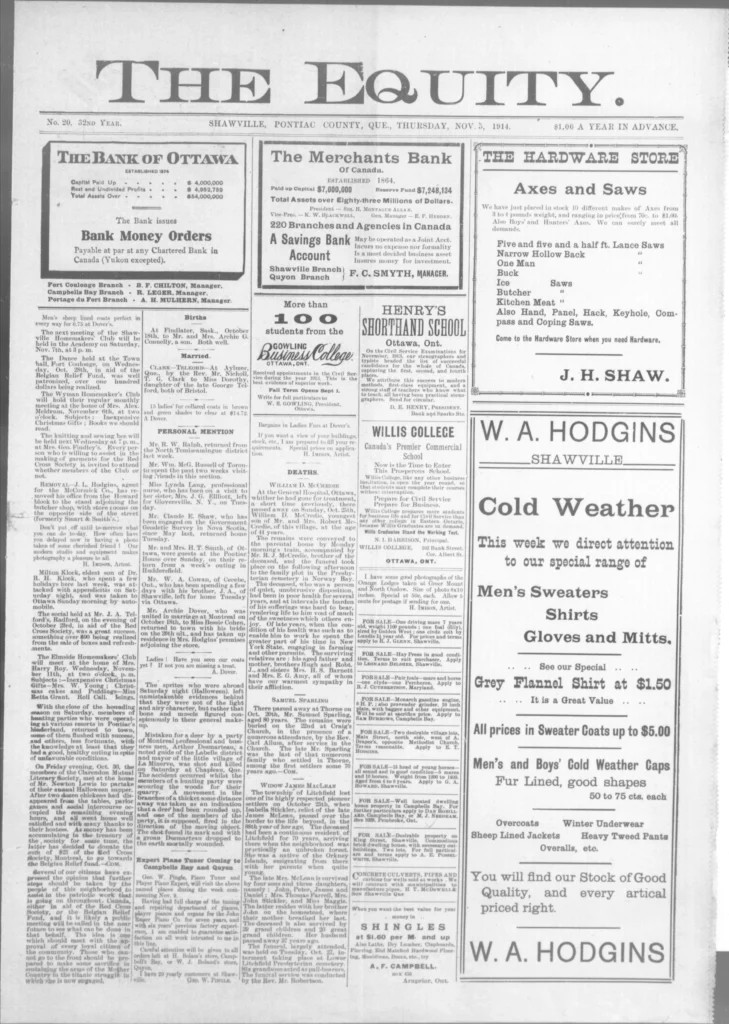
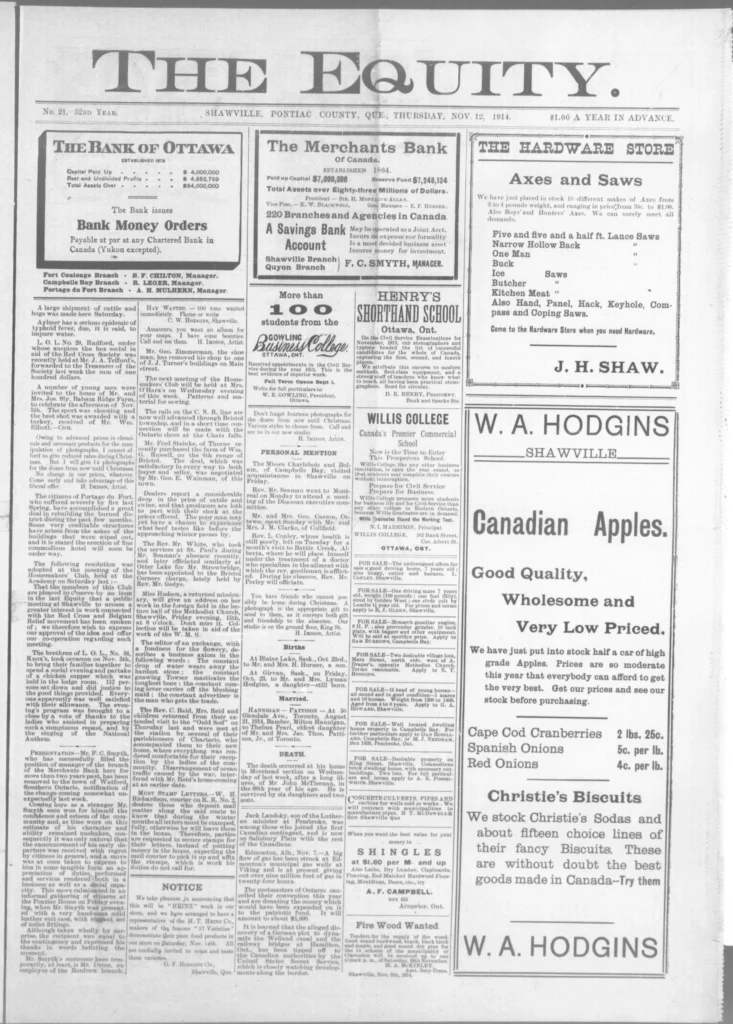
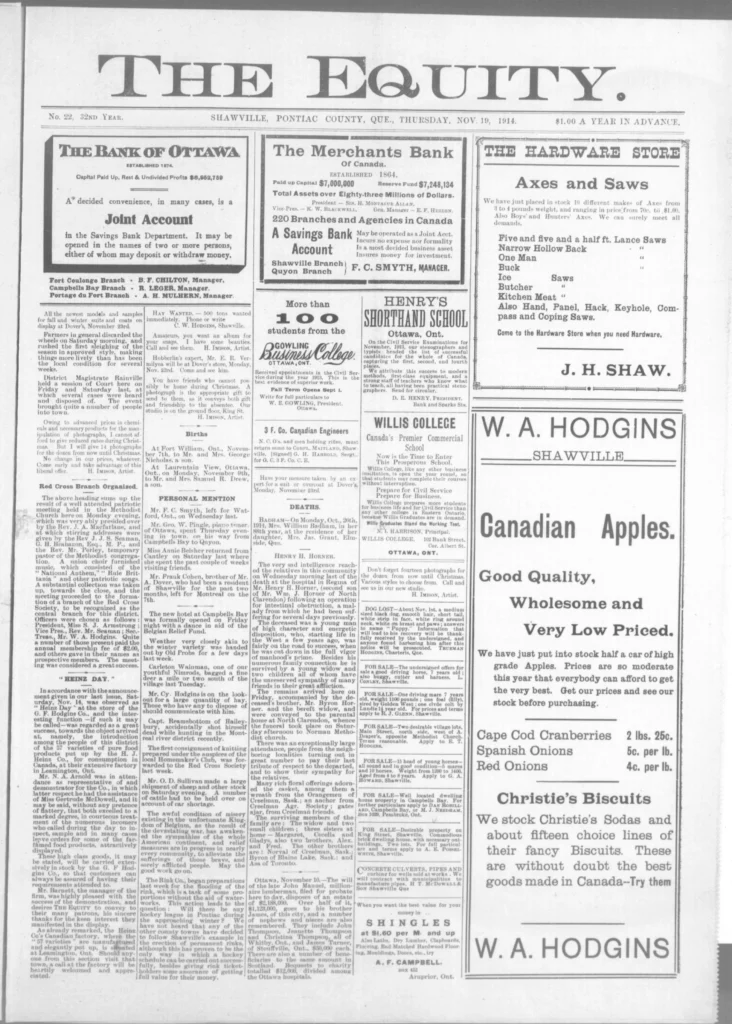
You could see the weird mix of war and “business as usual” in the pages of The Equity. One ad might warn that the price of hay wire was about to skyrocket because of the fighting overseas, while another merchant would be bragging that his apples were so cheap “everyone could afford the best.”
Advertisement in the October 1, 1914 edition of The Equity
The paper’s editorials really drove home the gritty reality of a soldier’s life, too. One piece reminded readers that a soldier is only as good as his feet, and his feet are only as good as his boots. It made the distant conflict feel a lot more personal.
The dispatches were full of both horror and strange moments of grace. One story told of a wounded Scot being cared for by a German soldier in a trench, the two men even swapping helmets as a sign of respect. But mostly, it was brutal. Readers learned about the Royal Engineers at the Aisne, where eleven men were cut down trying to light a fuse before the twelfth finally blew the bridge. They read about the Prussian Guard being mowed down by machine guns at Ypres, and the heartbreaking sight of Belgian refugees arriving in London too exhausted to even cry.
As the first frost hit the Pontiac and autumn turned to winter, the “over by Christmas” hope started to fade. The first letters from training camps and overseas began to trickle in, and the people who had rallied so quickly in the summer realized this wasn’t going to be a short sprint. The long haul had begun.
Photo printed in The Equity, December 3, 1914
Soldiers Mentioned in The Equity
These names have been extracted from copies of The Equity by AI and may have mistakes. Please let us know if you catch any at jon@theequity.ca.
Date
Soldier
Status / Location
Oct 22, 1914
Captain Barnet
Organized the Renfrew contingent; reported in England while organizing a home guard.
Oct 22, 1914
Mr. Code
Member of the Sifton gun corps; wife serving as a Red Cross nurse in France.
Nov 5, 1914
Rev. Mr. Boulden
Former Pembroke minister; joined the first Canadian contingent, stationed on Salisbury Plain.
Nov 19/26, 1914
Cpl. Maitland
3 F. Co. Canadian Engineers (Shawville); designated recipient for returned rifles.
Nov 19/26, 1914
Sgt. G. H. Harrold
Acting for O.C. 3 F. Co. (Shawville); issuing notices for equipment returns.
Nov 26, 1914
Dr. Lippiatt
Enlisted in Second Contingent; taking post-graduate course in military hospital work.
Nov 26, 1914
Lt. H. E. Maple
Acting Adjutant (Shawville); directing collection of uniforms and equipment.
Nov 26, 1914
Mr. Arthur Earle
Collecting uniforms and equipment from Wakefield members of the Engineers.
Dec 24, 1914
Col. Herbert Mackie
Reported to be serving as a staff officer with the Russian forces.
Listen to our Podcast!
We’ve used Artificial Intelligence to summarize what was covered in The Equity during this part of the Great War. Click the play button to listen.
00:00
Timelines:
October - December 1914
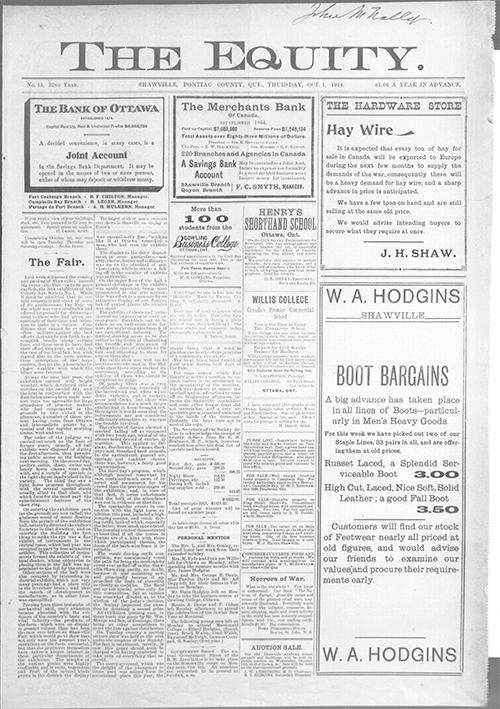
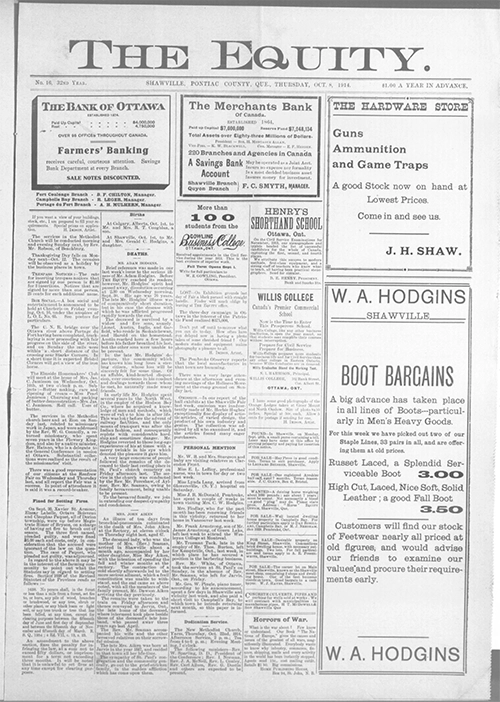
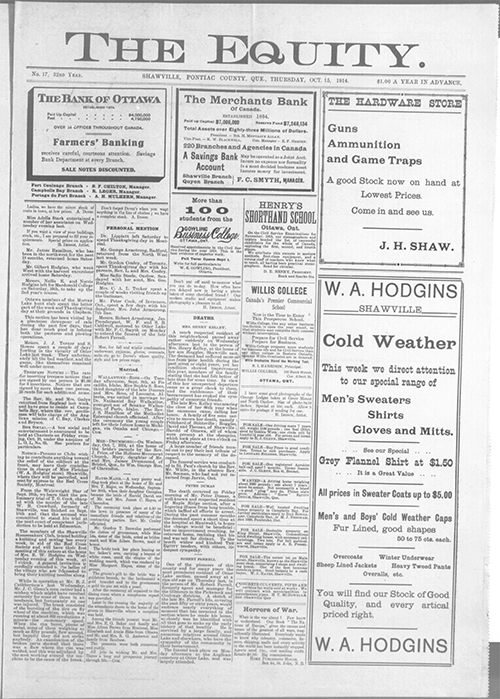
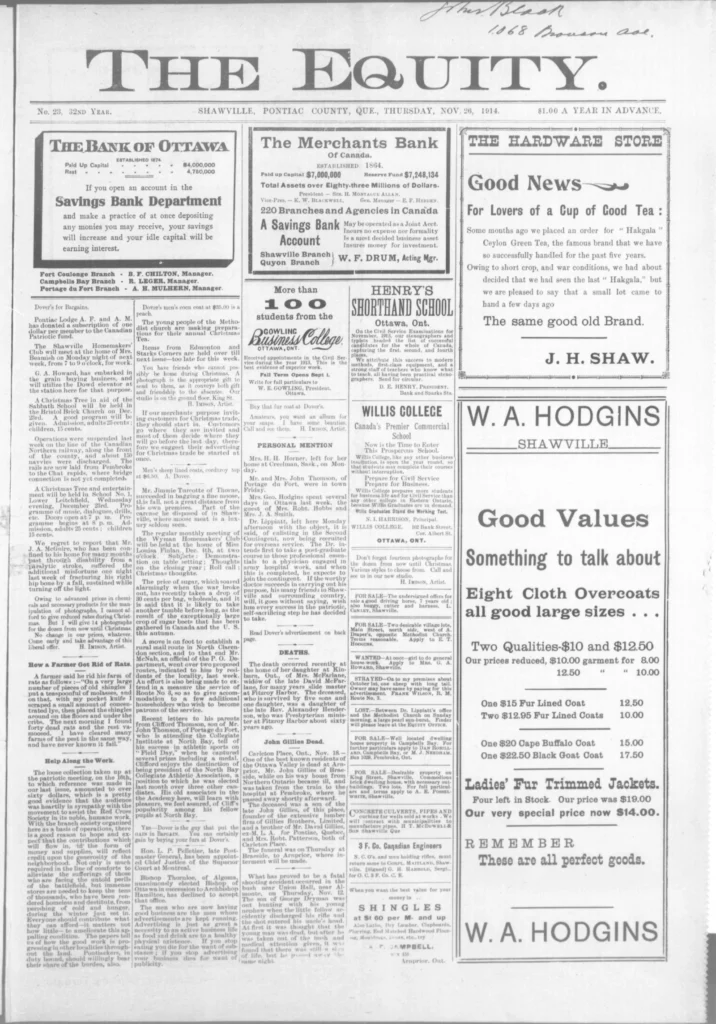
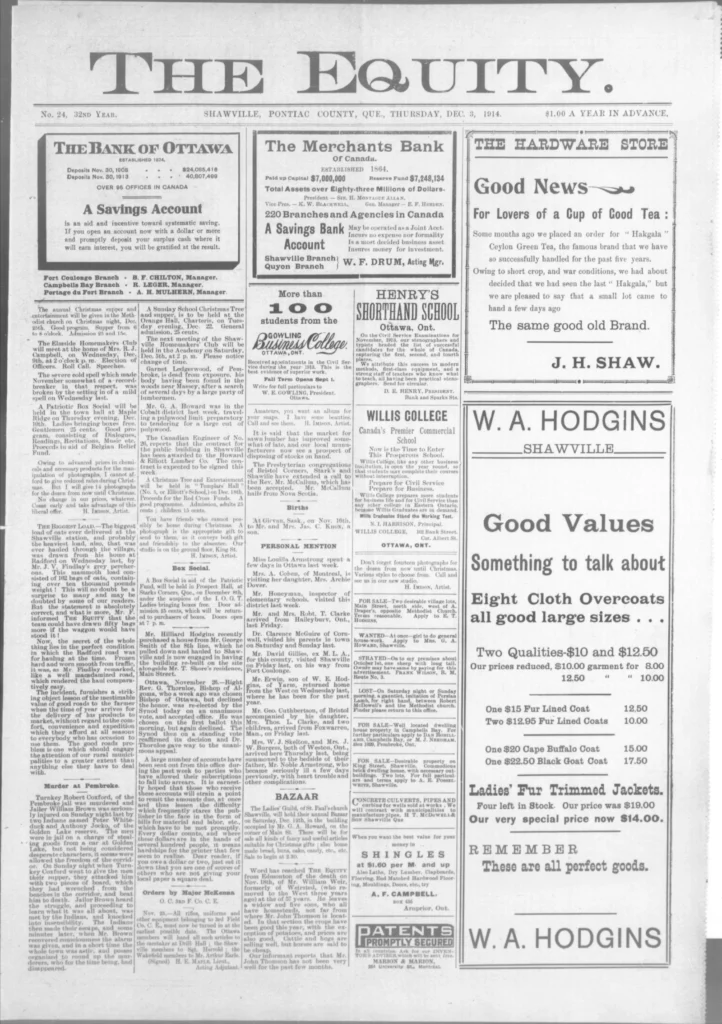
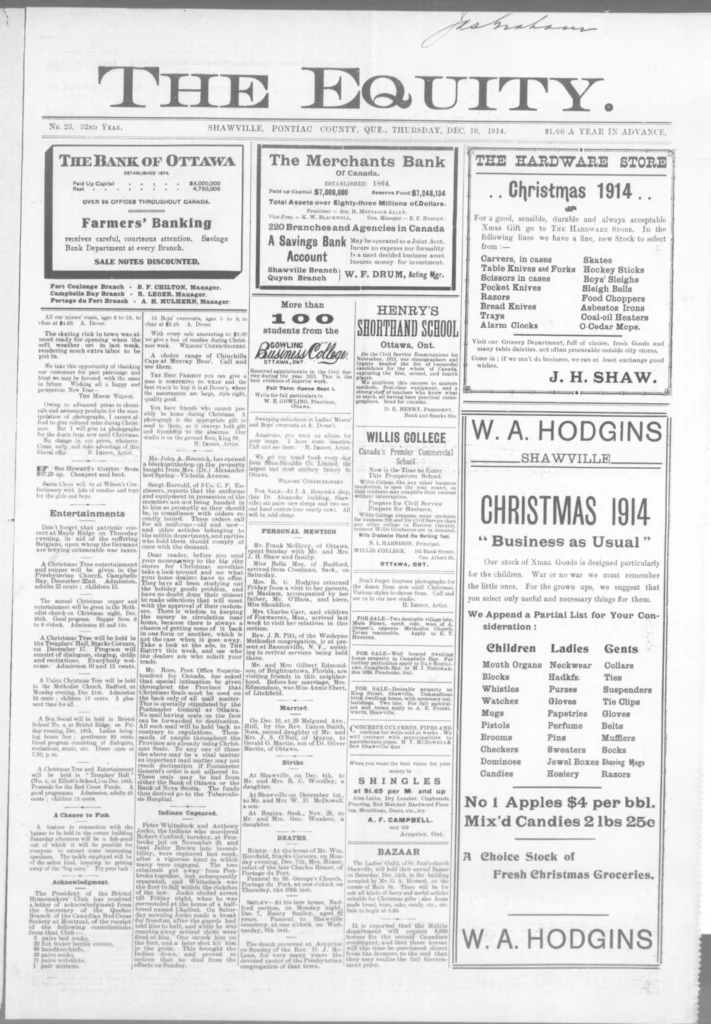
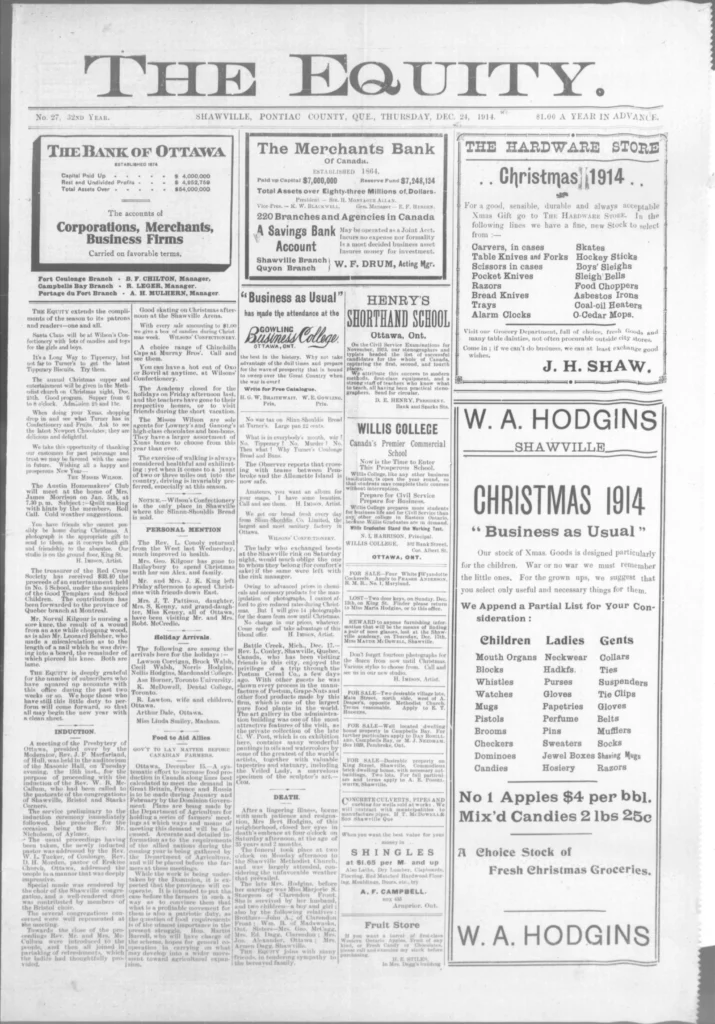
Below are the original copies of The Equity from this part of the War. Click any of them to download a PDF copy.