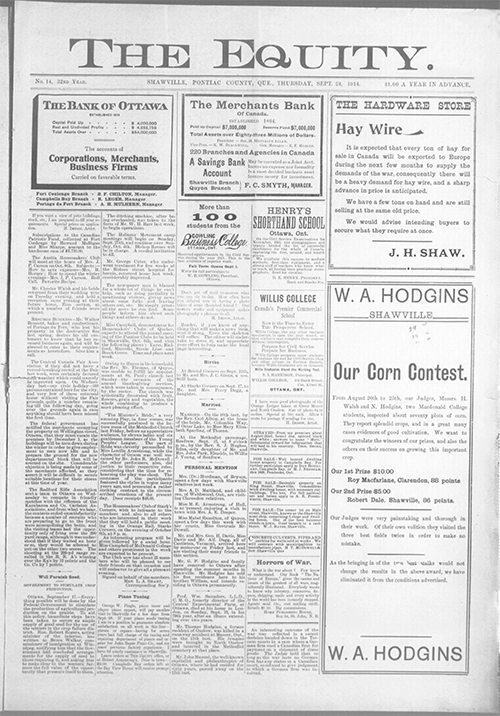
Summer 1914

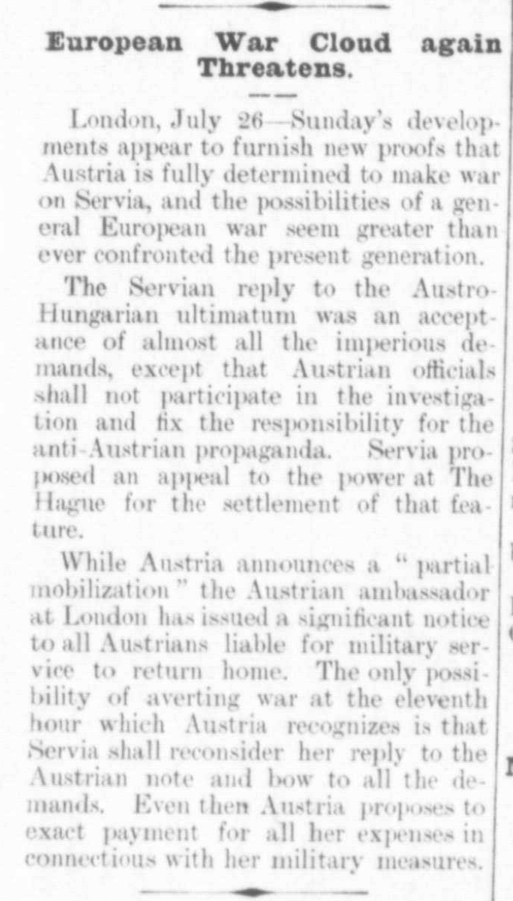
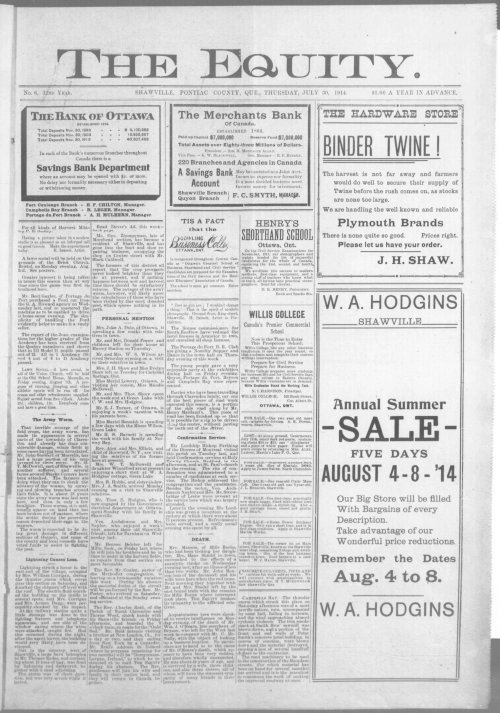
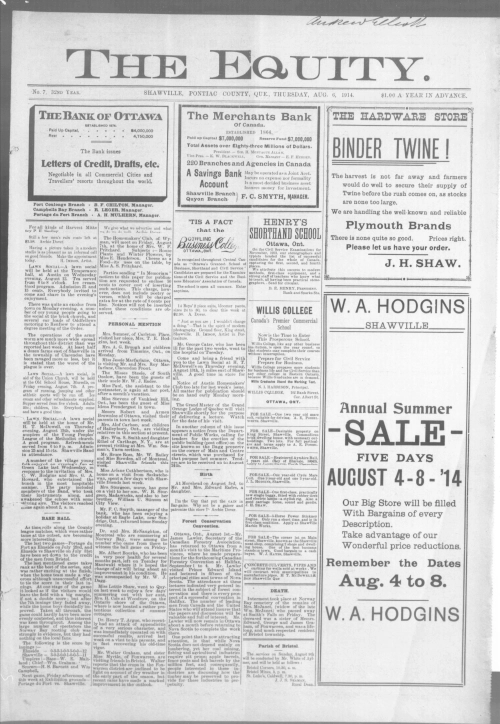
In late July 1914, The Equity  – the Pontiac’s local weekly newspaper – began to alert readers to the gathering storm in Europe. On July 30, 1914, as the crisis escalated, the paper noted that Austria-Hungary appeared “fully determined to make war on Servia, and the possibilities of a general European war seem greater than ever confronted the present generation”. Within days this ominous prediction became reality. By the first week of August 1914, headlines in The Equity announced the outbreak of hostilities on the continent. The August 6 issue’s war bulletin declared: “WAR!”, explaining that “Russia and France refuse to accede to the demands of Germany, and war results”. At that point Italy had “decide[d] to remain neutral,” but “Great Britain [would] likely be drawn into the conflict”. Indeed, on August 4 Britain entered the war, carrying Canada and the rest of the Empire with it.

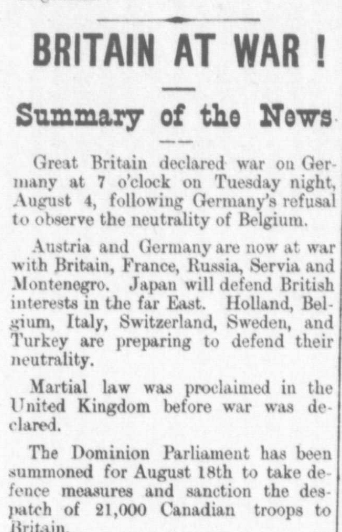
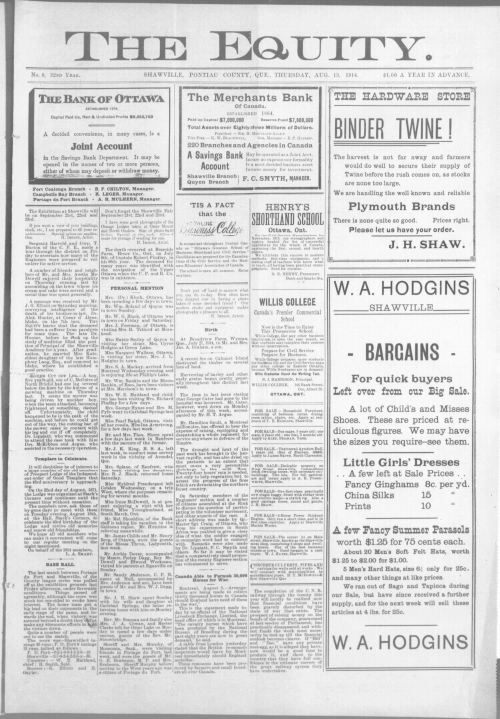
War announcement from The Equity, August 13th, 1914.

The Equity’s next edition brought home the momentous news. “Great Britain declared war on Germany at 7 o’clock on Tuesday night, August 4,” the paper reported on August 13, “following Germany’s refusal to observe the neutrality of Belgium.” 

As a member of the British Empire, Canada was automatically at war when Britain was. The paper also reported steps to strengthen Canada’s defenses – for example, acquiring two submarines on the Pacific coast to guard against German raiders. This was the national backdrop as the Pontiac region braced for the unknown of a world war. 

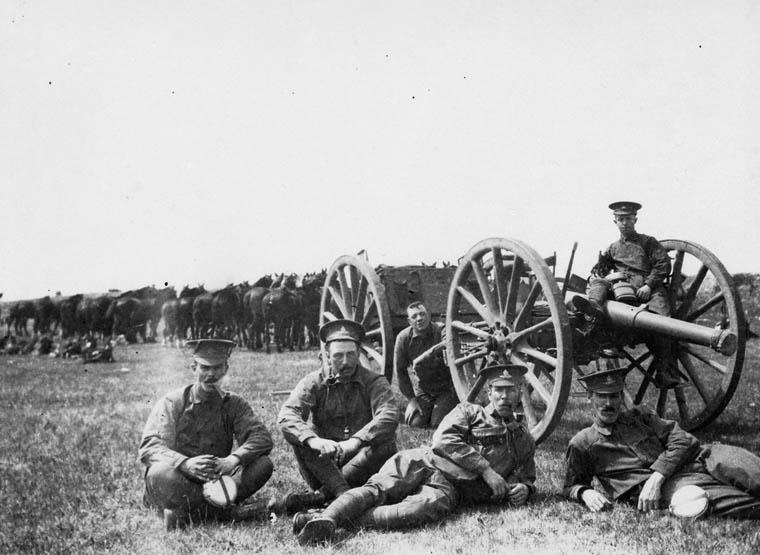
Royal Canadian Horse Artillery in England.
Credit: Canada. Dept. of National Defence/Library and Archives Canada

Almost as soon as war was declared, communities in the Pontiac began to mobilize men and resources for the war effort. Local militia units and volunteers prepared to answer the call. In mid-August 1914, Sergeant Harrold and Corporal T. Burton of the Canadian Field Engineers toured through the district to identify who among the local Engineers was ready to serve. They came “to ascertain how many of the Engineers were prepared to volunteer for active service”. Their recruiting tour, reported in the August 13 issue, shows that Pontiac’s own militia members were lining up to go to war from the very start.

Target practice and military training also took on new urgency. Notices appeared for rifle association meets and other drills. At a local rifle range in Radford, for example, militia marksmen gathered for a shooting match, prompting one Equity correspondent to quip that a certain crack shot “should be eligible for that over-seas contingent, if good shooting is the main qualification.” Such remarks, half-humorous, underscored that many in Pontiac were thinking about who among them would make a fine soldier abroad.

The community also contributed vital matériel – especially horses – to the mobilization effort. In early September, Dr. O’Hara, Shawville’s local veterinarian, was dispatched on an official errand to procure war horses. He “motored over to the Gatineau country” to inspect and purchase horses “for military purposes, in connection with the Militia Department.” By the end of that week, a shipment of cavalry and artillery horses was leaving the county. “Another car load of horses went from here last Wednesday, in charge of Lieut. Mills,” The Equity noted, to be handed over for the use of the army. These references illustrate how farmers and horse owners in the Pontiac region were enlisted to provide mounts for Canada’s new Expeditionary Force assembling at Valcartier Camp. Local men like Lieutenant Mills took responsibility for gathering and transporting the animals.

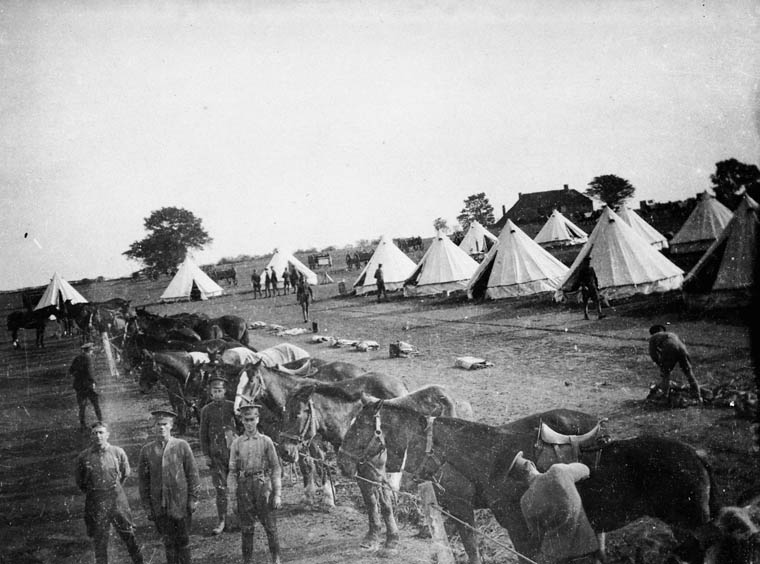
Horse Lines, Salisbury Plain, [England]. Credit: Canada. Dept. of National Defence/Library and Archives Canada.

Ordinary citizens, too, felt the pull of service. A number of Pontiac’s young men quietly left to join the colors in those first weeks, even if the paper did not yet list their names. One tangible sign of their departure came in a brief note on September 3: a Shawville clergyman, Rev. Charles Reid, sent word back home that he had “arrived safely at Queenstown, convoyed by a warship” on his voyage to Britain. He was one of the early volunteers from the area to go overseas (in his case likely as a chaplain), and his safe passage under naval escort was news of local interest. Bit by bit, the Pontiac was sending its sons – and its goods – off to war.

As the reality of war sank in, the Pontiac community responded with a mix of patriotism, charity, and even a dose of trademark Ottawa Valley humor. The tone in The Equity was strongly supportive of the Empire’s cause, and it encouraged unity on the home front. An editorial in early September lauded the patriotic spirit sweeping the country. Even those few who had been apathetic or isolationist were now silenced by events. “Although Canada contains its quota of anti-imperialists and ‘stand-patters’… the great over-ruling wave of patriotism surges on,” the paper observed, noting that each day brought fresh proof of Canadians’ loyalty to King and country.

Pontiac residents channeled that patriotic fervor into concrete actions. Local organizations and volunteers mobilized to support soldiers and their families. The Equity reported that two Shawville women – Miss M. McDowell and Miss L. Armstrong – would be making a door-to-door canvass “to collect donations,” answering the patriotic appeal for funds. “Everyone should assist this cause, no matter how small their contribution may be,” the paper urged. Across the county, similar efforts sprang up. 

For instance, in the village of Fort Coulonge, a committee led by Mr. Howard Mulligan and Miss Sharpe raised a “handsome sum” of $1,790 for the Canadian Patriotic Fund, as reported at the end of September. This fund had been established to support soldiers’ dependents, and Fort Coulonge’s substantial collection shows how even a small town in Pontiac enthusiastically did its part. Such sums would have been unthinkable to gather so quickly had the “wave of patriotism” not swept the community.

Expressions of loyalty were visible in everyday life. A local merchant, Mr. Archie Dover, found a patriotic way to attract customers to his store: he offered every household a free Union Jack flag “during the war.” “Get one free at Dover’s,” his advertisement beckoned. 

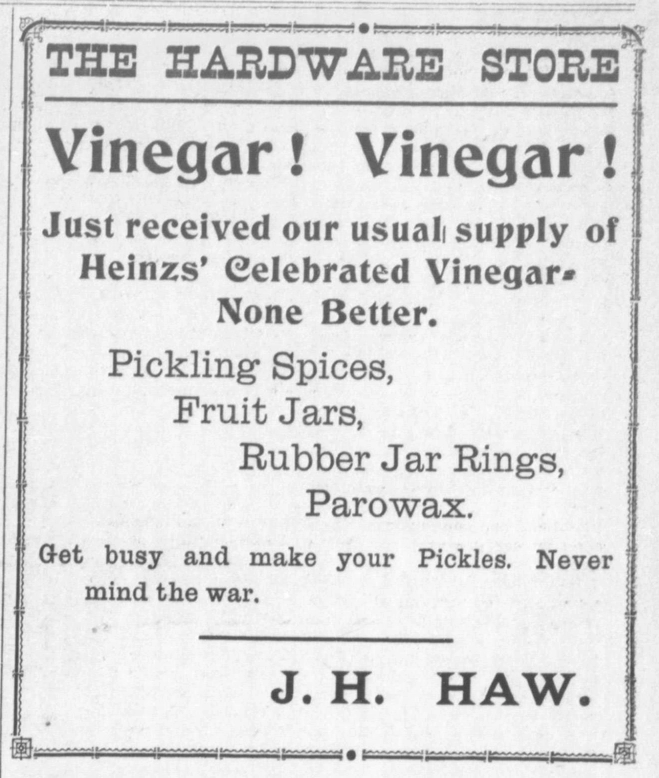
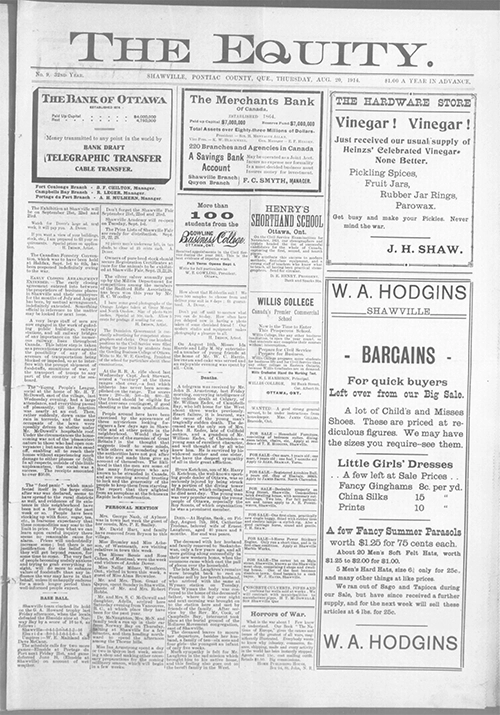
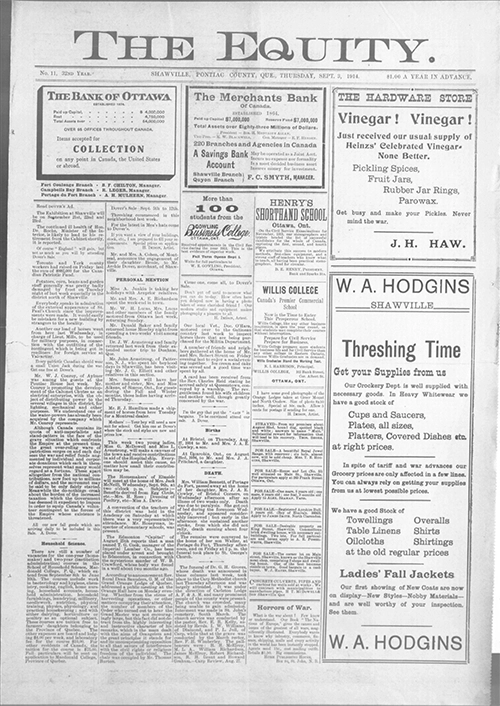
One lighthearted advertisement in August captured this balanced attitude. The hardware section of J.H. Shaw’s store urged readers to stock up on vinegar and canning supplies as usual, wartime or not. “Get busy and make your pickles. Never mind the war,” the ad cheerfully proclaimed. The message was subtle but clear: keep calm and carry on productively, whether by canning vegetables or by contributing to patriotic causes.

A front-page ad for J.H. Shaw appearing in the September 3, 1914, issue of The Equity. (Note: Shaw's name is misspelled in the original print).

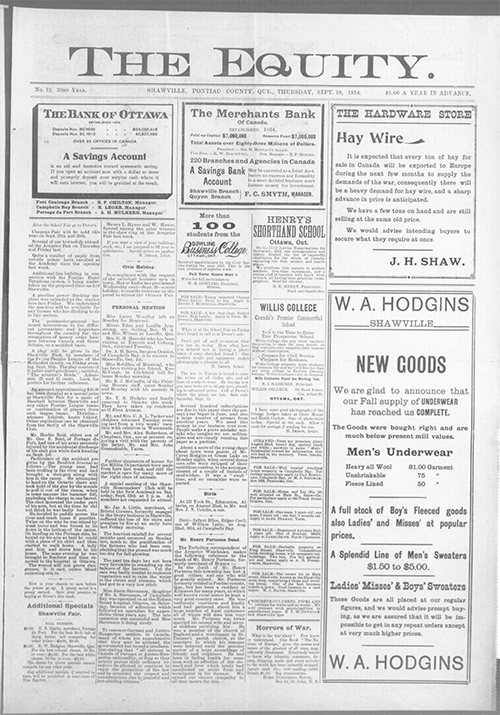
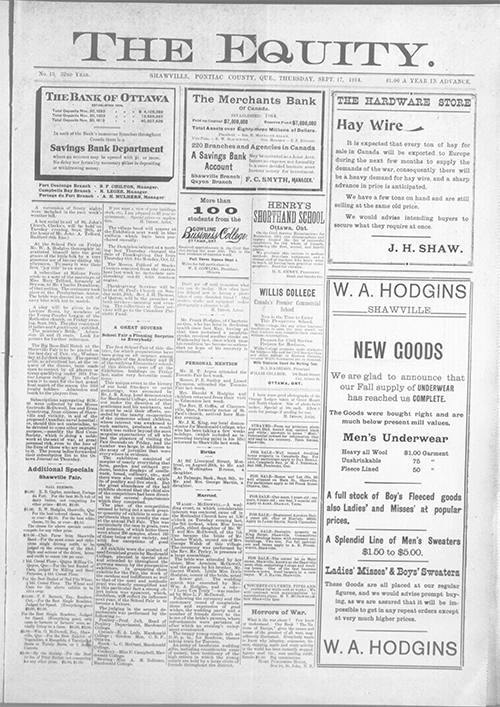
For the agricultural sector – the backbone of Pontiac’s economy – the war initially promised strong demand. Farmers followed war news not just out of patriotism but also pragmatism, wondering about markets for their produce. In September, local farmers learned that one unexpected Canadian export would be in high demand: hay for the armies of Europe. The Equity carried a notice that “every ton of hay for sale in Canada will be exported to Europe during the next few months to supply the demands of the war.” This looming hay shortage meant “a heavy demand for hay wire, and a sharp advance in price is anticipated.” The hardware store accordingly urged farmers to buy hay-baling wire while it was still at “the same old price”, lest they be caught without it when prices spiked. Indeed, with tens of thousands of horses mobilized in 1914, hay from Canadian farms would soon be feeding British and French cavalry mounts. Pontiac farmers were well positioned to benefit if they could get their hay to market.

Local industrial and trade prospects were also viewed with guarded optimism. On one hand, the war disrupted imports from Europe (including German-made goods that had been common in Canadian stores). On the other hand, Canadian manufacturers had an opportunity to fill that gap. The Equity relayed encouraging words from federal Minister of Trade and Commerce Sir George Foster. Speaking at the Canadian National Exhibition in Toronto, Foster “urged that instead of closing down factories and laying off men, the manufacturers… should seize the opportunity to extend their markets, which the war affords”. In Pontiac, this message resonated in small ways. For example, the Shawville Sash and Door Factory and other local mills stayed busy, perhaps anticipating orders that might result from wartime demand or from domestic building projects while foreign supplies were limited. The pages of The Equity in September 1914 feature advertisements for lumber, farm implements, and even a new gasoline-powered ditching machine – signs that business was continuing and looking ahead, despite the uncertainty.

Soldiers Mentioned in The Equity

These names  have been extracted from copies of The Equity by AI and may have mistakes.  Please let us know if you catch any at jon@theequity.ca.

Date Soldier Status
Aug 13, 1914 Sgt. Arthur Harrold Member of the C. F. E.; toured the district to ascertain volunteer readiness for active service.
Aug 13, 1914 Cpl. T. Burton Member of the C. F. E.; toured the district with Sgt. Harrold regarding volunteer recruitment.
Aug 27, 1914 Maj. James McKenna Officer of the C. F. E.; purchased ten horses for the Canadian military force at Valcartier.
Aug 27, 1914 Lt. Robert Thexton Took charge of shipping the ten horses purchased by Major McKenna to the military camp.
Sep 3, 1914 Lt. John Edgar Mills Took charge of shipping a second carload of military horses to the troops at Valcartier.

Listen to our Podcast!

We’ve used Artificial Intelligence to summarize what was covered in The Equity during this part of the Great War. Click the play button to listen.

00:00

Timelines: July - September 1914

Below are the original copies of The Equity from this part of the War. Click any of them to download a PDF copy.

July 30, 1914

August 6, 1914

August 13, 1914

August 20, 1914

August 27, 1914

September 3, 1914

September 10, 1914

September 17, 1914

September 24, 1914

Read More From Our Project