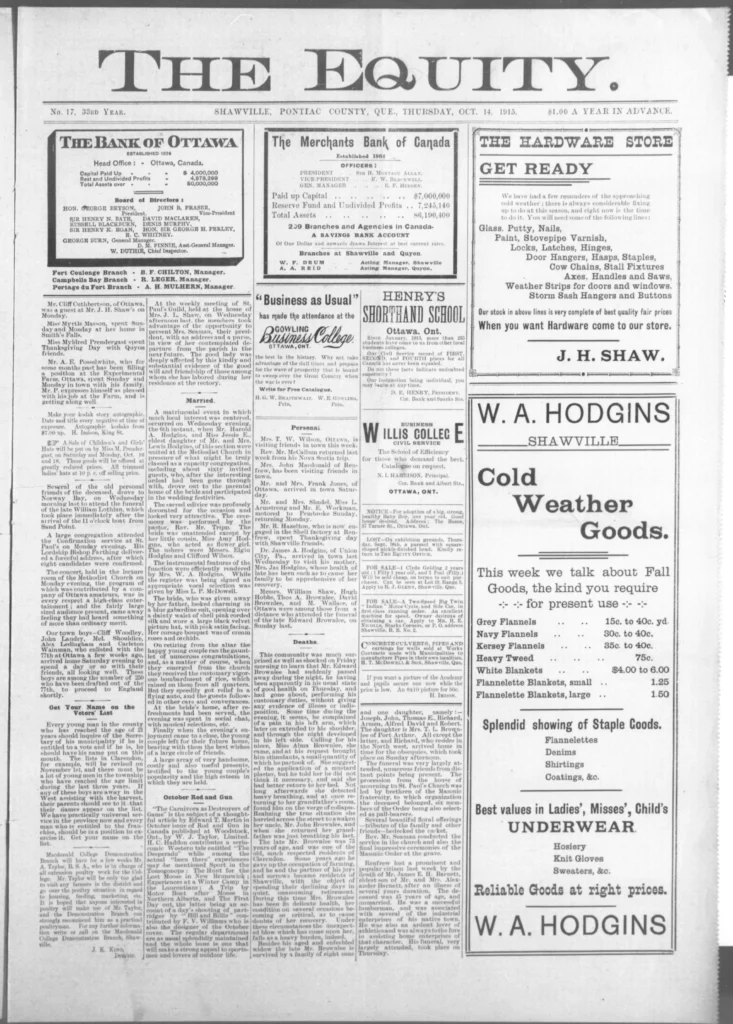
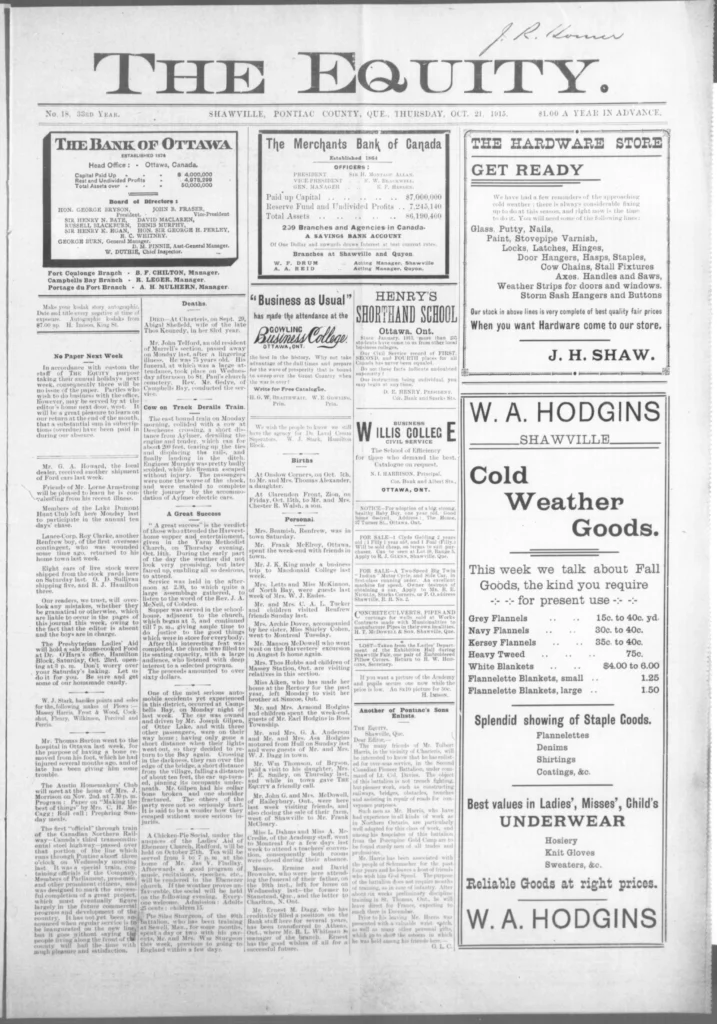
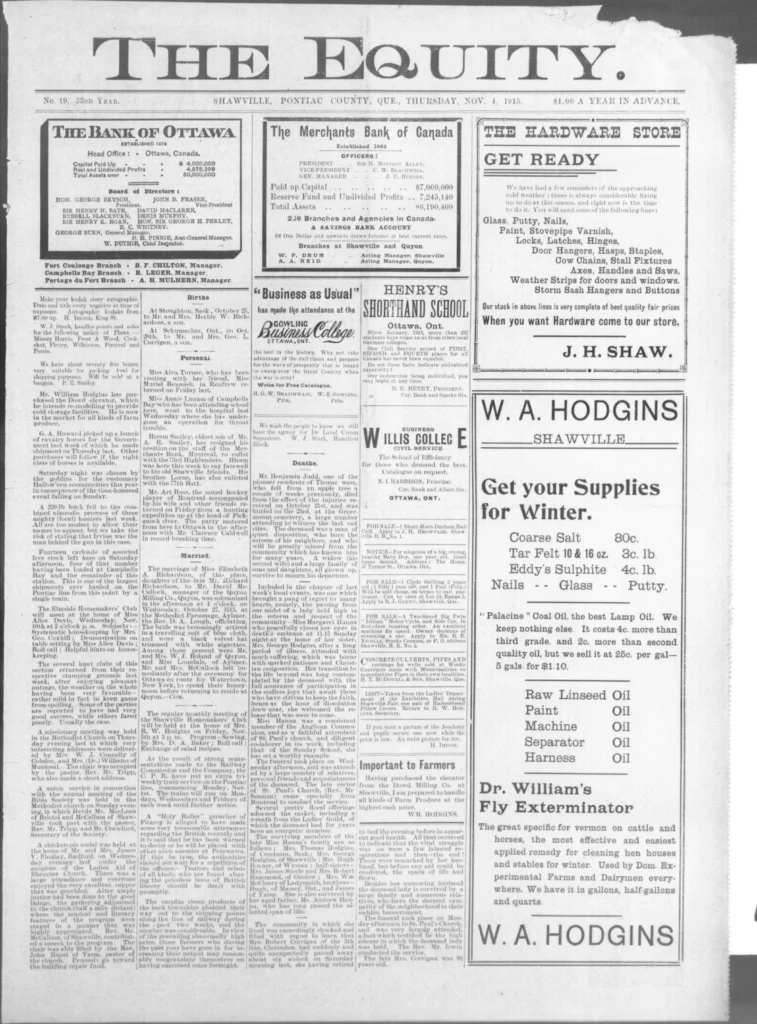
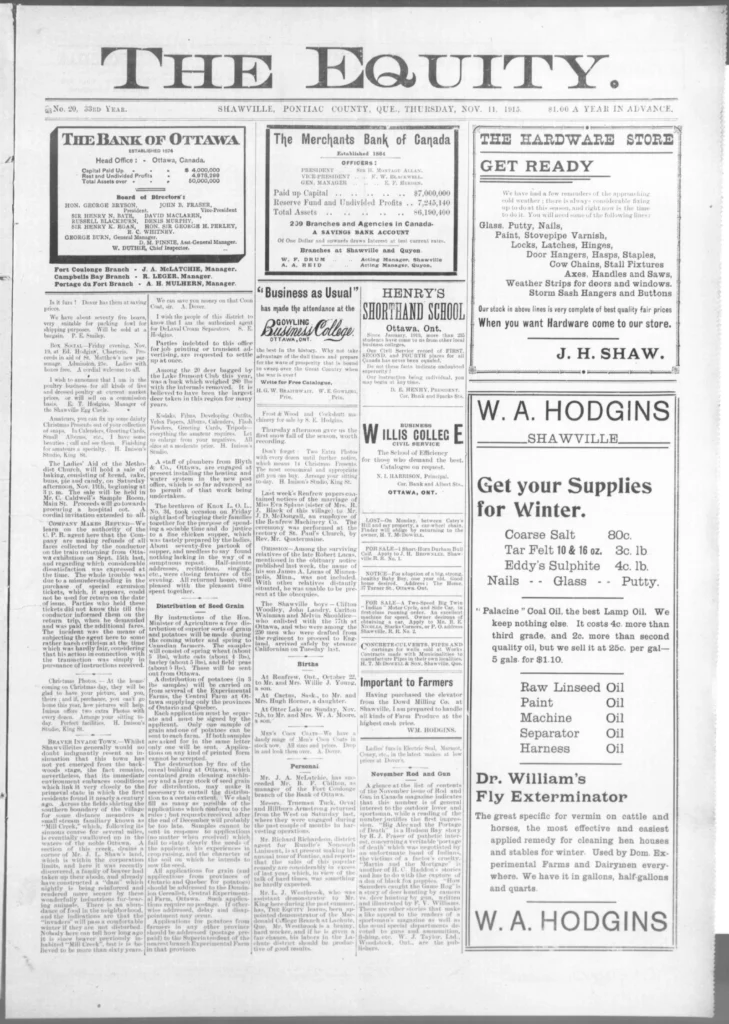
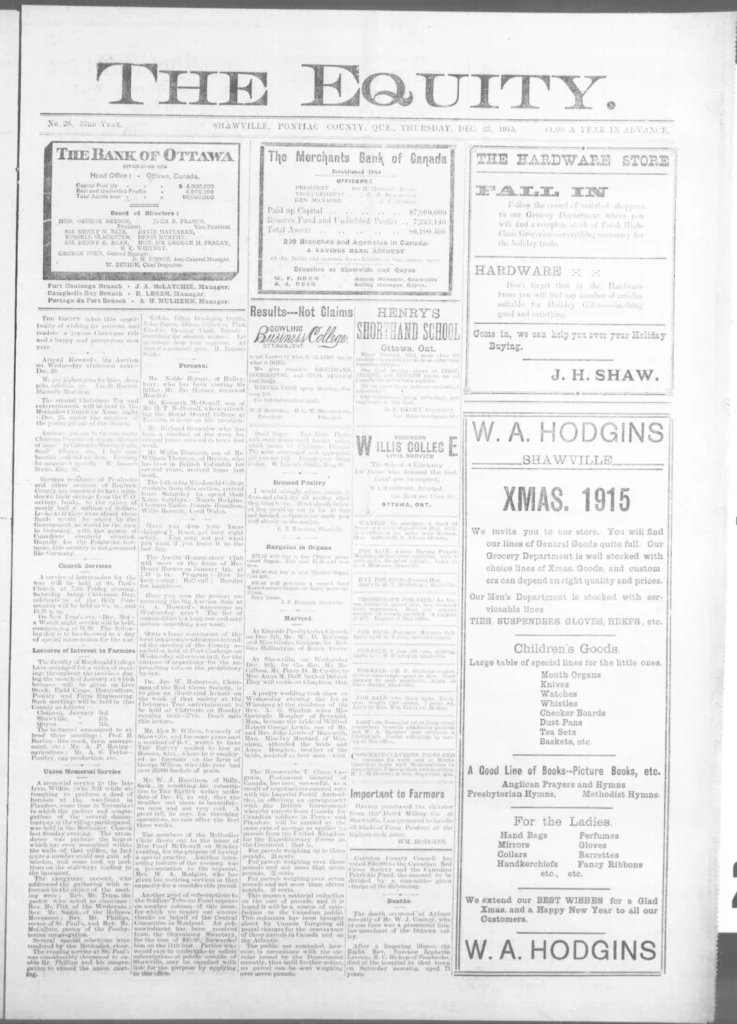
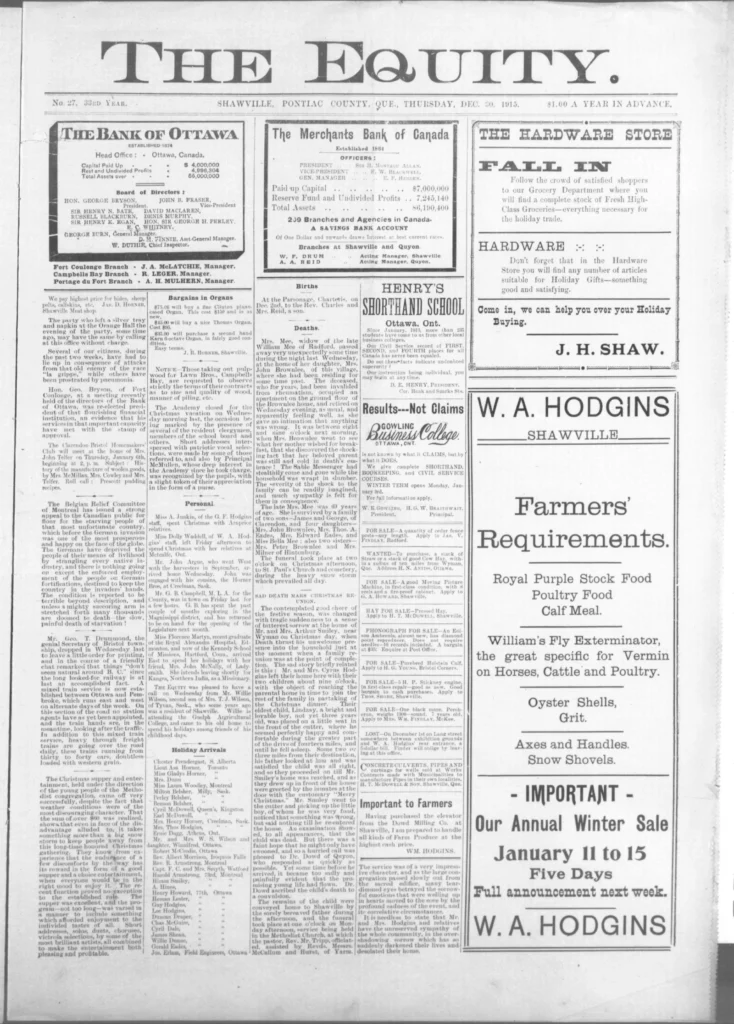
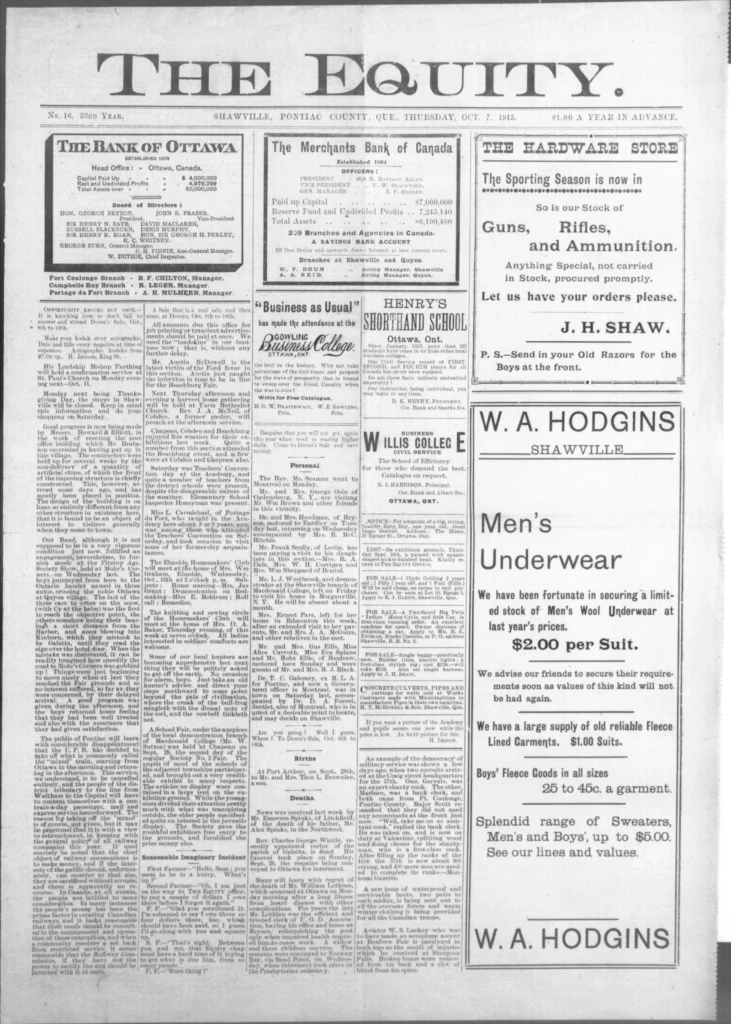
In the autumn of 1915, the reality of the Great War settled heavily over Pontiac County, intertwining the normal rhythms of rural life with the grim news of the conflict. On October 14, 1915, The Equity noted the brief return of several town boys—Cliff Woodley, John Landry, Mel Shouldice, Alex Ledingham, and Carleton Wainman—who had arrived home to spend a day or two with friends before proceeding to England. They had enlisted with the 77th Battalion in Ottawa and were drafted to leave shortly, their departure marking a tangible connection between the quiet county and the distant front.
As winter approached, the calls for support from the home front grew more urgent. The Canadian Patriotic Fund issued desperate appeals, reminding the public of their pledge to care for the wives, widowed mothers, and little children of the men who had gone forward.
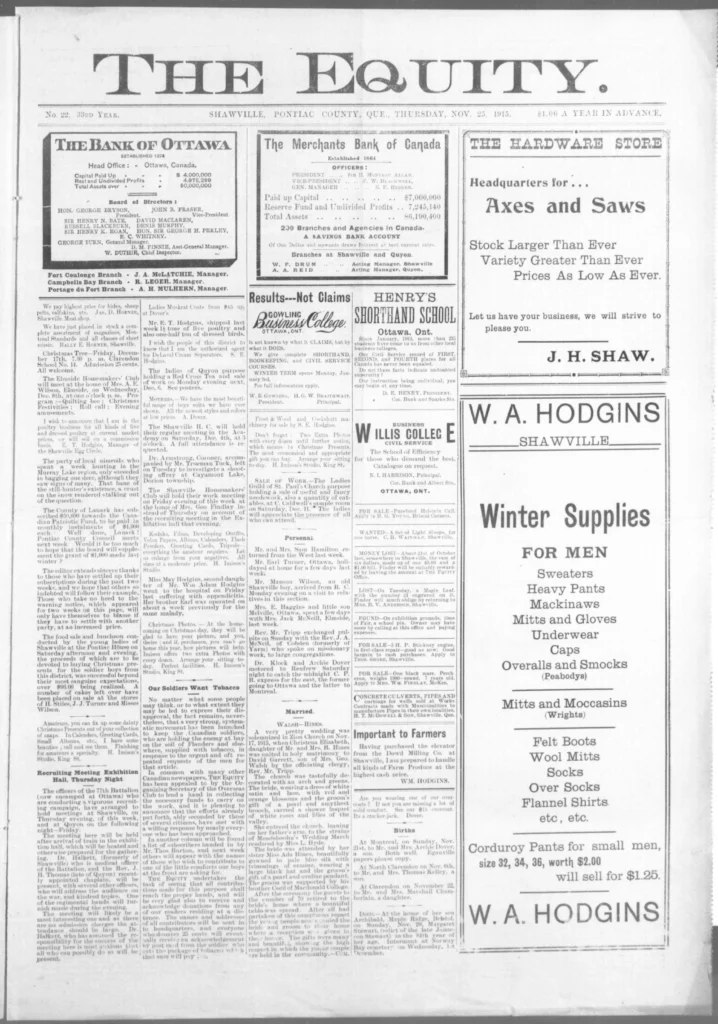
Meanwhile, local efforts focused on smaller, vital comforts. The Equity continually promoted the Soldiers’ Tobacco Fund, reminding readers that a mere 25 cents would send 50 cigarettes, a quarter-pound of tobacco, matches, and a return postcard to a soldier in the trenches.
Citizens and the Homemakers’ Clubs also busied themselves with raising funds for the starving people of Belgium, whose industries had been strangled by the German invaders.
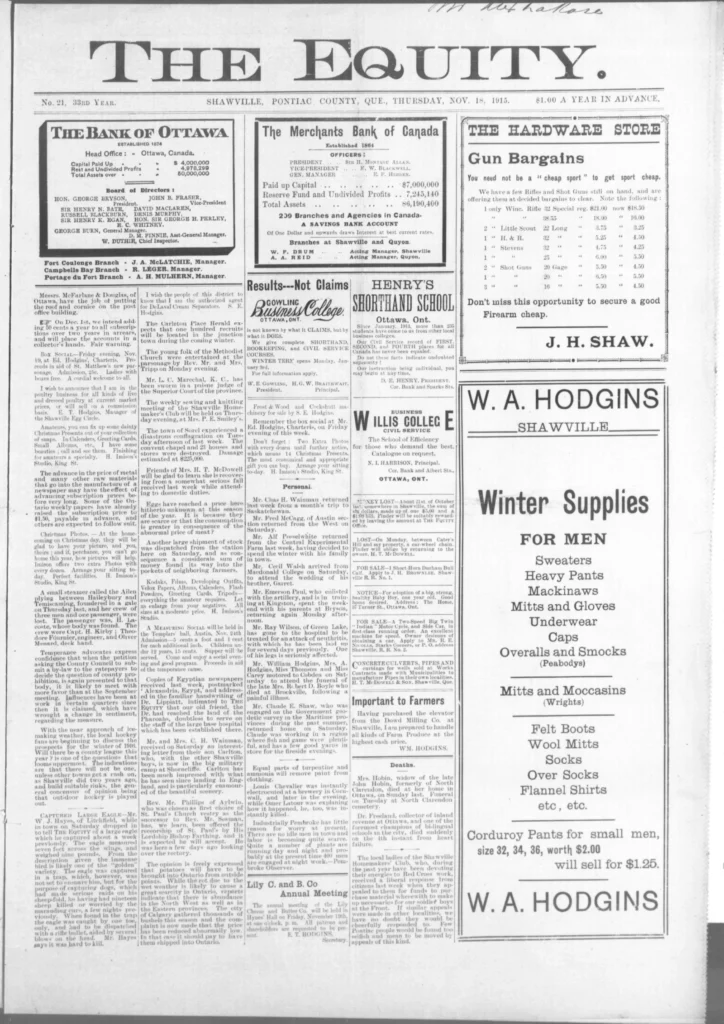
However, the burden of the war was not borne without internal friction, and ethnic and political tensions occasionally flared in the press. On November 18, 1915, The Equity published a piece titled “Satan’s Work,” which fiercely condemned a French-Canadian “demagogue” for reopening old wounds and portraying the French and English as hereditary foes.
Satan’s Work.
by J. S. Brierley
Fighting side by side, in the most Titanic struggle the world has ever beheld, fighting with their backs to the wall, in the darkest hour of that struggle; fighting for justice to ravaged Belgium, home of the Roman Catholic faith—France and Britain have forgotten the animosities of the past. Not so Monsieur Henri Bourassa. For some reason unfathomable by the ordinary man, he chooses this time, of all times, to re-open old wounds, to picture French and English as hereditary foes, and to speak of the English people in terms which, in such a crisis, can proceed only from the lips of a man who considers them still his enemies, and rejoices in their plight. It is Satan’s work, the work this man of influence and high ability is doing in deliberately fomenting discord between his fellow citizens of French-Canadian stock. A man who can scoff at the sacrifices of the English, when half a million of them have already suffered on the field of war; a man who can gloat over what he considers their degeneracy, when they have in one short year thrown three millions of men into the line of battle, and when their ships rode supreme on every tide; a man who can do these things at the moment when we, his fellow citizens of English descent, feel that we are fighting for our very existence as a people, has lost not only his sense of justice, but of common decency.
Further frustration was directed at Nationalist Armand Lavergne, who flatly declined an invitation from General Sir Sam Hughes to raise a regiment for overseas service, asserting his opposition to Canadians engaging in warfare other than the direct defense of Canada
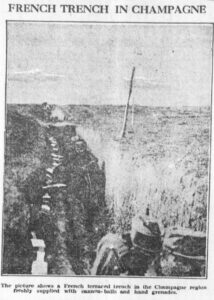
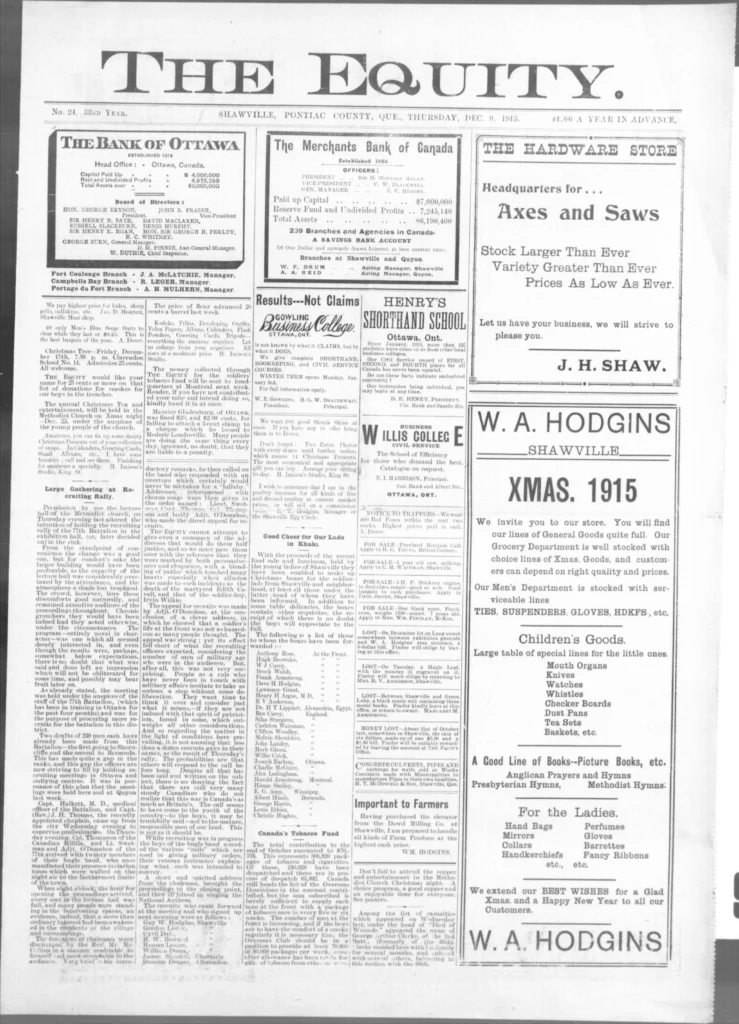
Despite these political storms, the local push for manpower continued. The December 9, 1915, issue of The Equity detailed a massive recruiting rally held in the Shawville rink by the officers of the 77th Battalion.
The evening was filled with the clarion tones of a bugle band and speeches that touched many hearts, including poignant references to the martyred Edith Cavell. But the results were sobering; less than a dozen recruits gave in their names.
The paper observed that men naturally hesitated to take such a serious step without deliberation, and lamented that the call to duty seemed to fall only on the youth, while the mature, responsible men of the land held back.
The hesitation of the older men stood in stark contrast to the supreme sacrifices already being made by the boys. In that same December 9 issue, the community was forced to add a name to the Empire’s “Roll of Honor” – our first local casualty of the war.
Word had arrived of the death of a promising local boy, Irvin Wilkie, who was killed while gallantly attempting to rescue a wounded comrade.
Dear Mr. Wilkie,
In behalf of the boys and myself, of your son’s company, I send you these few lines to convey our deepest sympathy to you. This is just how the affair happened: I was at the end of our line of trenches, when about the centre of a trench one of our boys crawled over the back and was shot. Your son (God rest his soul) immediately jumped over and ran to his rescue and was shot.
He was one of the brightest and best boys in my platoon. Never once did he grumble nor complain at whatever he was asked to do. I have his waist belt with a few badges, on which at the earliest opportunity I will send to you; and anything any of our boys or I can do for you, rest assured you will not have to ask twice.
Once more, conveying our deepest sympathy, and to tell you we are all certain your son’s soul now rests in heaven,
I am, yours sincerely,
SGT. H. M. MACDONALD.
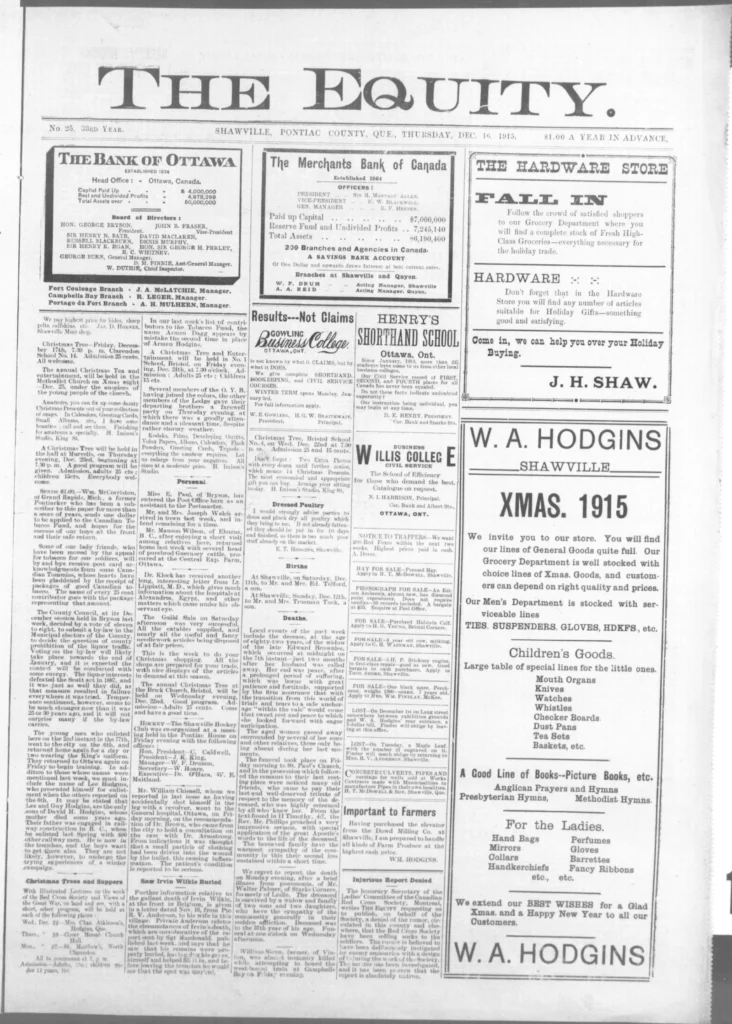
As the year drew to a close, the community sought to send whatever warmth it could across the ocean. With the proceeds from a food sale and luncheon, local young ladies packed and forwarded Christmas boxes to the soldier lads from Shawville and the neighborhood, hoping to bring a touch of home to the mud of Flanders. The war was far from over, but the county, amidst its grief and divisions, had settled into a steady rhythm of endurance.
Soldiers Mentioned in The Equity
These names have been extracted from copies of The Equity by AI and may have mistakes. Please let us know if you catch any at jon@theequity.ca.
| Mentioned | Soldier / Personnel | Status / Details |
|---|---|---|
| Oct 14 / Dec 9 | C. Woodley & J. Landry | 77th Battalion (Ottawa). Drafted to England; received Christmas boxes from Shawville. |
| Oct 14 / Dec 9 | M. Shouldice & A. Ledingham | 77th Battalion (Ottawa). Drafted to England; received Christmas boxes from Shawville. |
| Oct 14 / Dec 9 | Carleton Wainman | 77th Battalion. Stationed at Shorncliffe, England; wrote of English scenery and received a Christmas box. |
| Oct 14, 1915 | Pte. H. E. Brownlee | 90th Winnipeg Rifles (France). Described trench conditions: cold, lack of blankets, and heavy shelling. |
| Oct 14 / Nov 18 | Emmerson Paul | From Bryson; enlisted with Canadian Field Engineers. Stationed at Kingston for training. |
| Nov 4, 1915 | Lance-Corp. Roy Clarke | 77th Battalion; reported visiting his home town. |
| Nov 4, 1915 | Albert Hynes | Resident of Murrells; reported to have gone to enlist. |
| Nov 4, 1915 | E. Harris | Former Principal of Shawville Academy; enlisted with 77th Battalion for pioneer/construction work. |
| Nov 4, 1915 | Wm. H. Blakely | From Arnprior; described a massive military review of 40,000 troops by King George at Shorncliffe. |
| Nov 18 / Dec 9 | Pte. Charlie McGuire | 77th Battalion. Signed up at local rally; received a Christmas box. |
| Nov 18, 1915 | Irvin Wilkie | Killed in action (Flanders). Shot by a sniper while rescuing a wounded comrade in the open. |
| Nov 18, 1915 | Frank Armstrong | 6th Ambulance Corps (Front). Detailed the heroic death of Irvin Wilkie in a letter home. |
| Nov 18 / Dec 9 | Dr. H. T. Lippiatt | Serving at a base hospital in Alexandria, Egypt. Sent a Christmas box from Shawville. |
| Nov 25, 1915 | L. Carey | Firing line (Belgium). Reported resting in huts but in need of blankets, socks, and gloves. |
| Dec 9, 1915 | D. Draper & C. Dale | Recruited for the 77th Battalion at the Shawville rink rally; received Christmas boxes. |
| Dec 9, 1915 | J. Shean, W. Deans, G. Eades | Shawville residents; signed as recruits for the 77th Battalion following the local rally. |
| Dec 16, 1915 | Mabel Hamilton | Military Nurse; cabled safe arrival at Lemnos (near the Dardanelles) via the Aquitania. |
| Dec 16, 1915 | Graham | Eldest son of R. A. Graham (Cobden); enlisted with 73rd Royal Highlanders. |
| Dec 16, 1915 | Alex V. Wilson | Formerly of Shawville; enlisted for service at Barons, Alberta. |
Listen to our Podcast!
We’ve used Artificial Intelligence to summarize what was covered in The Equity during this part of the Great War. Click the play button to listen.
Timelines: October - December 1915
Below are the original copies of The Equity from this part of the War. Click any of them to download a PDF copy.