As the summer of 1916 faded into autumn, the heavy reality of the Great War settled deeper into the daily lives of the local community. On the home front, the economic strain became increasingly palpable as the crisp weather set in. Families faced a serious shortage in potatoes, and by October, the price of flour had taken another jump, bringing anxiety to many households.
Despite these burdens, the community’s dedication to their boys overseas never wavered. Local women’s groups, like the Willing Workers and the various Homemakers’ Clubs, tirelessly gathered to pack hundreds of items, including flannel shirts, pajamas, socks, and bandages for the Red Cross.
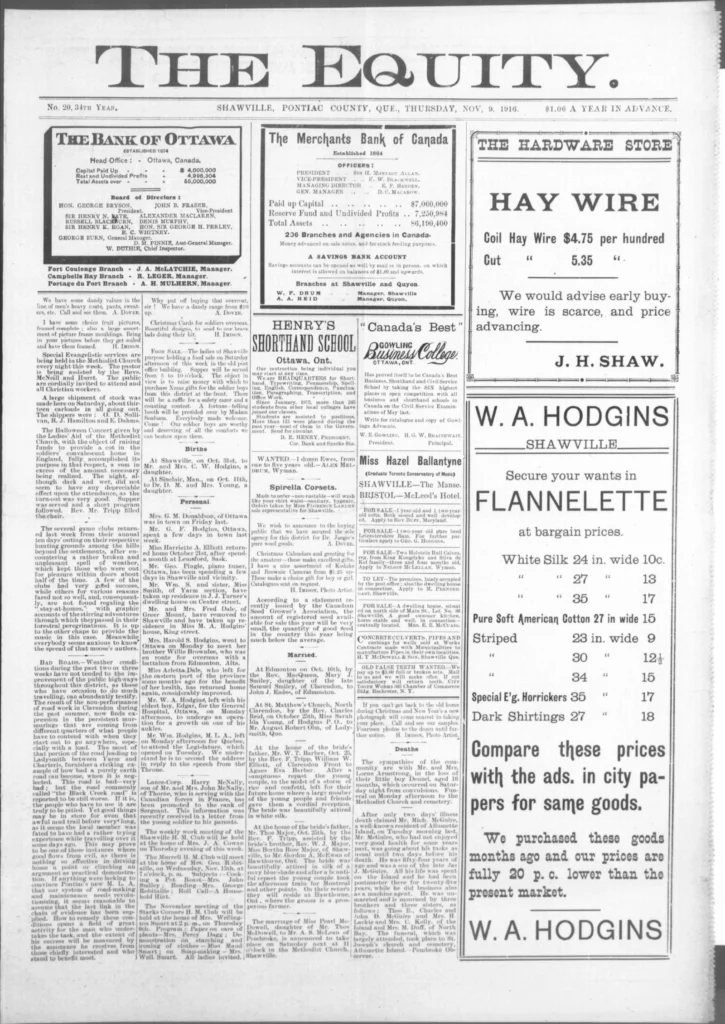
In November, the women of Shawville organized a highly successful food sale and supper specifically to buy Christmas gifts for the soldiers at the front, raising approximately $220.
“The money will at once be used in procuring such things as may be thought our soldier lads will most appreciate when the festive season arrives, and it is hoped no hitch will occur in the numerous parcels that will be made up reaching their destination in good time.”
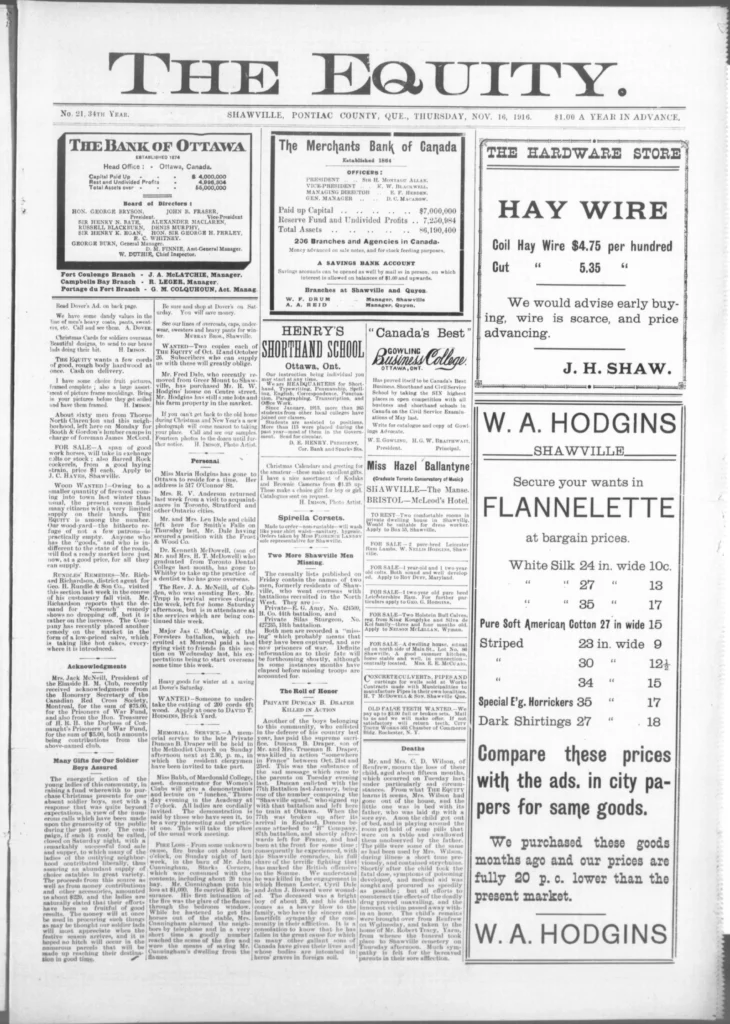
The Equity, November 11, 1916
These efforts were deeply felt across the ocean; Private Walter Marks wrote home thanking the community for a gift of tobacco, poignantly noting, “it shows that we are not forgotten by the people of Canada.”
The financial toll on the nation was staggering, with the government paying out $2,000,000 monthly in separation allowances and the Patriotic Fund distributing another $1,000,000 a month to dependents. The sheer volume of this relief unfortunately attracted deceit, as seen when one woman fraudulently collected Patriotic Fund money using the marriage certificate of her bigamist partner’s deceased first wife.
As the need for manpower grew critical, the government issued a public notice requiring an inventory of every male between the ages of 16 and 65 via National Service Cards.
Beneath the unified war effort, cultural fractures were beginning to show. In November, local papers noted that the claims of “bilingual agitators” regarding educational laws had fallen to the ground. The tension between French and English Canada was further highlighted in December when Col. Tancrede Pagneulo, the commander of the 206th French-Canadian Battalion, was summoned before a Court Martial on the grave charge of giving his men a “very strong hint to desert.”
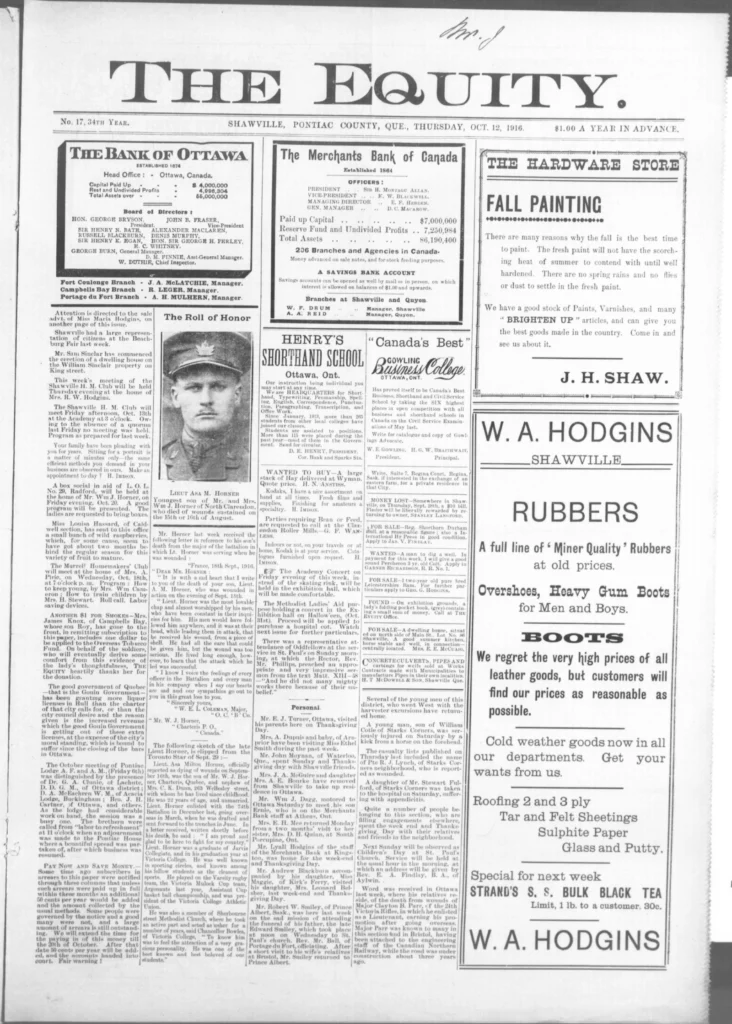
However, these domestic disputes were often overshadowed by the grim news arriving from the trenches of the Somme. The community was heartbroken by the loss of Lieut. Asa M. Horner, a 22-year-old unmarried Varsity rugby player renowned for his sportsmanship.
AI restored photo of Lieut. Asa M. Horner, who died of wounds sustained on August 15th or 16th. Published in The Equity, October 12th, 1916.
Having enlisted with the 74th Battalion, Horner was deeply respected by his men. His commanding officer wrote that they “would have followed him anywhere,” and it was while he was successfully leading them in an attack on the evening of September 15th that he was mortally wounded by a piece of shell.
He lived just long enough to learn that his attack had been a success, and a solemn memorial service was held in his honor at the local Methodist church.
Just weeks later, the war claimed another local son. Private Duncan B. Draper, the son of Mr. and Mrs. Trueman B. Draper, was killed in action “somewhere in France” between October 21st and 23rd. Duncan had enlisted in January as part of the original “Shawville squad” of the 77th Battalion before being transferred to the 87th Battalion.
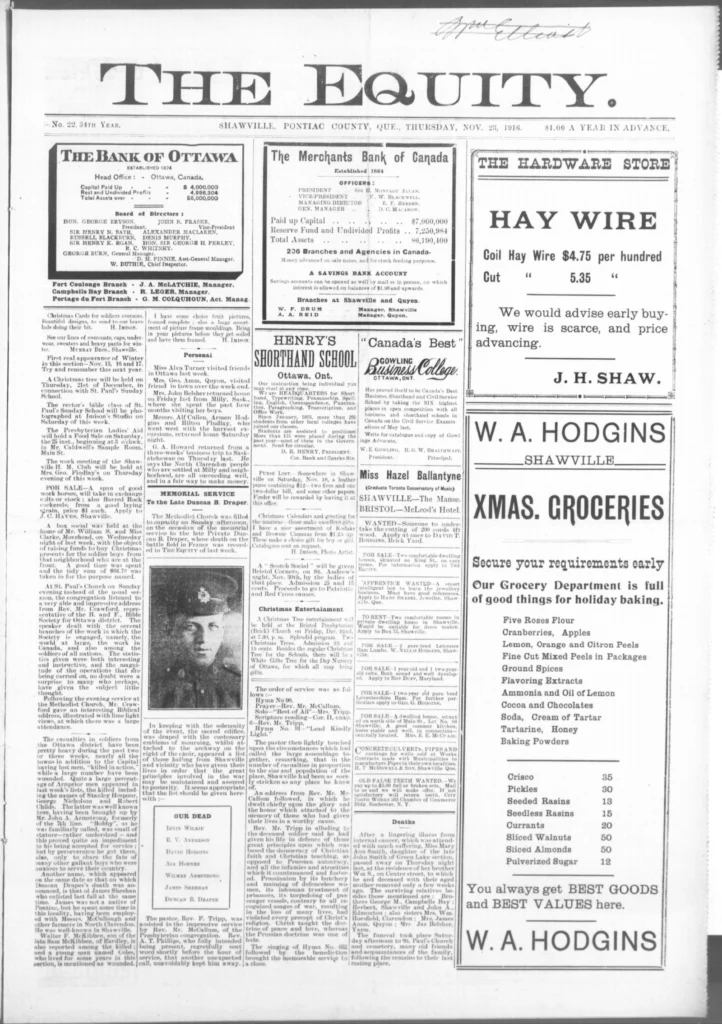
AI restored photo of Private Duncan B. Draper, who died on the battlefield in France. Published in The Equity, November 23, 1916.
Having survived months in the danger zone, he ultimately fell during the terrible fighting that marked the British offensive on the Somme. His death, mourned at a community memorial service, stood as a tragic testament to the heavy and heartbreaking price the locals were paying for the war abroad.
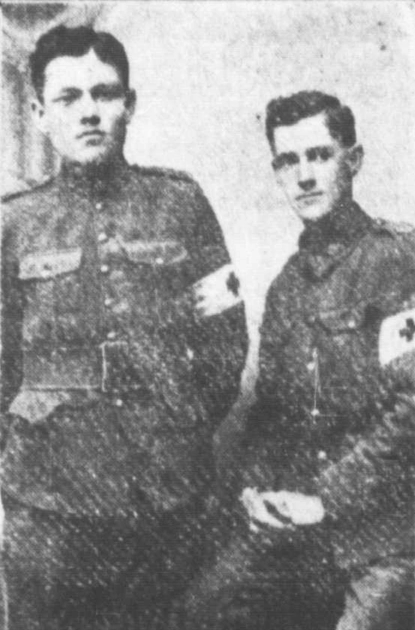
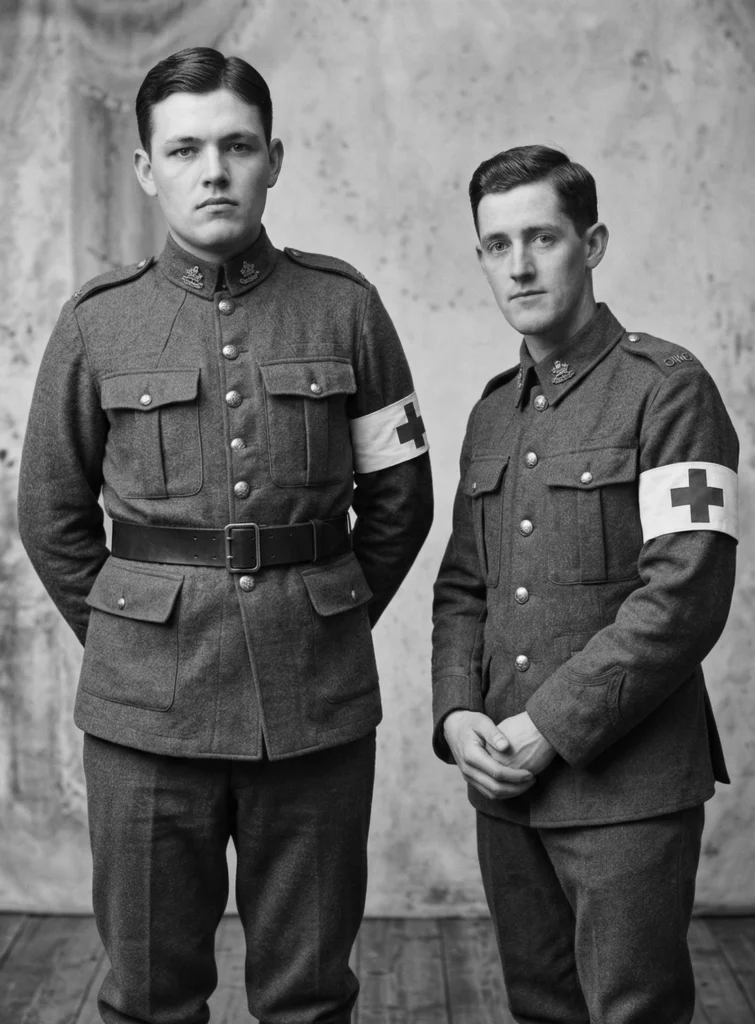
In the crucible of the Great War, the stories of the Armstrong brothers, Frank and Wilmer, stand as a poignant testament to the courage and self-sacrifice of the Canadian Expeditionary Force. Serving side-by-side in the Ninth Field Ambulance Corps, these two brothers from Shawville, Quebec, dedicated themselves to the perilous task of retrieving and treating the wounded under heavy fire.
While Frank survived a serious neck wound sustained during a rescue, Wilmer’s journey ended in a final, heroic act of devotion. Below is the somber correspondence sent to their father, James Armstrong, detailing the circumstances of Wilmer’s death and the profound respect he earned from his comrades on the battlefield.
October 6, 1916.
From Lt. Col. C. A. Peters, O. C., No. 9 Can. Field Ambulance,
To Mr. James Armstrong, Shawville, Que., Canada.
Dear Mr. Armstrong:—We regret to have to inform you of the death of your son, Wilmer; he was killed on the 30th September.
A shell exploded amongst a number of men who were at work in his neighborhood, injuring several; stretcher bearers were called and the squad, of whom your son was one, readily responded. Whilst your boy was engaged in bandaging a Sergeant of the C. M. R., who was on a stretcher, a shell exploded quite close to them; your son leaned over his patient and a fragment hit him in the back just below the shoulder blades; he died in two or three minutes. The man on the stretcher said: “Well, that boy gave his life for mine.”
We all feel sorry to lose our comrade, but we are glad to be able to let you know how splendidly he worked in all kinds of danger and how much he was liked by all the members of this Unit.
Kindly accept our sincerest sympathy.
Yours very truly,
C. A. PETERS, Lt. Col.
Soldiers Mentioned in The Equity
These names have been extracted from copies of The Equity by AI and may have mistakes. Please let us know if you catch any at jon@theequity.ca.
| Mentioned | Soldier / Personnel | Status / Details |
|---|---|---|
| Oct 5 / 19, 1916 | Sgt. C. & A. Shaw | Visited Shawville before returning to Artillery training at Petawawa Camp. |
| Oct 5 / Nov 23 | Frank Armstrong | 9th Ambulance Corps. Sustained severe neck wound from shell fire while rescuing an officer. |
| Oct 5 / Nov 16 | Lieut. Asa M. Horner | 74th Battalion. Mortally wounded Sept 15 after leading a successful attack. Memorial held in Shawville. |
| Oct 5, 1916 | Lt. A. G. Rosamond | Princess Patricia's Light Infantry; reported instantly killed in action. |
| Oct 12, 1916 | Major Clayton Parr | 24th Victoria Rifles. Promoted from Lieutenant to Major; died of wounds. |
| Oct 12 / Nov 30 | Pte. E. G. Amy | 44th Battalion. Wounded in Belgium; later found recovering in an English hospital. |
| Oct 12, 1916 | J. E. & J. G. Smart | James (honorable discharge); Jason (10th Battalion, actively engaged on the Somme). |
| Oct 19, 1916 | Melvin Shouldice | Wounded in the shoulder; his second injury following gas and previous minor wounds. |
| Oct 19, 1916 | Pte. Frank Cluke | 230th Battalion; died in hospital from a cocaine overdose. |
| Nov 9, 1916 | L-Cpl. Barry McNally | Serving in France; recently promoted to the rank of Sergeant. |
| Nov 9, 1916 | C. Dale & H. Lester | Cyril (hand wound) and Heman (foot wound) during Somme engagements. |
| Nov 9 / 16, 1916 | Pte. Duncan Draper | 87th Battalion. Killed in action in France between Oct 21st and 23rd. |
| Nov 9, 1916 | Pte. J. Landry | Wounded in the instep; recovering in an English hospital. |
| Nov 16, 1916 | W. Eades & S. Sturgeon | Recorded as "Missing" on casualty lists; presumed to be Prisoners of War. |
| Nov 16, 1916 | Robert & James Sheehan | Brothers; both appeared on casualty lists as killed in action. |
| Nov 16 / 23, 1916 | Wilmer Armstrong | 9th Field Ambulance. Killed by shell fragment while bandaging a wounded sergeant. |
| Nov 23, 1916 | Major Gordon Southam | 40th Battery. Renowned athlete; killed in action in France. |
| Nov 30 / Dec 7 | Hugh E. Brownlee | 8th Battalion. Killed by a sniper on Nov 5th and buried at Villers Aux Bois. |
| Dec 14 / 21, 1916 | Jack (J. W.) Elliott | 77th Battalion. Recovering from shell shock in an English hospital. |
| Dec 14, 1916 | Col. Tancrede Pagneulo | Commander 206th Battalion; Court Martialed for hinting his men should desert. |
| Dec 21, 1916 | Mr. Percy Twa | Passed medical exam for the Navy; scheduled for duty Dec 27th. |
| Dec 28, 1916 | Capt. Smythe & A. McCuaig | Listed among soldiers returning to Shawville on holiday leave. |
Listen to our Podcast!
We’ve used Artificial Intelligence to summarize what was covered in The Equity during this part of the Great War. Click the play button to listen.
Timelines: October - December 1916
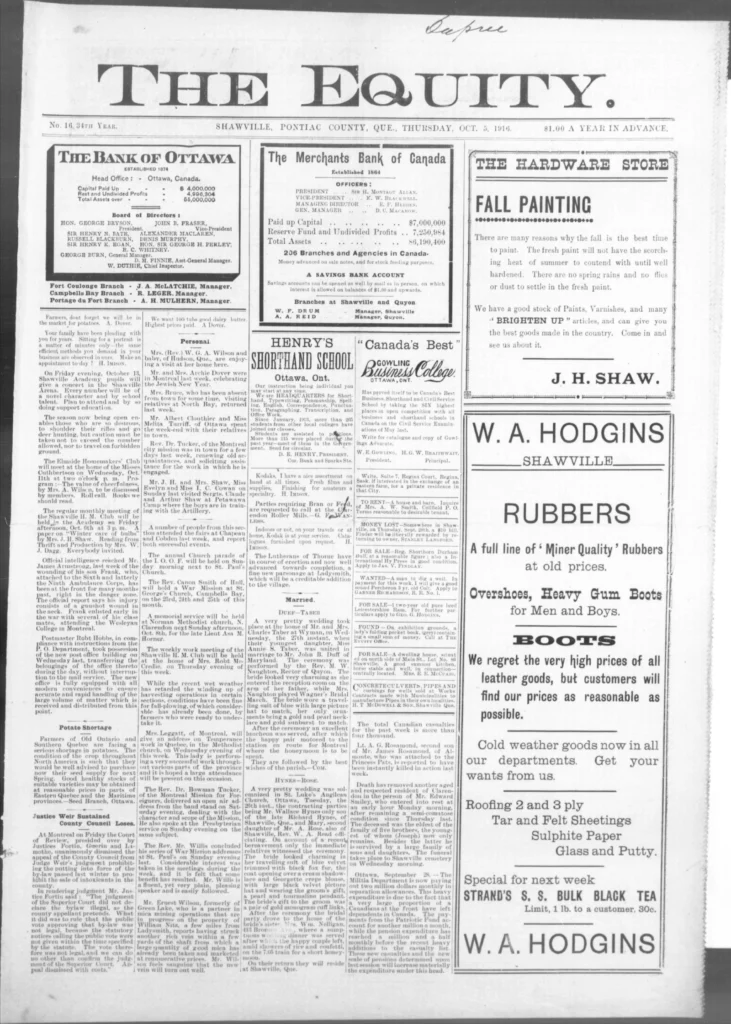
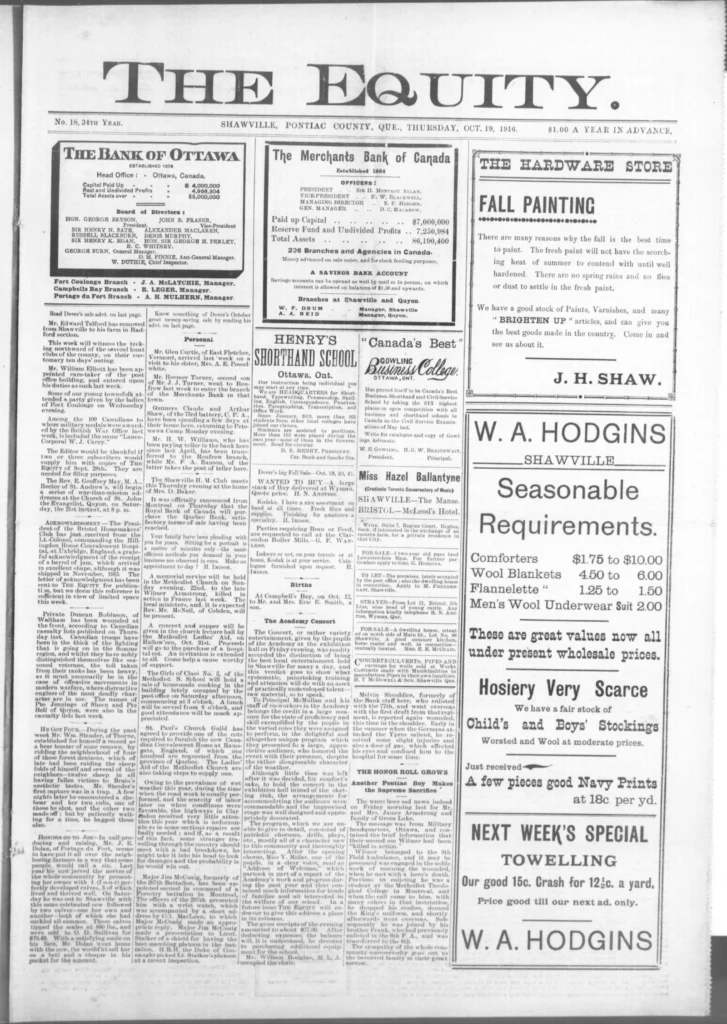
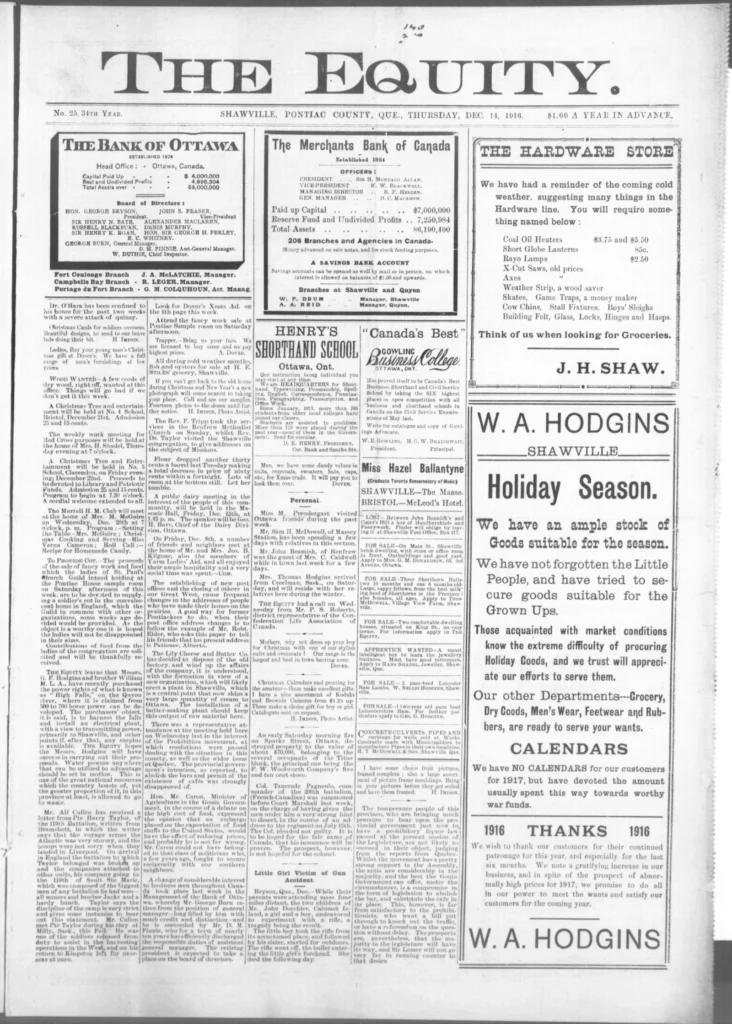
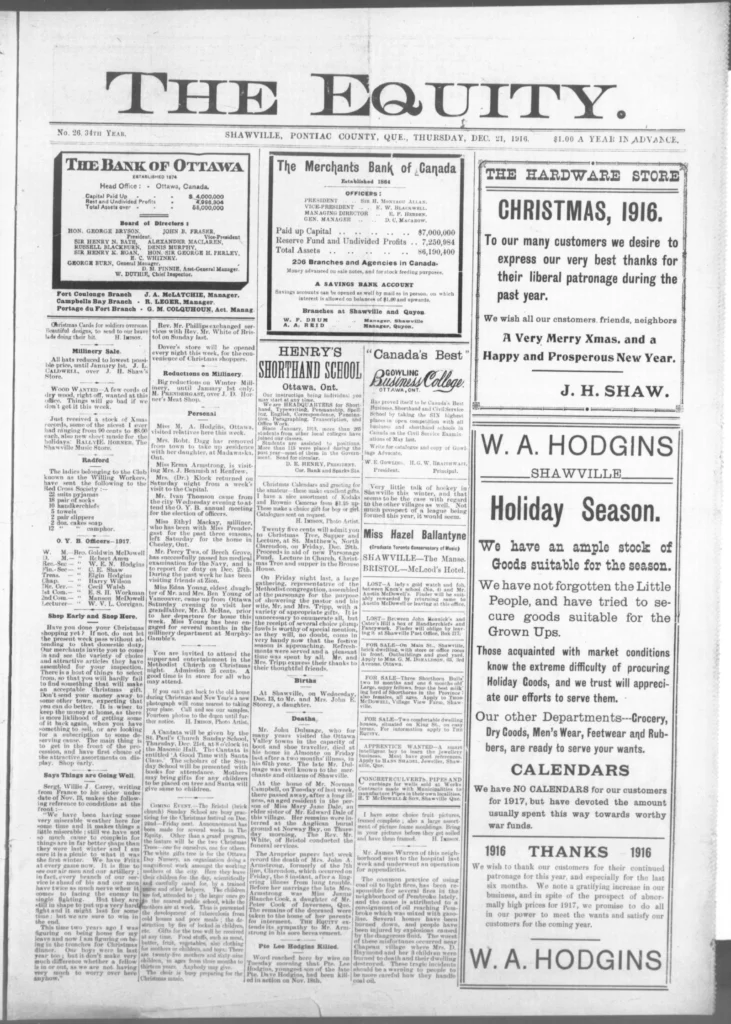
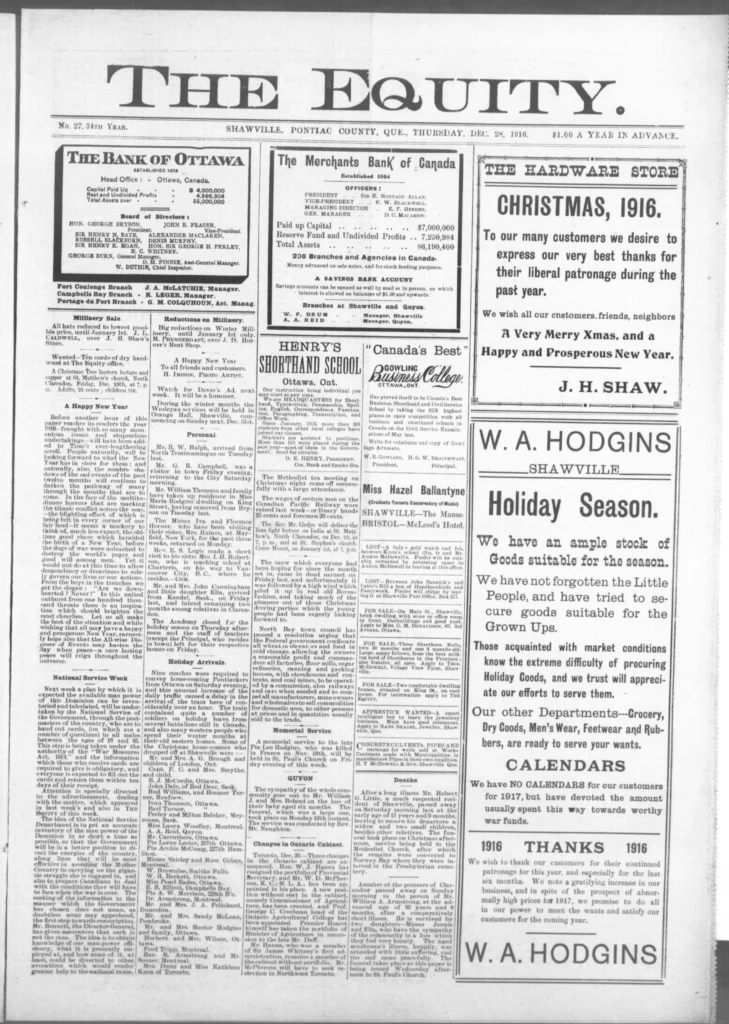
Below are the original copies of The Equity from this part of the War. Click any of them to download a PDF copy.