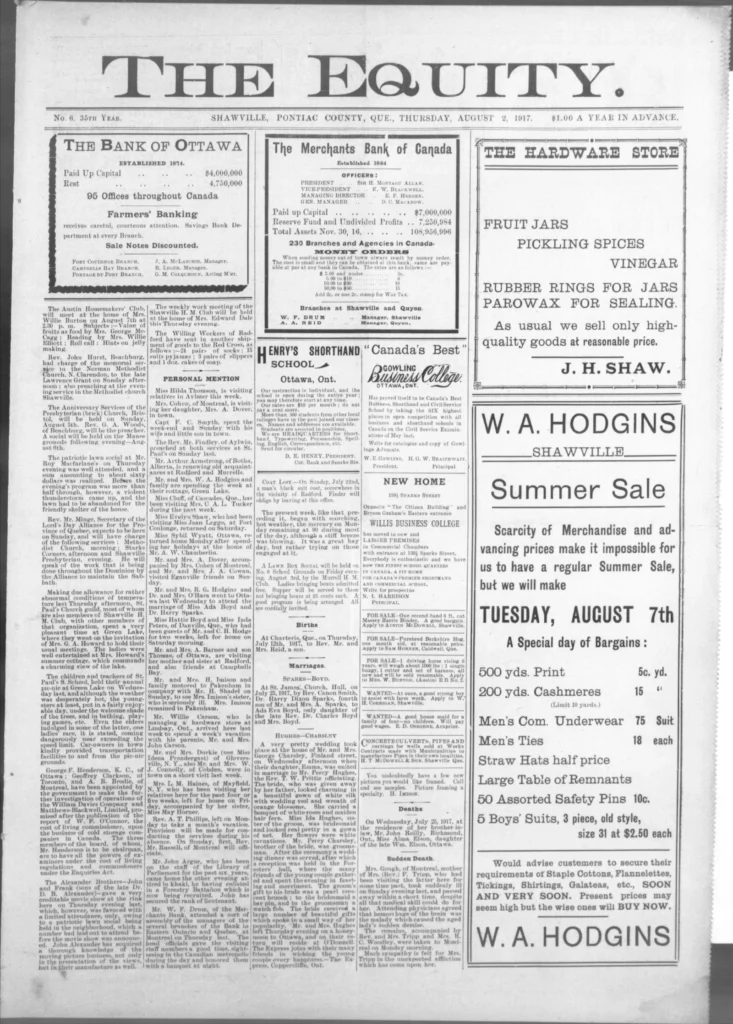
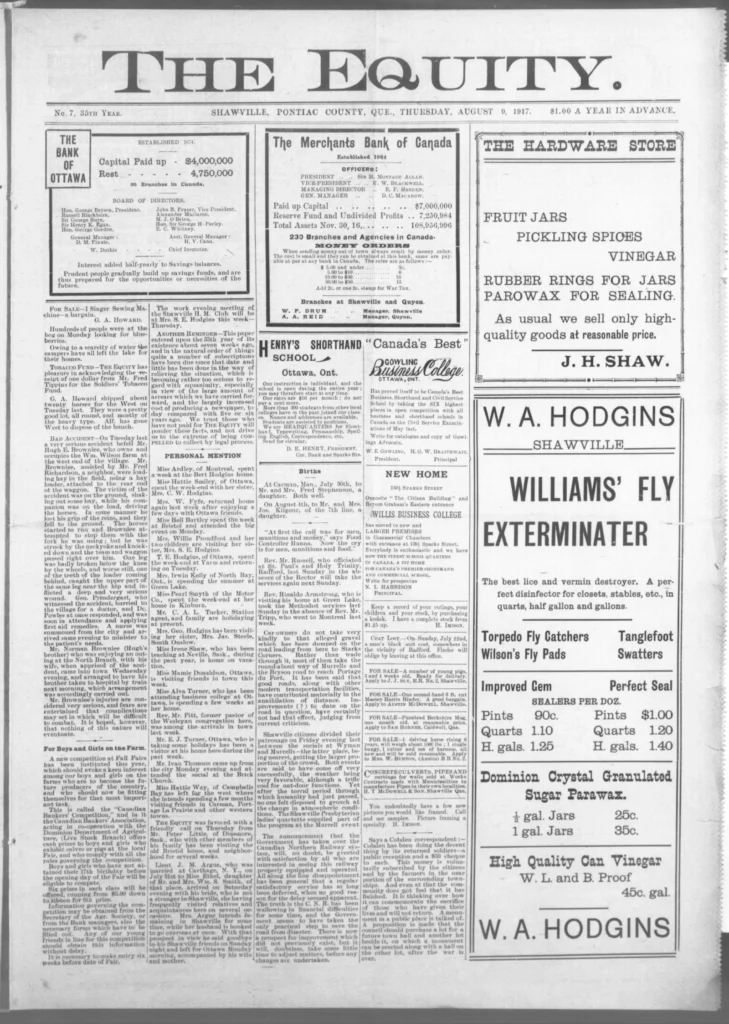
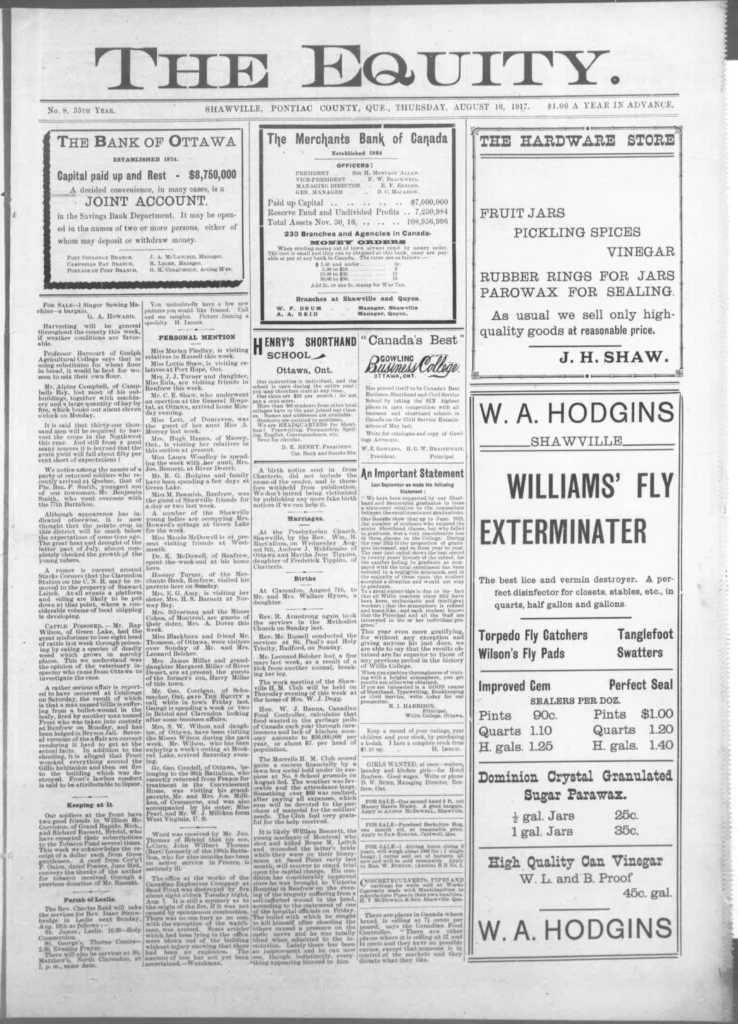
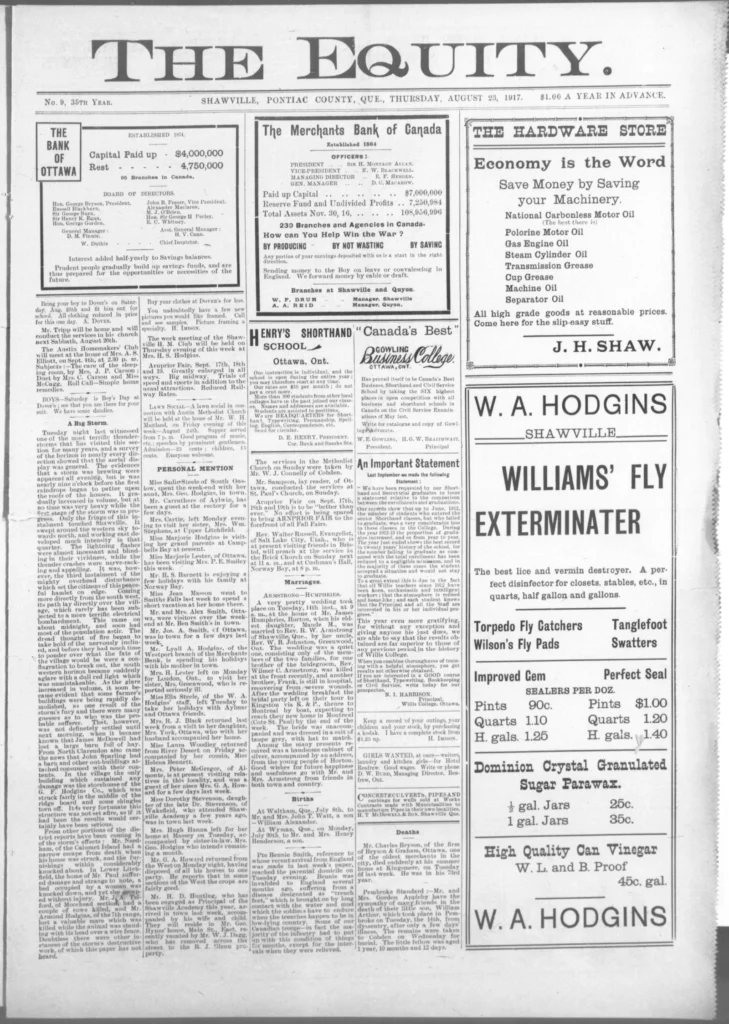
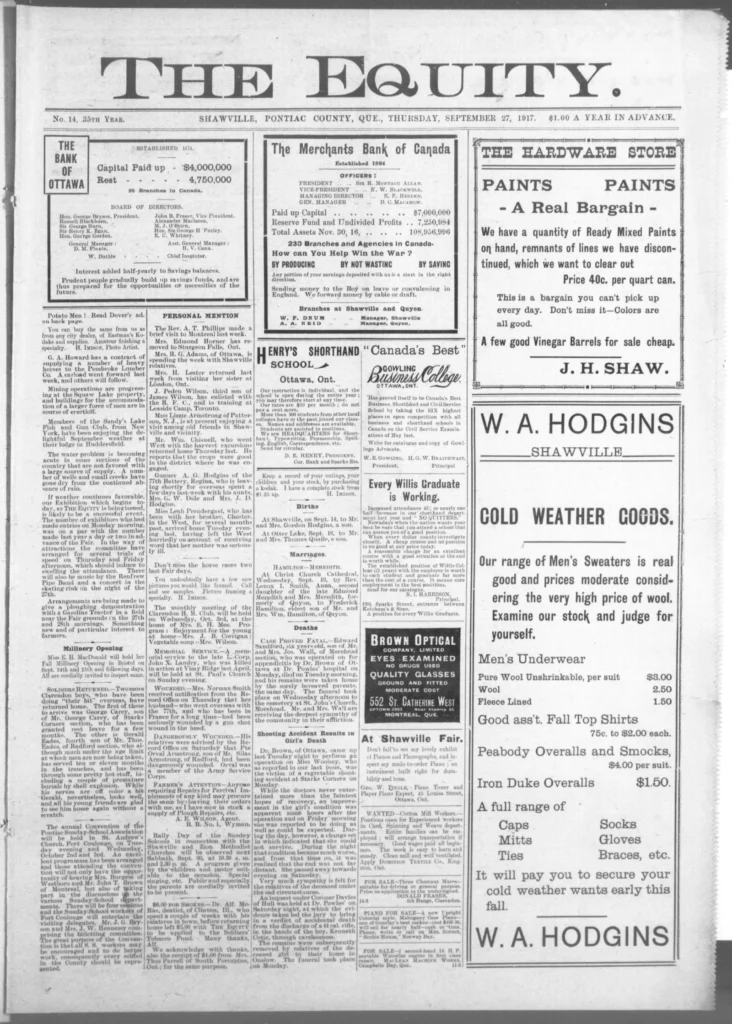
The summer of 1917 brought both sorrow and steadfastness to the Pontiac, as the weight of three long years of war pressed ever more heavily upon the community. The pages of The Equity reflected a population both hardened by loss and sustained by duty. Editorials spoke with solemn pride of Canada’s progress in the war, while acknowledging that the dream of a swift victory had long vanished. Instead, they called for continued endurance and sacrifice, promising that through trial and discipline the country would emerge into a “higher and better life.” The war had ceased to be a moment of crisis — it was now a condition of existence, defining every family, every business, and every act of civic life.
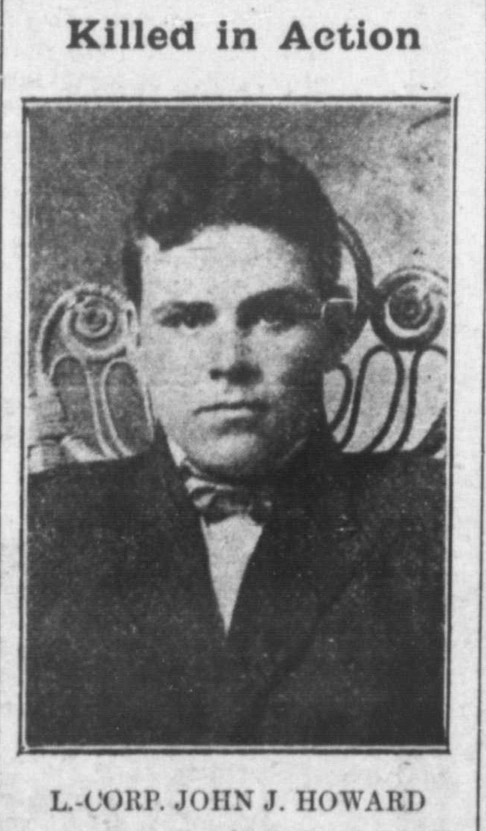
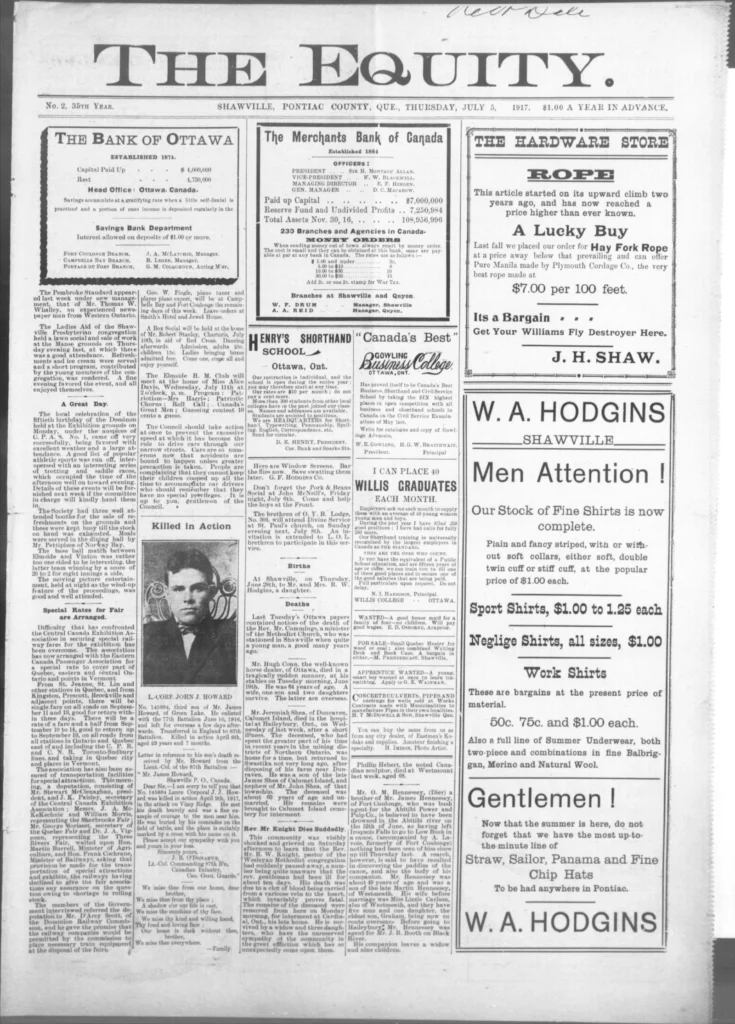
The cost of that existence was counted in names and faces. Letters from Europe and telegrams from Ottawa brought the war home with relentless regularity. Memorial services filled the churches of the Pontiac — among them a service in Shawville honoring Lance Corporal J. J. Howard of Green Lake, who fell at Vimy Ridge. His loss, like so many others, linked the great victory of April to the grief of small towns half a world away. Notices of the wounded appeared side by side with obituaries: Private Ben F. Smith and Private John Elliott returned home bearing the marks of battle; Lance Corporal Crawford Dolan of Portage du Fort was reported injured, while Private Roy M. Knox of Campbell’s Bay was said to be recovering in hospital overseas. Each story carried a mix of pride and pain — proof that even triumph came at an impossible price.
At home, patriotism took the form of unending labor and generosity. Homemakers’ Clubs across the county organized socials and fundraising events, with groups like the Murrells H.M. Club devoting their proceeds entirely to “soldiers’ needs.” Even schoolchildren joined the cause — pupils in Clarendon pooled their pennies to send aid to war victims in Belgium. Everyday life became part of the national campaign of thrift and conservation. Under the new federal Food Controller’s regulations, hotels and restaurants were ordered to observe “meatless days,” limiting servings of beef and bacon to preserve supplies for the front. Editorials urged families to plant more gardens, to can fruit and vegetables, to waste nothing. Rising prices — particularly for staples like potatoes — drove home the necessity of self-reliance. The household economy had become a front line of its own.
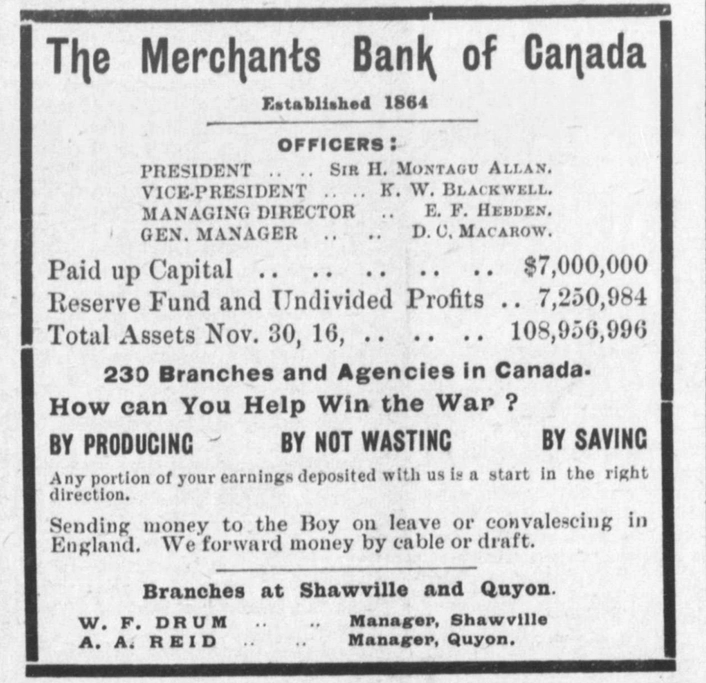
The region’s farmers continued to shoulder an enormous share of the burden. Labor was scarce and the work relentless, but agriculture was now recognized as a patriotic enterprise. Government policies rewarded farmers who stayed home to work the land, allowing service on farms to count toward homesteading duties for returning soldiers.
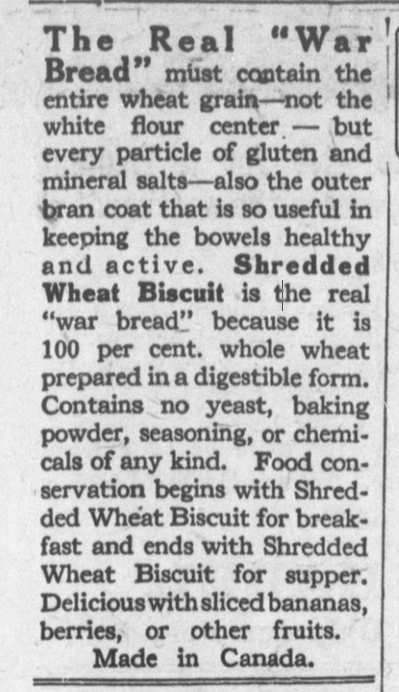
Machinery dealers warned farmers to buy immediately or face steep price hikes next year, while the local telephone company began charging penalty fees for overdue rentals — small signs of how even rural systems strained under the pressure of wartime economics. And even your choice in breakfast cereal had to be patriotic.
Yet it was politics — not prices — that defined the tone of that summer. The debate over the Compulsory Service Bill reached fever pitch, tearing open divisions that had long been simmering beneath Canada’s patriotic surface. English-speaking editorials, echoing Ottawa’s rhetoric, accused Quebec of failing to “flock to the colors,” and condemned Sir Wilfrid Laurier for “truckling to French-Canadian sentiment.”
An article in The Equity, published in July 1917, framed the conscription debate less as a clash of political parties and more as a profound linguistic and cultural divide.
The Conscription Bill
SECOND READING CARRIED BY A MAJORITY OF SIXTY-THREE.
Ottawa, July 6.—The second reading of the Compulsory Service Bill was passed at five minutes after five o’clock this morning by a majority of 63.
The vote stood 118 to 55.
Twenty-five English-speaking Liberals and one French-speaking Liberal, on the final division, cast their votes with the Government, and only twelve English-speaking Liberals voted against the measure. Half of these were from Quebec.
In the Pontiac, this friction was felt with particular intensity. While the region’s Conservative MP, Gerald Hugh Brabazon, remained loyal to the Borden government and cast his vote in favor of the Bill, he found himself increasingly isolated from his own constituents.
The bitterness of the Conscription debate was inflamed by acts of violence, including the dynamiting of Lord Atholstan’s Montreal residence, an act widely blamed on anti-conscription radicals. For many in Pontiac — a region straddling both linguistic traditions — the conflict was deeply personal. Families, businesses, and councils with both English and French names tried to navigate loyalties that were increasingly at odds, even as both sides shared the same losses and anxieties.
Amid the tension, new voices began to emerge. The government’s announcement of a limited war franchise for women — particularly those who were mothers, sisters, or wives of soldiers — was celebrated as both a recognition of service and a political strategy to bolster support for the war. It marked the first significant expansion of the vote in the region’s history, and for many local women already leading Red Cross and Homemakers’ work, it felt like a long-overdue acknowledgment of their indispensable role.
By the close of the summer, the Pontiac — like Canada itself — stood on uncertain ground. The war’s purpose remained clear, but the unity that had once defined it was beginning to fray. Even so, The Equity continued to insist on perseverance: that service, savings, and sacrifice were the pillars on which victory rested. As autumn approached, the war showed no sign of ending, and the first drafts of conscription loomed ahead. The months to come would test not only the Empire’s endurance abroad, but the country’s fragile sense of solidarity at home.
Soldiers Mentioned in The Equity
These names have been extracted from copies of The Equity by AI and may have mistakes. Please let us know if you catch any at jon@theequity.ca.
| Mentioned | Soldier / Personnel | Status / Details |
|---|---|---|
| Jul 5, 1917 | L-Cpl. J. J. Howard | Killed in action on April 9, 1917, during the attack on Vimy Ridge. |
| Jul 5, 1917 | Graham Hennessey | Eldest son of the late O. M. Hennessey; reported en route for overseas service. |
| Jul 12, 1917 | Corp. John McNally | Described the Canadian breakthrough in a letter; hit on April 11 while serving in France. |
| Jul 12, 1917 | Pte. T. D. Fournier | Portage du Fort soldier; listed in Canadian casualties as wounded. |
| Jul 12, 1917 | Pte. W. A. Roy Onegl | Portage du Fort soldier; listed as wounded and missing. |
| Jul 19, 1917 | Pte. John Elliott | Local soldier who arrived back home after crossing the ocean a few weeks prior. |
| Jul 19, 1917 | Pte. O'Connor | From Litchfield; arrived home after being wounded in France. |
| Jul 26, 1917 | Sapper Lawrence Grant | Enlisted from Fort William; died of wounds on July 5 while being transported in an ambulance. |
| Jul 26, 1917 | Cyril Dale | Severely wounded in the left hand by a rifle bullet on the Somme front. |
| Aug 9, 1917 | C. H. C. Greentree | Resigned as bank manager to enlist in an overseas Railway Construction battalion. |
| Aug 9, 1917 | Pte. Roy M. Knox | Wounded in France; recuperating in a hospital at Leith, Scotland. |
| Aug 16/23, 1917 | Pte. Ben F. Smith | Served overseas with the 77th Battalion; returned to Quebec after being invalided to England. |
| Aug 16, 1917 | Corpl. F. Onion | Sent a card from France thanking the Tobacco Fund for a local donation. |
| Aug 16/30, 1917 | L-Cpl. J. W. Thomas | Reported dangerously ill after nine months of active service in France. |
| Aug 16, 1917 | L-Cpl. Clifford Dolan | Portage du Fort soldier; seriously wounded in heavy fighting in France. |
| Aug 23, 1917 | Sandford Leitch | Reported to have fallen in action on Easter Monday, April 9. |
| Aug 23, 1917 | Robert McKinnon | Reported killed in action on the morning of June 3. |
| Aug 23, 1917 | Pte. H. C. Oliver | Described casualties and conditions after surviving Vimy Ridge. |
| Aug 23, 1917 | W. Biscoe & R. Woollven | Soldiers expected to join Pte. Oliver's brigade shortly. |
| Aug 23, 1917 | Capt. Arthur Gillies | Forwarded weapons captured at Vimy Ridge back to his father in Carleton Place. |
| Aug 30, 1917 | Corp. L. H. Thomas | Reported wounded in France a short time prior. |
| Aug 30, 1917 | Arthur Thomas | Wounded soldier reported to be getting along well. |
| Aug 30, 1917 | Rev. Capt. J. A. Macfarlane | Visited by his brother while serving in his current position. |
| Aug 30, 1917 | Capt. Dave Macfarlane | M.D. who returned from France for a two-week visit before redeploying. |
| Aug 30, 1917 | Bdr. E. W. Paul | Sent a thank-you letter to a local Girls' Club for sending socks to his unit. |
| Sep 6, 1917 | Sergt. McNally | Name appeared in official casualty lists as having been wounded. |
| Sep 13, 1917 | Pte. Clifton Woodley | Wounded and captured at Ypres in 1916; sent a photo home showing him as a POW in Germany. |
| Sep 13, 1917 | Robin (Family Member) | Formerly of North Clarendon; believed to be a fellow prisoner pictured in Pte. Woodley's photo. |
| Sep 20, 1917 | Pte. John McCorriston | Reported wounded in action for a second time. |
| Sep 20, 1917 | George Madore | Portage du Fort man; appeared in casualty list as wounded. |
| Sep 20, 1917 | Willie Brownlee | Serving with an Edmonton unit; reported wounded in action. |
| Sep 20, 1917 | Pte. J. A. McCuaig | Shawville resident; listed as dangerously ill in official casualty reports. |
| Sep 20, 1917 | Pte. C. R. McArthur | Son of a former Shawville resident; reported killed in action. |
| Sep 27, 1917 | Gnr. A. G. Hodgins | Attached to the 77th Battery; preparing to leave shortly for overseas service. |
| Sep 27, 1917 | L-Cpl. John N. Landry | Killed at Vimy Ridge in April; memorial service scheduled at St. Paul's Church. |
| Sep 27, 1917 | Gerald Eades | Granted rest leave for a duration of a few months. |
| Sep 27, 1917 | Pte. Macfarlane | Reported missing since Aug 15, but later confirmed as safe. |
| Sep 27, 1917 | Pte. Jack McDonald | Returned to Petawawa for further training after a neighborhood visit. |
| Sep 27, 1917 | Pte. James Raymond | Remembered in an "In Memoriam" poem; killed at Vimy Ridge, April 10, 1917. |
Listen to our Podcast!
We’ve used Artificial Intelligence to summarize what was covered in The Equity during this part of the Great War. Click the play button to listen.
Timelines: July - September 1917
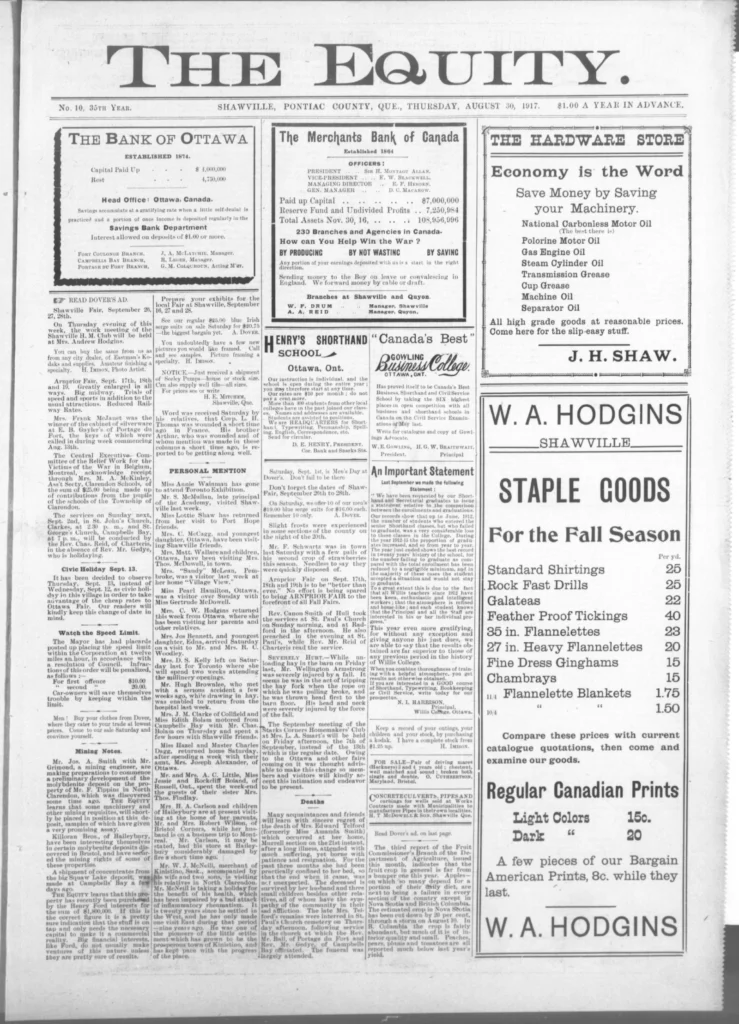
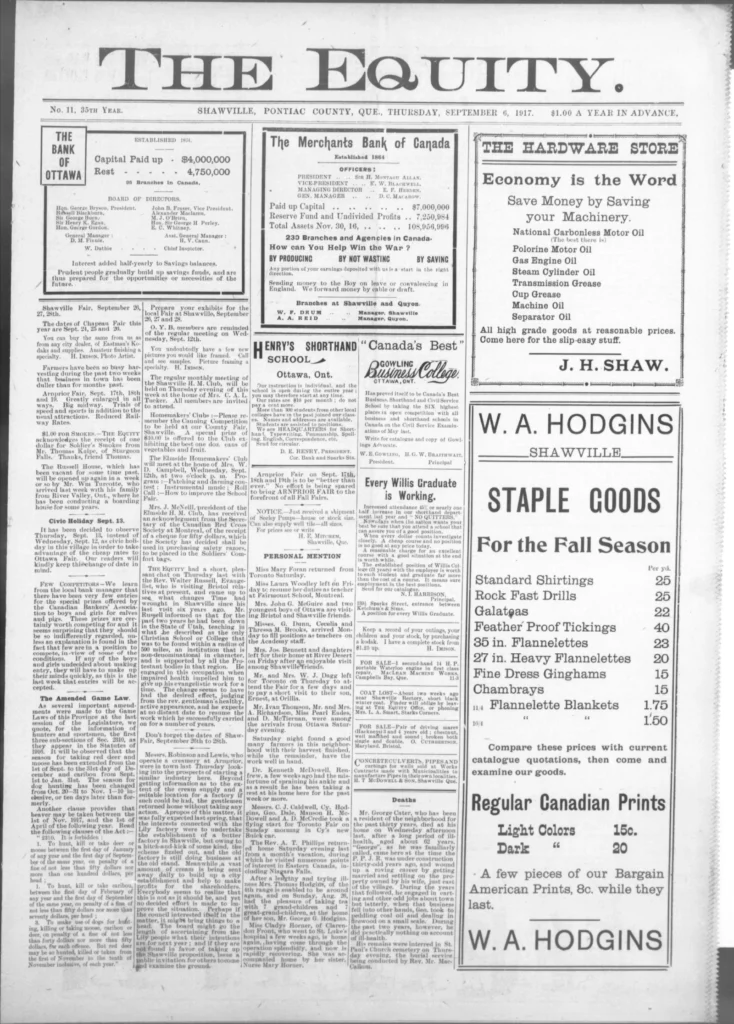
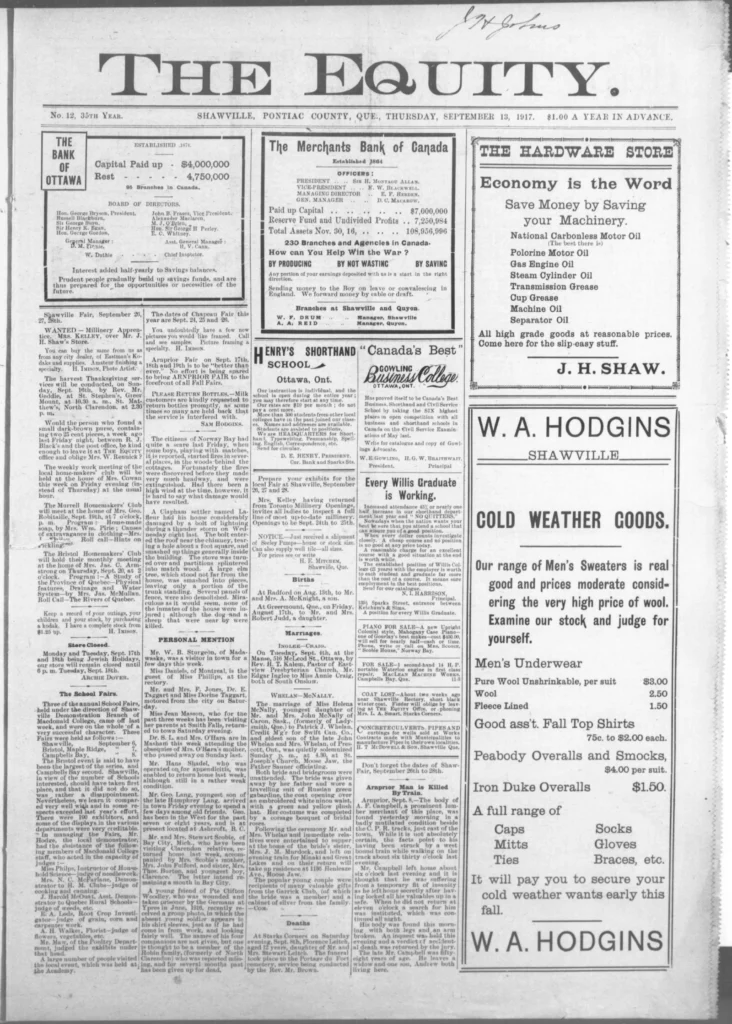
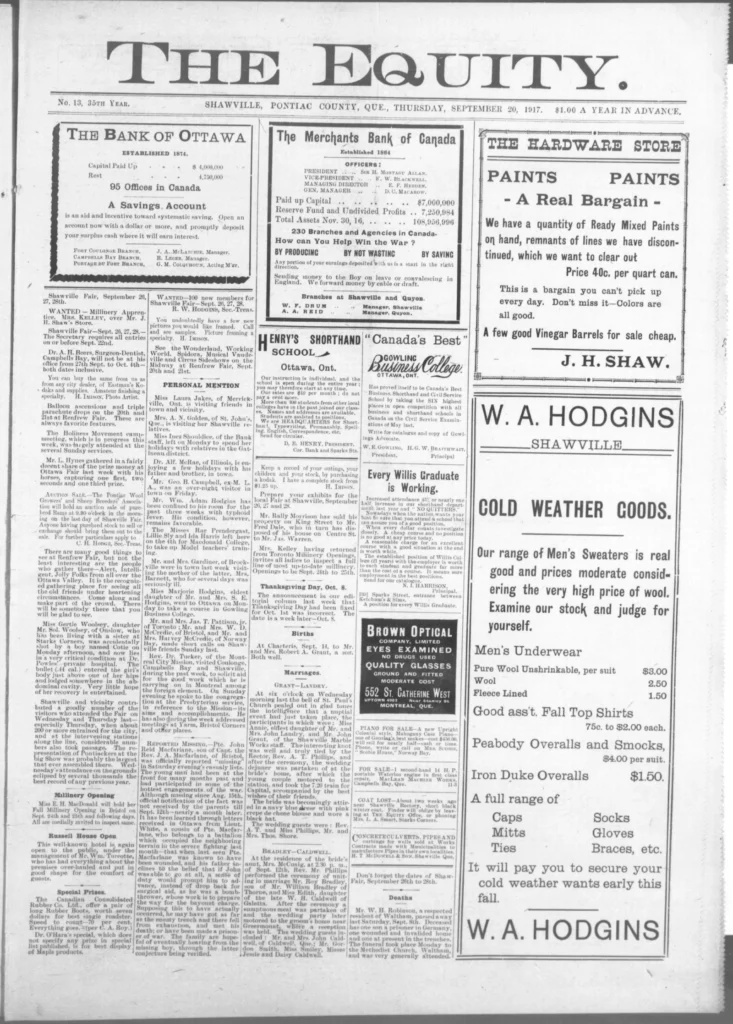
Below are the original copies of The Equity from this part of the War. Click any of them to download a PDF copy.