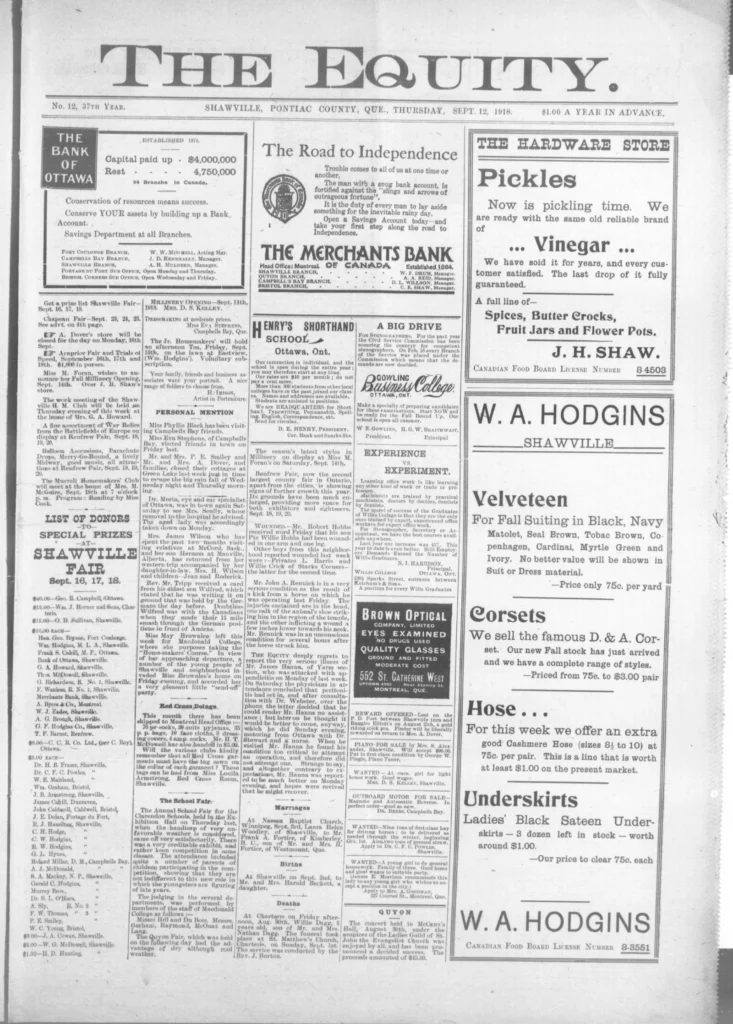
The summer and early autumn of 1918 found the Pontiac in a final, intense season of endurance — a community disciplined by four years of sacrifice and now focused on the war’s closing struggle.
The Pontiac’s newspaper of record, The Equity, framed the conflict in moral as well as military terms, describing it as “God’s war” for righteousness and civilization. Duty was no longer a matter for soldiers alone; the “Draft of Duty,” it declared, applied to every citizen.
Well, the Bible urges us to be “laborers together with God,” and if we do this we cannot help knowing Him better. That is what these boys and men are doing at the front. They are laboring together with God, for this is God’s war, as it is a war for righteousness, humanity and civilization. And by working with Him our boys are getting to know Him better, as these books just mentioned show.
– The Equity, September 19, 1918
The greatest local expression of that duty came through food conservation. Families were told to “keep faith with the Allies” by obeying every Canada Food Board rule — baking with corn meal or barley instead of wheat, serving the mandated “dark loaf” in place of white bread, and avoiding meat on restricted days. Enforcement was real and strict: police were authorized to fine or jail anyone found wasting food or defying ration rules.
Economic life adjusted to this total-war footing. The shortage of labor, described as a “veritable handicap” to farmers, forced innovation. Local dairies adopted new mechanical milkers to offset the loss of manpower.
No single piece of farm machinery has increased more in use in the last two years than the mechanical milker. In this country, where the labor shortage became critical early in the war as a result of the enlistment of farm laborers, the milking machine is the one thing that has averted a disastrous drop in dairy production.
On hundreds of Canadian farms women, with the aid of this machine, do the milking. As the war progresses, many more dairy farmers will be compelled to adopt the milking machine, or curtail operations, or go out of business. The dairyman who thinks the initial investment is too great or the cost of upkeep too high makes a mistake.
– The Equity, September 26, 1918
War gardens flourished across the Pontiac, producing vegetables and root crops that were eagerly canned or dried for winter use. Despite shortages and strain, these efforts carried a quiet pride — tangible proof that Pontiac households were contributing directly to the Allied cause.
In the lumber industry, reduced manpower and difficult logging conditions continued to cut into production, yet mills persisted in buying poplar, spruce, and balsam pulpwood even at sharply higher costs. The price of horse feed and labor rose so steeply that local cartage rates had to be increased in August — another small reminder that even ordinary errands bore the imprint of war.
The human cost of the conflict remained close to home. Families mourned familiar names — Robert Andrew Leitch of Starks Corners, dead at twenty, and Private Harry Eldon McDowell of Shawville among them. Yet even amid grief, life went on with quiet gestures of connection.
The newspaper reminded readers that “pictures of home folks carry warmth and comfort to the heart of a soldier,” while shopkeepers advertised simple but heartfelt gifts — a safety razor, a photograph, a letter — to send across the ocean. Reports from the front praised the humor and endurance of Canadian troops, whose cheer under fire became a source of pride for those who waited at home.
On the battlefields of France, the news at last began to change. In August, the Allied armies launched the great offensive that would become known as the Hundred Days. The Canadian Corps broke through entrenched lines, captured prisoners and guns in the thousands, and reclaimed territory lost since 1914.
“The beginning of the end is in sight,” The Equity declared on July 25th, echoing a sentiment felt across the county. Yet triumph was tempered by reminders of horror. The torpedoing of the Canadian hospital ship Llandovery Castle was reported in chilling detail, its story reinforcing the conviction that the war’s brutality demanded not just victory, but justice. British authorities, the paper noted, were keeping careful record of every known atrocity for the coming “Day of Reckoning.”
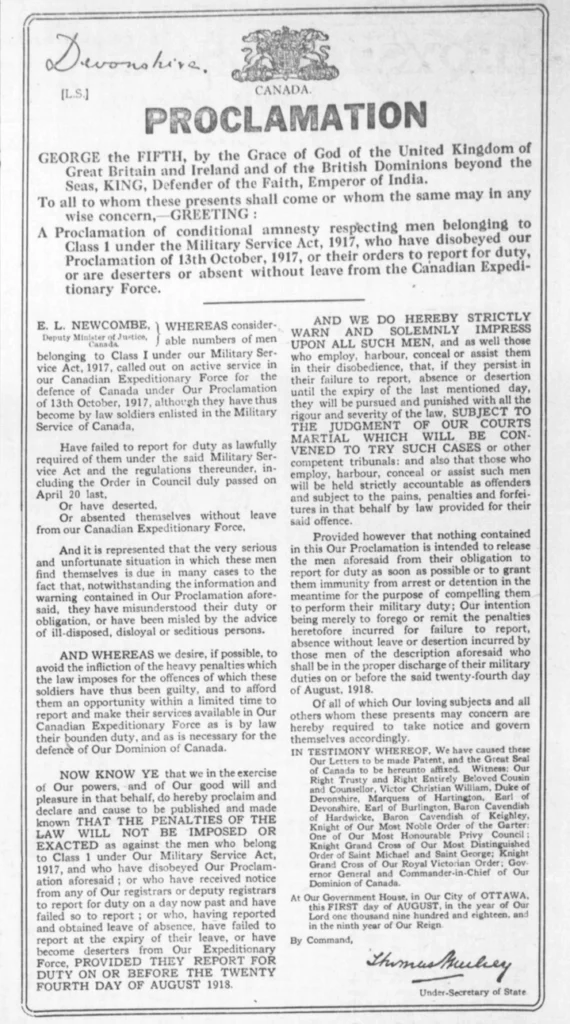
Even as morale lifted, political and social strains persisted. The Governor General’s amnesty of August 1 granted Class I deserters and absentees a chance to report for duty before facing penalties, a concession made necessary by widespread evasion — some of it uncomfortably close to home. Pontiac farmers were fined for sheltering deserters, and editors noted that “recriminations between Ontario and Quebec go merrily on.”
The tension over conscription remained so charged that soldiers were officially forbidden to use the word “conscript” in training camps. Meanwhile, long-standing social traditions were subdued under wartime restraint: even the Orange Lodge’s annual “Twelfth” celebration was reduced to a modest basket picnic, held within Food Board limits.
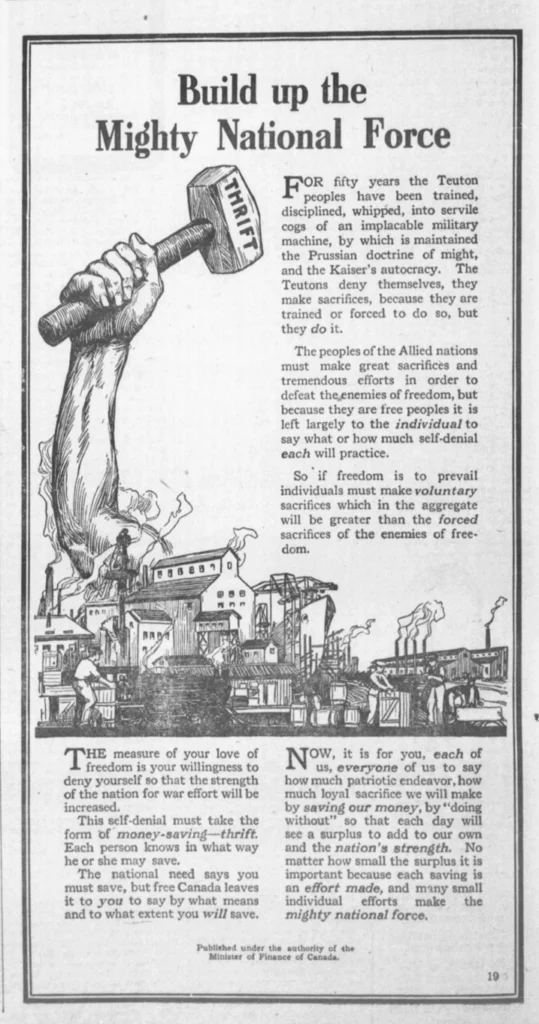
Through all this, the tone of the season was one of optimism. Loss and fatigue were balanced by unmistakable signs of progress — a conviction that the long years of endurance were finally yielding results. The local press urged citizens to see thrift as a moral act: “The saving man is therefore a real patriot.”
Bonds were purchased, gardens tended, and rules obeyed not out of fear but conviction. By late September, as word of Allied victories filled the papers, the Pontiac shared in a cautious but growing certainty — that the war would be won, and that their perseverance, in field and home alike, had helped make it so.
Soldiers Mentioned in The Equity
These names have been extracted from copies of The Equity by AI and may have mistakes. Please let us know if you catch any at jon@theequity.ca.
| Mentioned | Soldier / Personnel | Status / Details |
|---|---|---|
| Jul 11, 1918 | Cadet W. G. Eades | In training with the Royal Air Force in Toronto; his wife was visiting friends there. |
| Jul 11, 1918 | Frank Armstrong | Son of Jas. Armstrong; joined the Royal Air Force and took holiday leave at home. |
| Jul 11, 1918 | Stanley Reed | Recently returned home to visit his aunt in Shawville; wounded at Passchendaele, losing power in right hand. |
| Jul 11, 1918 | Albert Chisnell | Son of Wm. Chisnell; in training in Winnipeg with the engineers. |
| Jul 18, 1918 | Cadet E. V. Murphy | Royal Air Force member; married Miss Laura Annie Lang at the local parsonage. |
| Jul 18, 1918 | Dr. Perley Dagg | Stationed at Petawawa Camp; visiting his parents in town. |
| Jul 18, 1918 | Pte. John George Smith | (No. 336782) From Campbells Bay; enlisted with Ottawa battalion; reported wounded in France. |
| Jul 25, 1918 | L-Cpl. John N. Landry | Fell at the Battle of Vimy Ridge; local memorial service held in his memory. |
| Aug 1, 1918 | William McInnerny | Returned soldier (First Contingent); saw significant service; returned home on two weeks' leave. |
| Aug 1, 1918 | W. F. Watson | Returned soldier (two years in trenches); gave patriotic address at a local lawn social. |
| Aug 8, 1918 | Clarence Eades | Local farmer called for service; in training in a western military camp. |
| Aug 8, 1918 | Pte. Harvey McLarnon | Son of Edward McLarnon (Clarendon); arrived home on two weeks leave. |
| Aug 8, 1918 | San. H. L. McDowell | Formerly in B.C.; came to Brockville with engineers; secured leave to visit home. |
| Aug 15, 1918 | Dr. Abb Brownlee | Stationed at Petawawa; visited sister and relatives locally for a few days. |
| Sep 5, 1918 | Pte. Harry Eldon McDowell | Formerly of Shawville; reported killed in action. |
| Sep 5, 1918 | Willie Barnett | Son of H. S. Barnett; went overseas two months prior; spent leave visiting Scotland. |
| Sep 12, 1918 | Pte. L. Harris | Of Starks Corners; reported wounded in casualty lists. |
| Sep 12, 1918 | Pte. Willie Crick | Of Starks Corners; reported wounded for the second time. |
| Sep 19, 1918 | Pte. Joshua Ostrom | (No. 449140) Next of kin: Derrick Ostrom (Fort Coulonge); reported gassed. |
| Sep 19, 1918 | Pte. Fred Moore | Next of kin: Mrs. John Moore (Calumet Island); reported gassed. |
| Sep 19, 1918 | Pte. William John Toner | (No. 788840) Next of kin: Edward Toner (Allumette Island); reported wounded. |
| Sep 19, 1918 | Pte. Thomas Robert Farrell | (No. 3320173) Next of kin: Mrs. Jam Farrell (Campbells Bay); reported wounded. |
| Sep 19, 1918 | Pte. Robert Moorhead | Next of kin: Robert Moorhead (Campbells Bay); reported wounded. |
| Sep 19, 1918 | Pte. Joseph Edwin Kerrigan | (No. 3055191) Next of kin: Paul Kerrigan (Campbells Bay); reported wounded. |
| Sep 19, 1918 | J. A. Macfarlane, M.A. | In Memoriam: Of Campbells Bay; killed in action at Lens on August 15, 1917. |
| Sep 26, 1918 | Corp. Robert W. Shirley | (No. 874736) Born at Maple Ridge; killed in action Aug 11 while serving with a machine gun section. |
Listen to our Podcast!
We’ve used Artificial Intelligence to summarize what was covered in The Equity during this part of the Great War. Click the play button to listen.
Timelines: July - September 1918
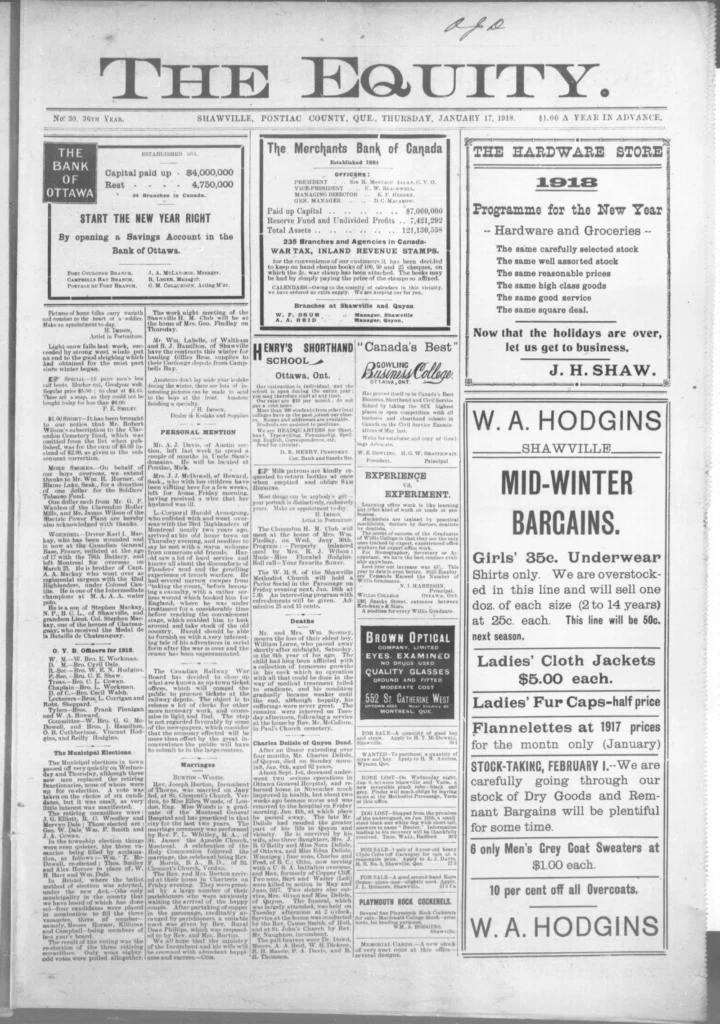
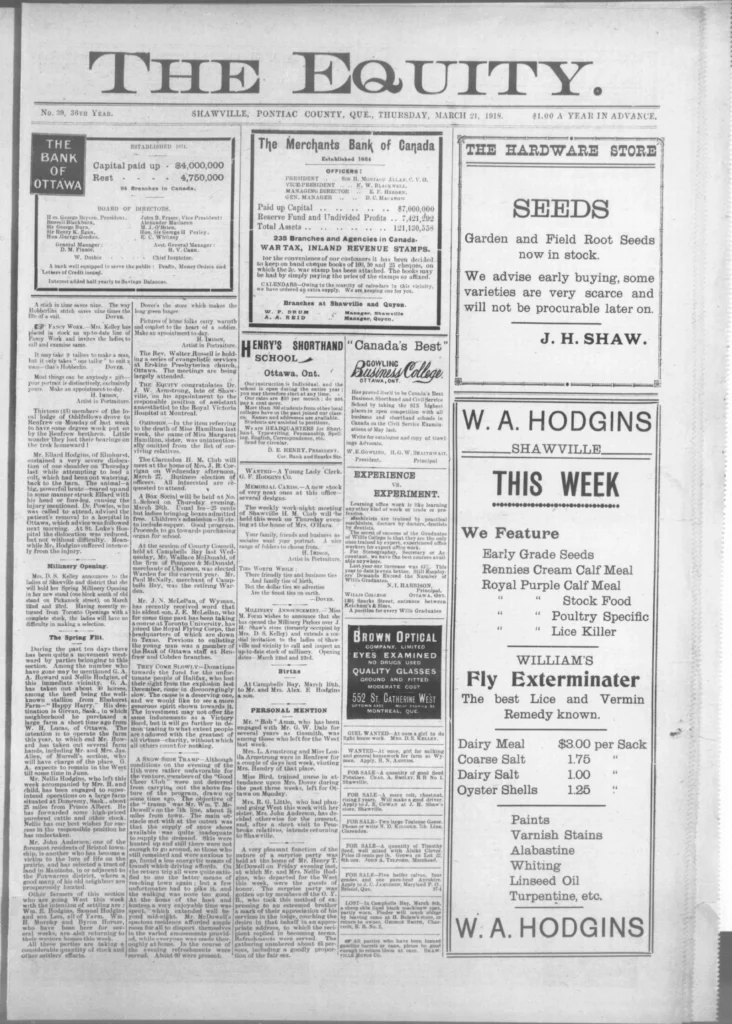
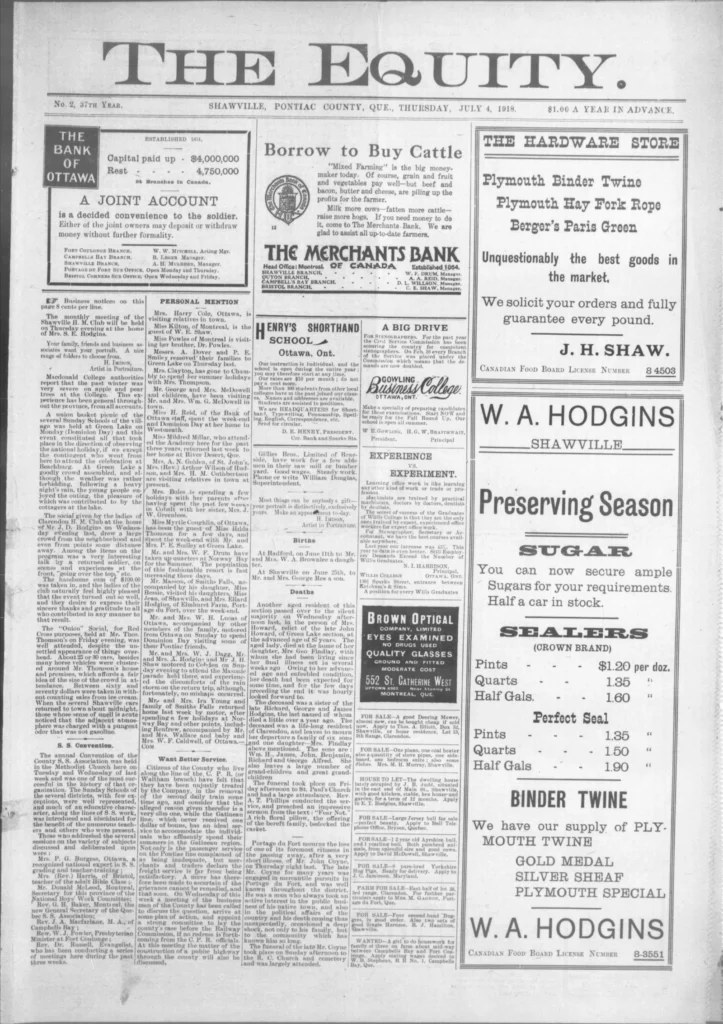
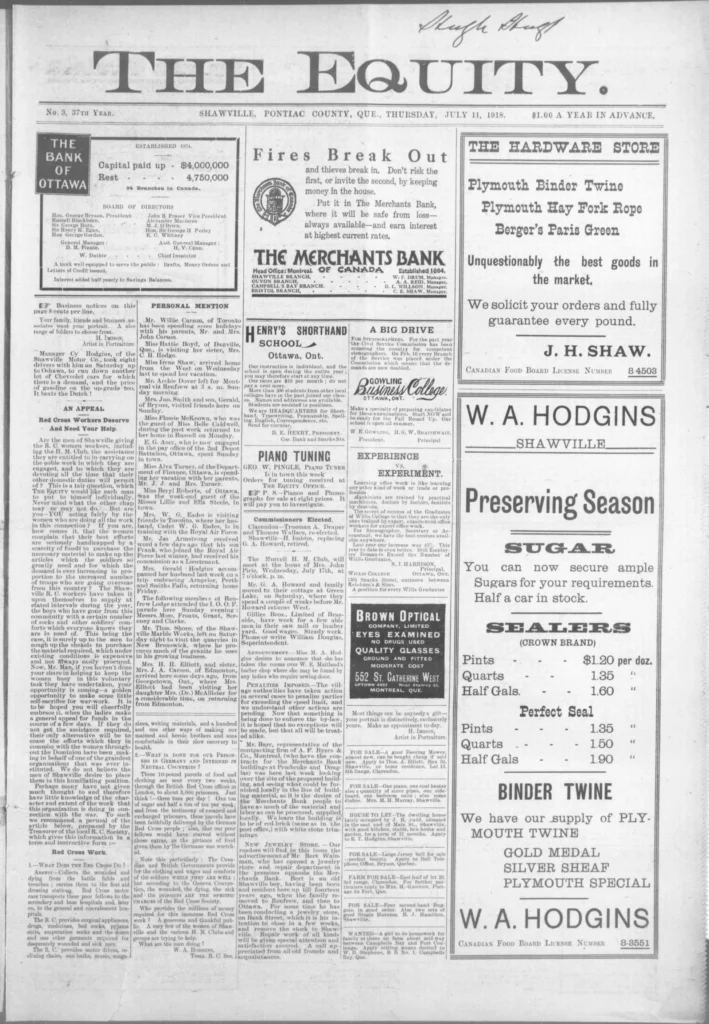
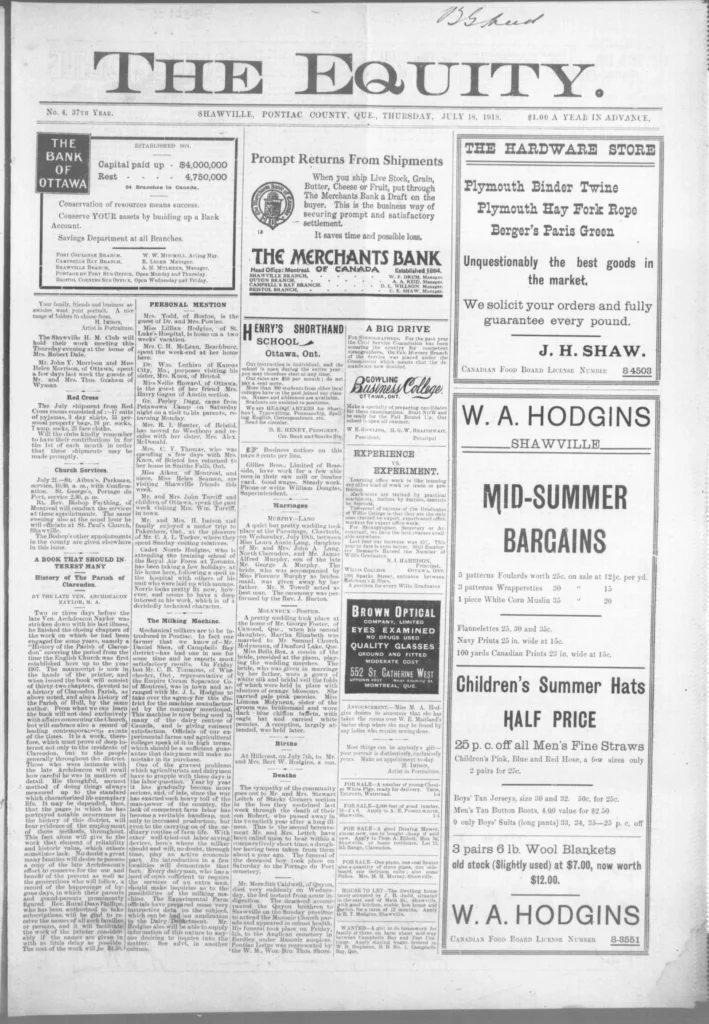
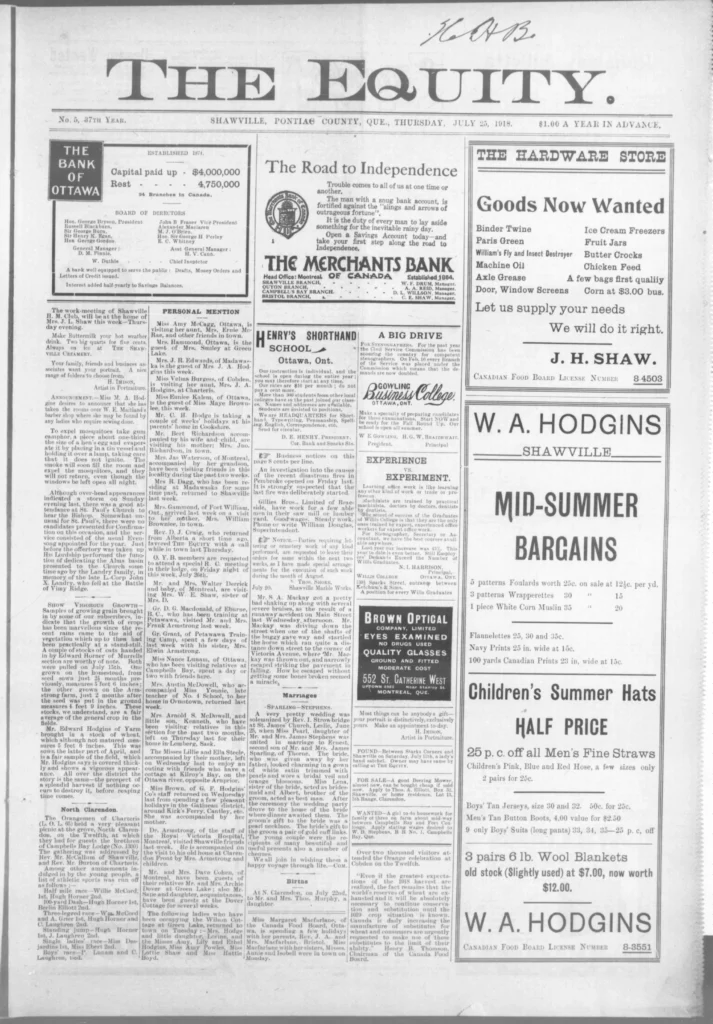
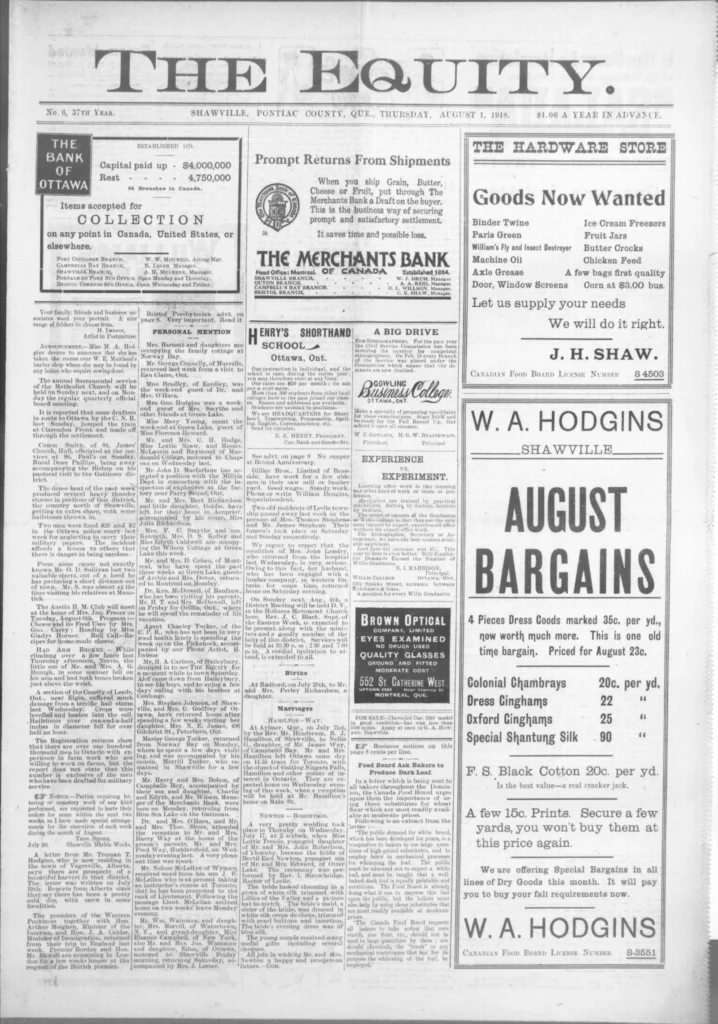
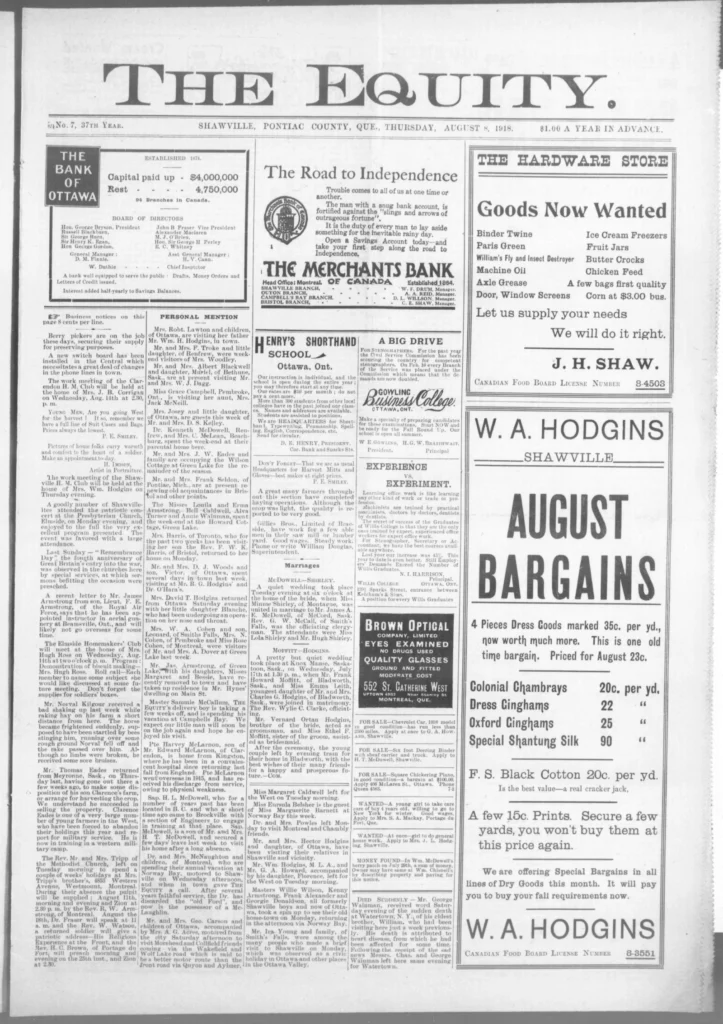
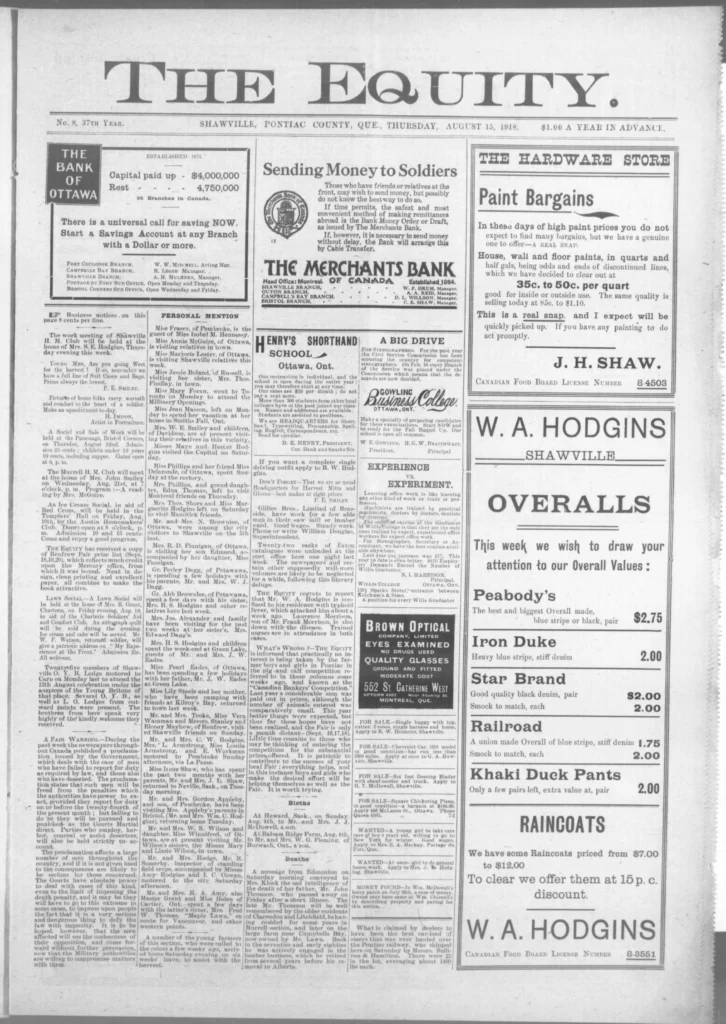
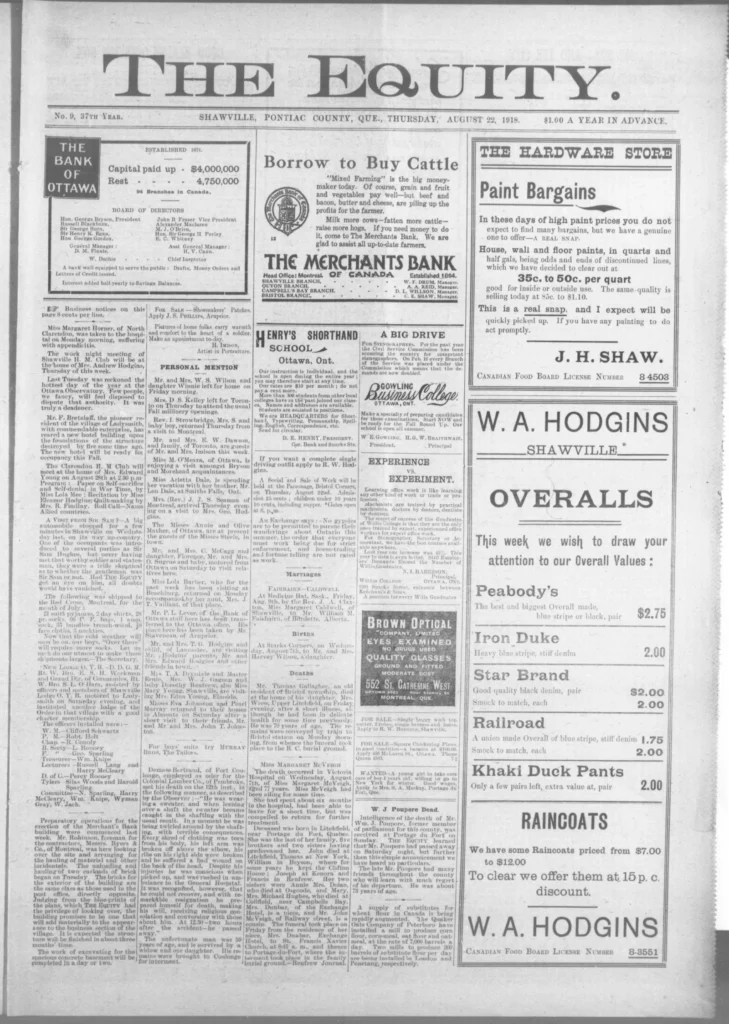
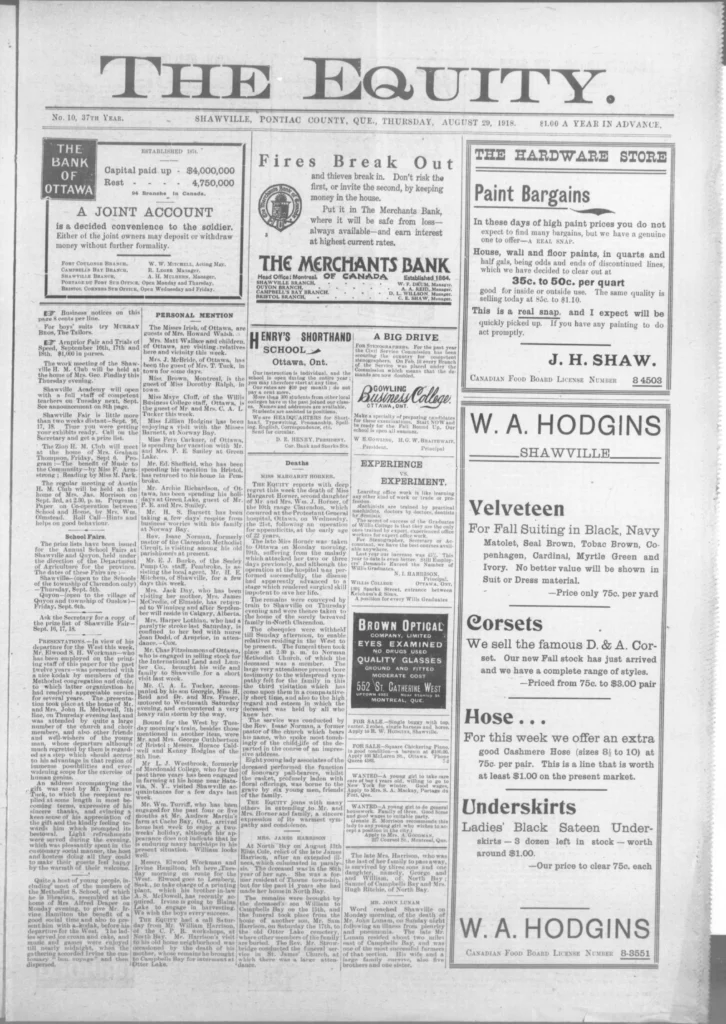
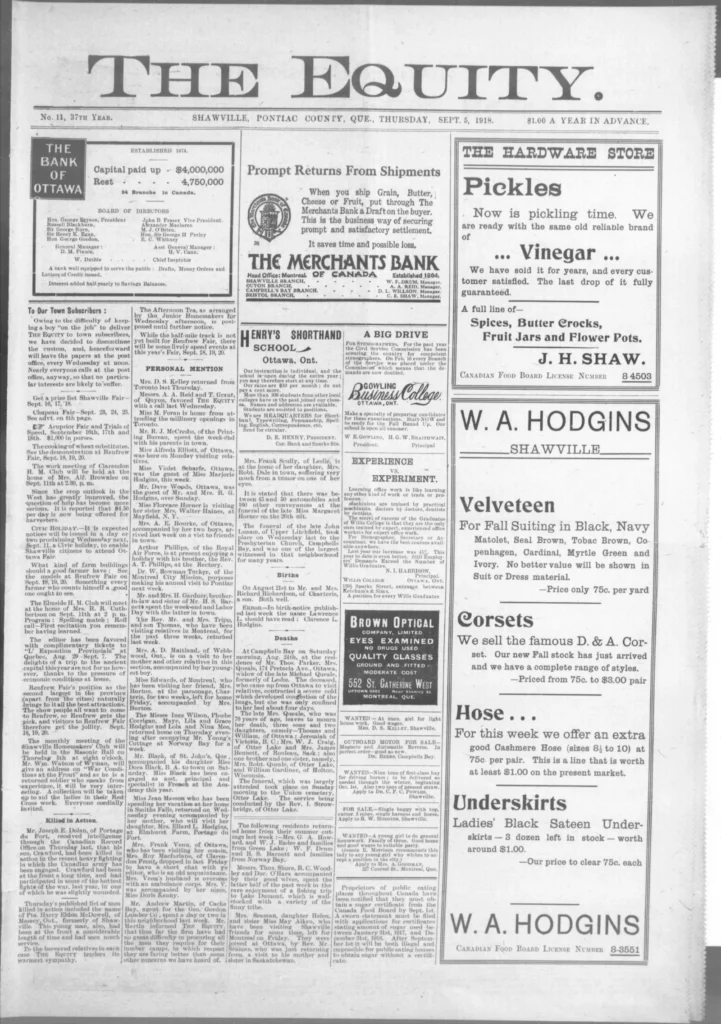
Below are the original copies of The Equity from this part of the War. Click any of them to download a PDF copy.