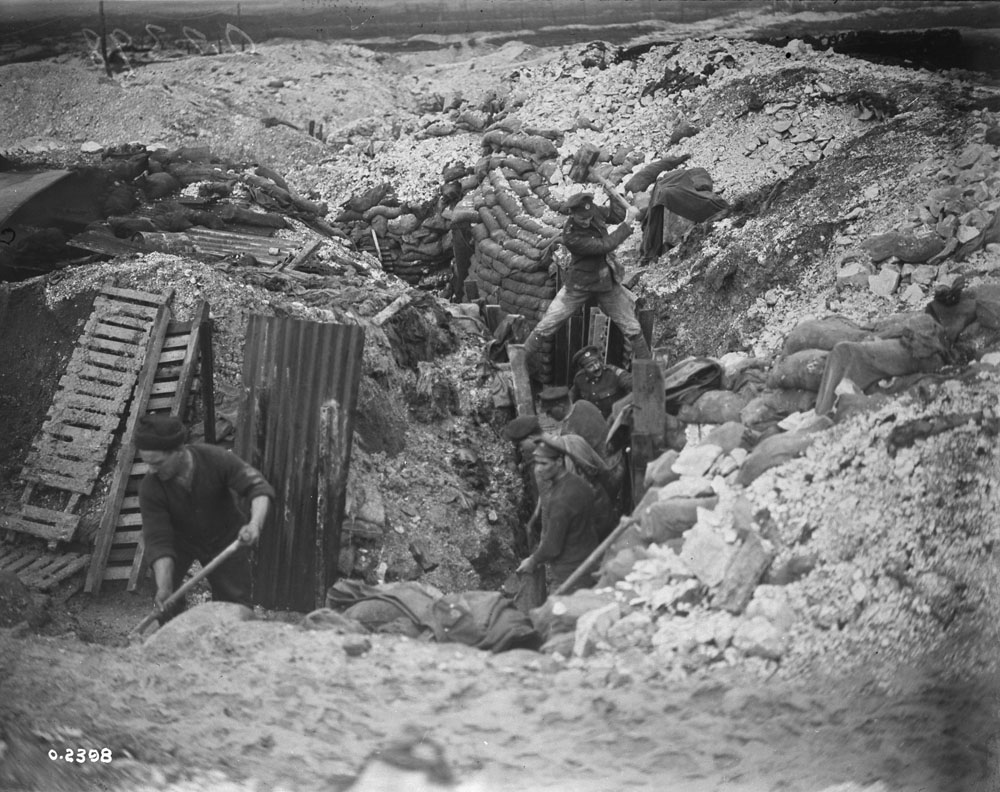
Canadians repairing a trench near Lens. January, 1918, Credit: Canada. Dept. of National Defence/Library and Archives Canada
The winter of 1918 brought the Pontiac to a moment of grave endurance and anxious resolve. The previous year’s divisions lingered sharply, yet the tone across The Equity reflected a community now resigned to total war — every home enlisted in the fight through conservation, taxation, and sacrifice. Patriotism had become both a daily discipline and a civic expectation. Editorials no longer spoke of victory as a distant hope but as a test of fortitude, insisting that only through collective restraint could Canada sustain the struggle to its end.
It now seems to be the general belief of Allied military authorities that the expected German drive on the Western front will be staged next month, but at what point or points is not yet clear. The British and French forces have their teeth set for the impending struggle, which is likely to be the fiercest and, maybe, the deciding battle of the war. Old Hindenburg has made the boast that he will be in Paris in April. What if the prediction should be verified and the old war-horse reach his goal under guard instead of as victor?
– Editorial, The Equity, February 21, 1918
Food conservation dominated household life. Canada was asked to release one-fifth of its wheat supply to the Allies, and the mandate reached deep into local kitchens. Families were instructed to bake “war breads,” combining wheat with corn, oats, barley, or rye. The rhetoric was moral as much as practical — waste was “unpatriotic,” and each home was called to a “voluntary pledge of sacrifice.” Rationing brought this duty into sharp focus: the allowance of sugar was fixed at one and a half pounds per person per month, and substitutes for meat and fats were widely promoted. The effort extended beyond compliance; it became a symbol of loyalty. Housewives in Shawville and Fort-Coulonge alike joined Homemakers’ Clubs to share recipes for substitute flours and discuss methods to stretch scarce ingredients, demonstrating a quiet, bilingual solidarity even as national politics strained those same ties.
"War Bread" Recipes
Recipe
Ingredients
Instructions
Raisin Bread
1 ½ cups rye flour
2 cups graham flour
½ cup dark corn syrup
1 tablespoon fat
yeast
¼ cup lukewarm water
¾ cup hot water
1 teaspoon salt
¾ cup raisins
Pour hot water over syrup, fat and salt. When lukewarm add yeast softened in lukewarm water. Add flour gradually, stirring well after each addition. Add raisins, stir well. Let rise until double in bulk. Beat. Turn into a greased pan. Let rise until almost double in bulk. Bake in a moderate oven for about one hour.
Bread Crumb Bread
1 cup milk
⅝ cup warm water
1 ⅔ cup dry bread crumbs
1 tablespoon corn syrup
yeast
1 ½ teaspoons salt
1 ½ tablespoons fat
1 cup graham flour
1 ⅓ cup white flour
Pour scalded milk over syrup, salt and fat. Add 2-3 cup water. When lukewarm add yeast softened in remainder of water (1-3 cup). Stir; add bread crumbs. When softened, add flour gradually and knead on floured board. Let rise until double in bulk. Knead lightly and shape into loaves. Let rise until double in bulk. Bake in a moderate oven one hour.
Originally printed in The Equity, January 24, 1918.
The local councils reinforced this spirit of service through organized generosity. Clarendon Council voted $2,000 to the Canadian Red Cross and $1,700 to the Canadian Patriotic Fund — significant sums for a rural county. Fundraising became a communal rhythm: literary evenings, hockey matches, and socials directed their proceeds toward Red Cross work and the Soldiers’ Tobacco Fund.
Donations were also gathered for those blinded in the Halifax explosion, linking Pontiac’s charity to a broader national grief. The Equity encouraged families to send portraits to loved ones overseas, reminding readers that “pictures of home folks carry warmth and comfort to the heart of a soldier.”
Economic hardship deepened under the twin pressures of labor shortages and federal regulation. With so many men enlisted, farms struggled to meet production quotas. Agricultural officials urged Pontiac farmers to defy the old notion that wheat could not thrive in Quebec soil, challenging each to cultivate at least three to five acres for the war effort. The shortage of labor extended beyond the fields — a scarcity of woodcutters created a local fuel crisis, driving up prices and leaving many without winter firewood.
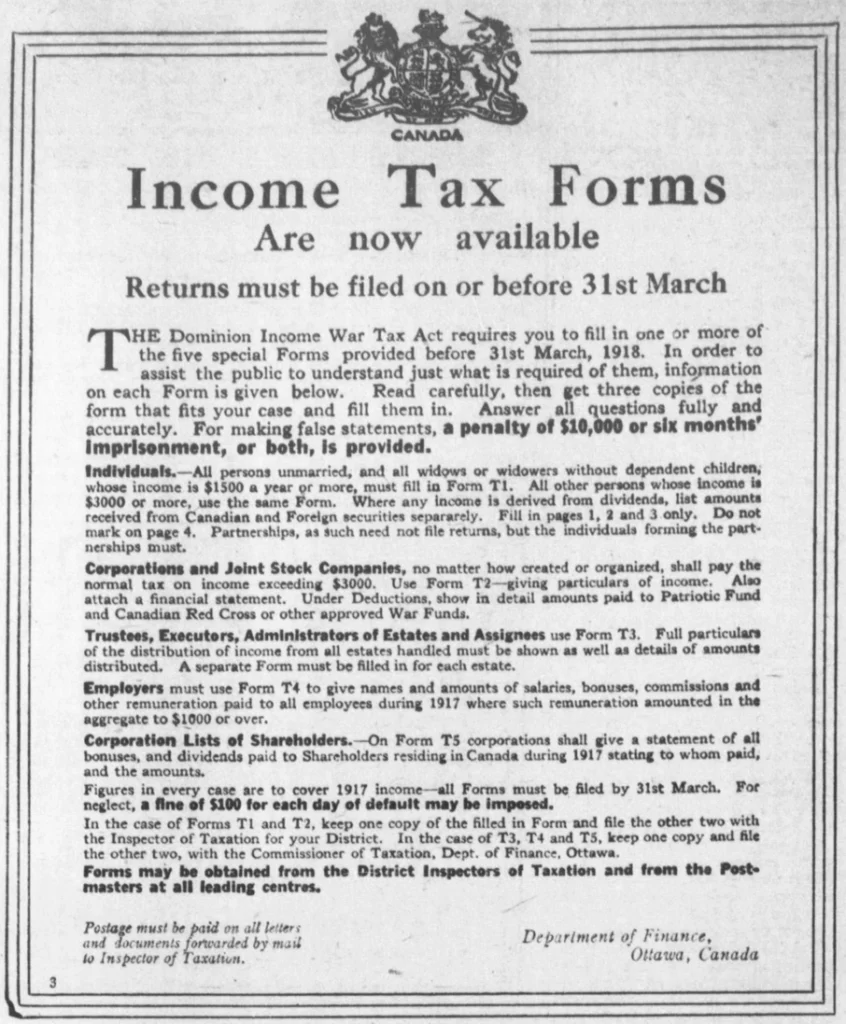
The government’s fuel order, mandating the temporary closure of businesses to save coal and light, frustrated residents who traveled long distances to find Shawville shops shuttered. Adding to the strain, Ottawa introduced the Dominion Income War Tax Act, requiring citizens and corporations to file returns by March 31st — a new intrusion of wartime bureaucracy into private life.
Reminder about the first income tax, printed March 21st, 1918.
The war’s human dimension was ever-present. The mother of Private John N. Landry, who had fallen at Vimy Ridge the year before, received his identification disc and a ring he had fashioned from a shell fragment — a painful reminder of loss and remembrance.
News of the wounded and returning soldiers continued: Driver Kurt L. Mackay was reported injured in France, while Corporal Harold Armstrong returned home from the front to a warm welcome. Letters from the trenches, such as Sergeant Jason Smart’s account of “mud, rain, and endless waiting,” kept the community tethered to the distant front. Meanwhile, enlistment and agricultural service continued hand in hand — young men like W. A. Craig and his son Harry left for military camp, while others, such as G. A. Howard and Nellis Hodgins, moved west to operate large farms, their work framed as part of the national campaign to feed both soldiers and allies.
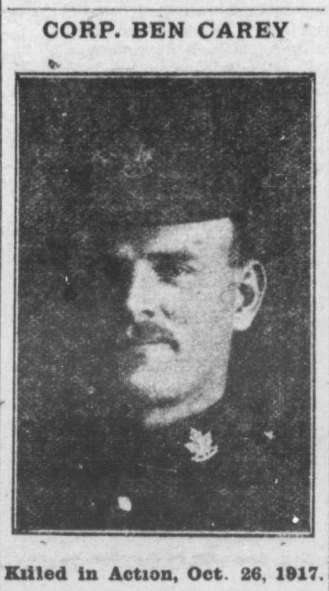
Photo published in The Equity in January, 1917.
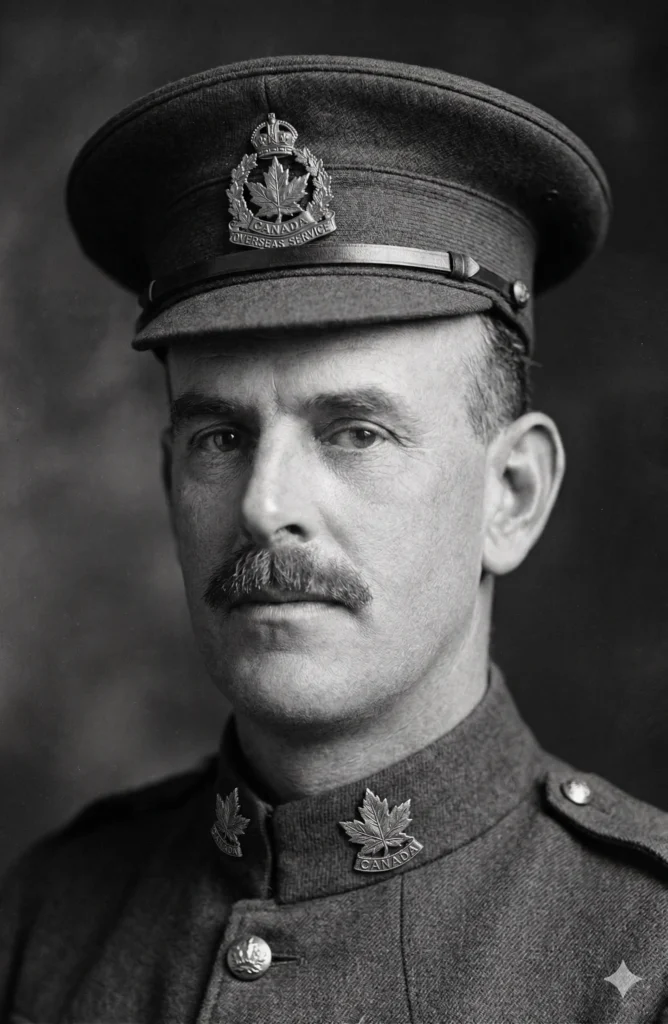
Photo of Ben Carey, reimagined by AI.
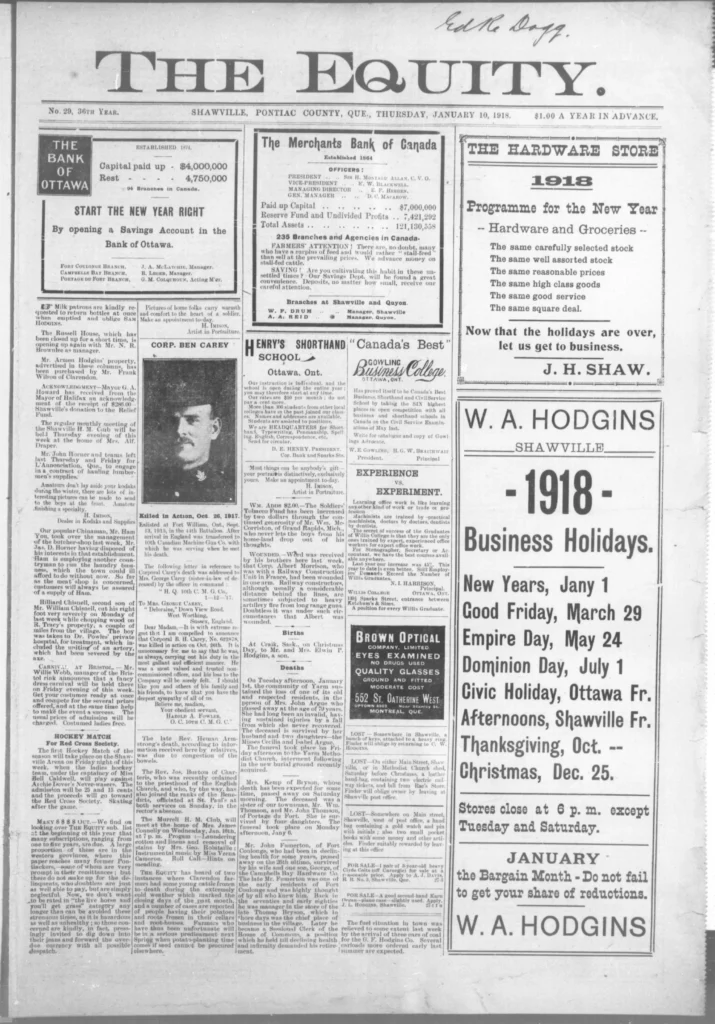
In January, readers of The Equity learned about the death of Corporal Ben Carey who had been killed in action in October 1917 at the Battle of Pashendale. His sister-in-law received a letter from the front.
Dear Madam,—It is with extreme regret that I am compelled to announce that Corporal B. H. Carey, No. 622878, was killed in action on Oct. 26th. It is unnecessary for me to say that he was, as always, carrying out his duty in the most gallant and efficient manner. He was a most valued and trusted non-commissioned officer, and his loss to the Company will be sorely felt. I should like you and others of his family and his friends, to know that you have the deepest sympathy of all of us.
Believe me, madam, Your obedient servant, HAROLD A. FOWLER, O. C. 10th C. M. G. C.
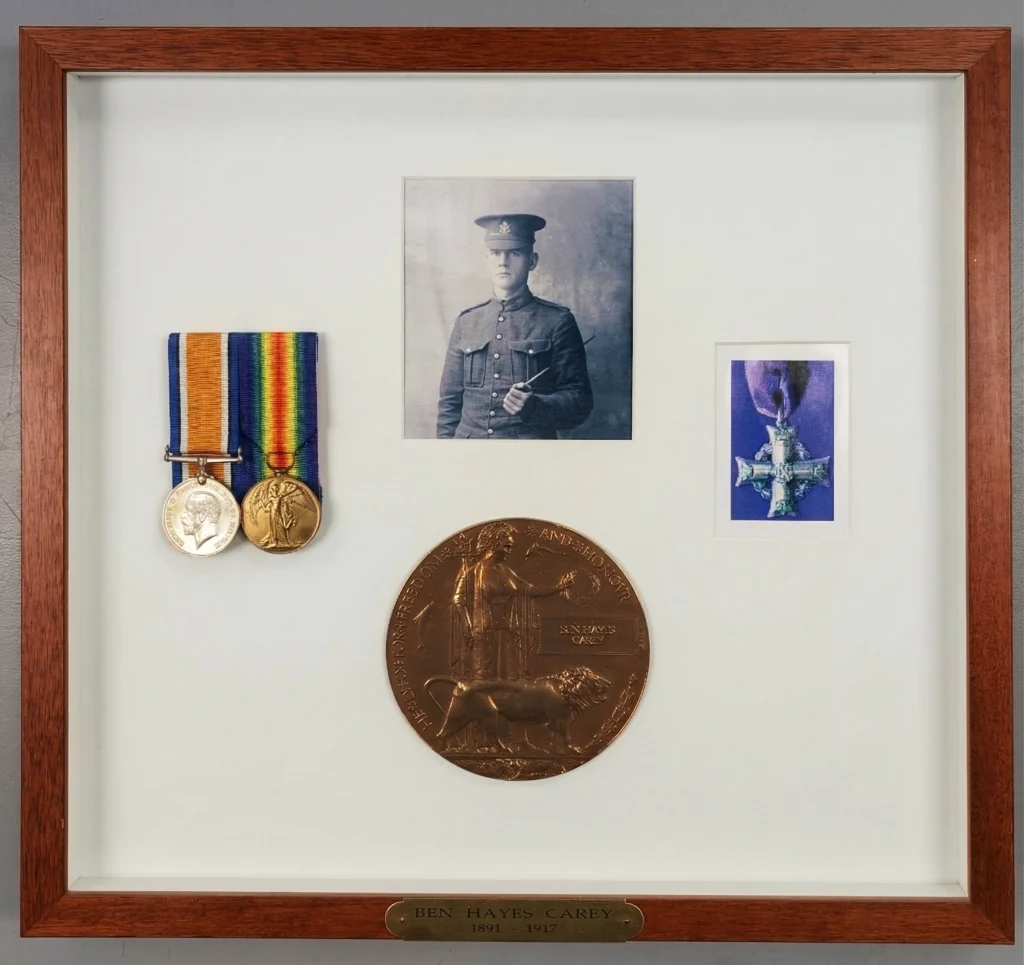
At the center is the bronze Memorial Plaque, known as the "Dead Man’s Penny," issued to the families of the fallen and inscribed with his name. To the left are his campaign medals: the British War Medal and the Victory Medal, a pair often awarded to those who served in the theaters of the Great War. On the right is a representation of the Military Cross, a prestigious decoration for gallantry in the field, which Carey earned before falling at the Battle of Passchendaele.
On display at the Pontiac Archives.
Politically, the province of Quebec remained restless and resentful in the wake of the 1917 conscription election. The Equity reported with unease on debates within the Quebec Legislature, including a motion that suggested the province might consider secession if it were viewed as a hindrance to national progress.
Though the motion failed, it revealed the depth of alienation. Laurierite newspapers floated the notion of an economic boycott against Ontario in protest of the conscription vote, further straining the federation’s unity. Yet, the paper also highlighted contrasting stories of cohesion — such as the service of over five thousand Indigenous soldiers from Algonquin and Iroquois communities, who fought “side by side in the same Indian units in France,” a rare example of unambiguous national solidarity amid fracture elsewhere.
By late March, the cautious optimism that had carried Pontiac through winter gave way to grim apprehension. News of the massive German offensive on the Western Front broke across the headlines, with the Equity warning that the situation was “certainly not of a cheering character.”
The editorials urged calm courage, calling it “the most critical stage of the ordeal.” What had begun as a season of enforced thrift and disciplined patience ended in anxious prayer. The hope that conscription and sacrifice might soon deliver victory was replaced by the sobering knowledge that the final reckoning was yet to come.
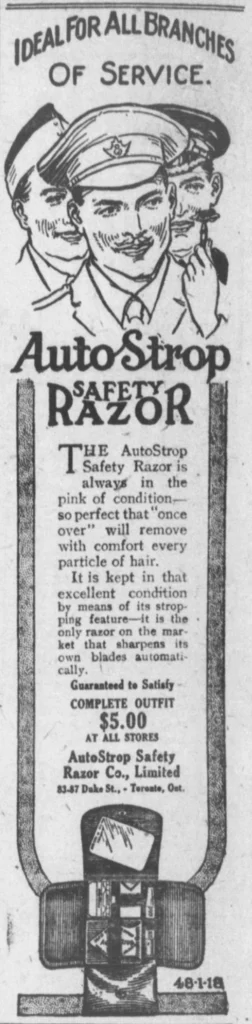
Advertisement appearing in The Equity, March 1918.
Soldiers Mentioned in The Equity
These names have been extracted from copies of The Equity by AI and may have mistakes. Please let us know if you catch any at jon@theequity.ca.
Mentioned
Soldier / Personnel
Status / Details
Jan 3, 1918
Thomson, Turner, & Horners
Ivan Thomson, Earl Turner, Noble Horner, and Raleigh Horner; all of the 74th Battery visiting as holiday visitors in town.
Jan 3, 1918
Miss Evelyn Brown
First Canadian girl chauffeur in the Canadian army; serving as driver and secretary to Colonel Godson-Godson.
Jan 3, 1918
Col. Godson-Godson
Severely wounded at Ypres; currently occupying the position of Provost Marshal of Canadians in England.
Jan 10, 1918
Corp. Ben Carey
44th Battalion; killed in action on October 26, 1917.
Jan 10, 1918
Albert Chisnell
10th M. G. Co.; reported as severely wounded.
Jan 10, 1918
Pte. H. Craig
Noted as a holiday visitor at home.
Jan 10 / 24, 1918
Sgt. W. J. & Corp. G. B. Carey
Serving overseas; both were presented with a purse.
Jan 10, 1918
J. C. Fitzpatrick
Serving in France; acknowledged receiving a tobacco gift.
Jan 17, 1918
Driver Earl L. Mackay
79th Battery; wounded and recovering at the Canadian General Base in France.
Jan 17, 1918
Capt. A. A. Mackay
42nd Highlanders; serving as regimental surgeon overseas.
Jan 17, 1918
L-Cpl. Harold Armstrong
73rd Highlanders; wounded and returned to his old home town.
Jan 17, 1918
The Delisle Brothers
Otto serving with a U.S.A. battalion; Bert and Walter (Loll) both killed in action in May/June 1917.
Jan 17, 1918
Pte. Edward Nicholl
Recently returned from overseas; found dead in bed at the Ottawa Hotel in Hull.
Jan 31, 1918
Pte. John X. Landry
4th C. M. R.'s; killed in action at Vimy Ridge last April.
Feb 7, 1918
Mark Ollerenshaw
Drafted in A-1 category but subsequently found unfit for military service and returned to civilian life.
Feb 7, 1918
Sister Mabel Hamilton
Nursing Sister on leave for several months; reporting at Kingston.
Feb 28 / Mar 21, 1918
Sergt. Jason Smart
Overseas in the trenches; winner of the Military Medal.
Mar 14, 1918
Lieut. Howard K. Reid, R. N.
Saved when his ship was torpedoed; currently awaiting orders in England.
Mar 14, 1918
Forrest Kidney
On active service with the signallers in France.
Mar 21, 1918
J. E. McLellan
Joined the Royal Flying Corps; headquarters located in Texas.
Listen to our Podcast!
We’ve used Artificial Intelligence to summarize what was covered in The Equity during this part of the Great War. Click the play button to listen.
00:00
Timelines: January - March 1918
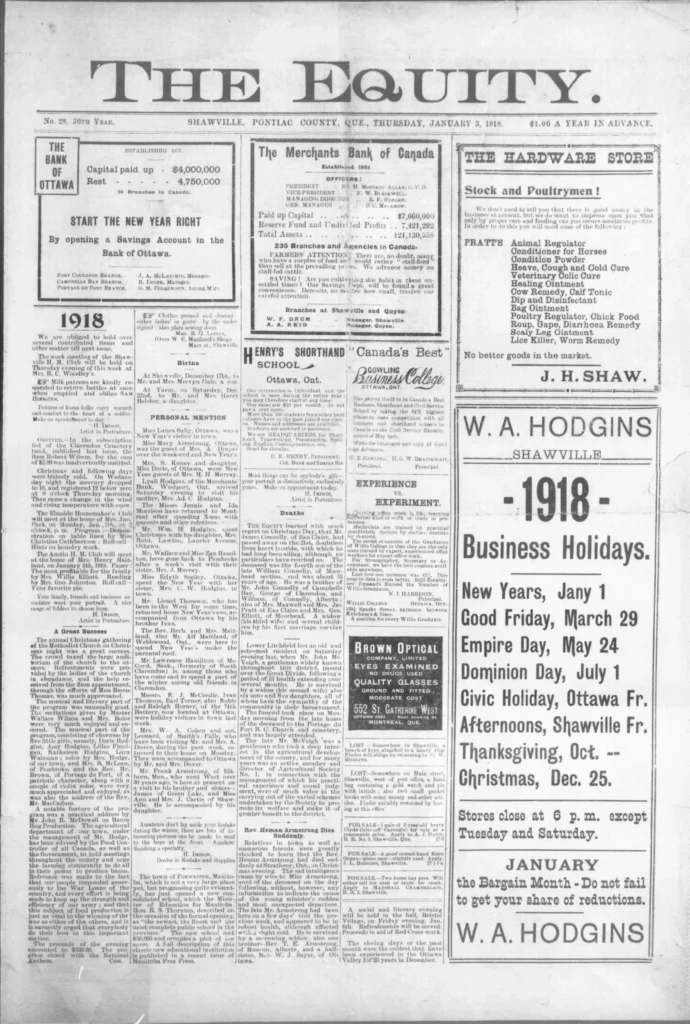
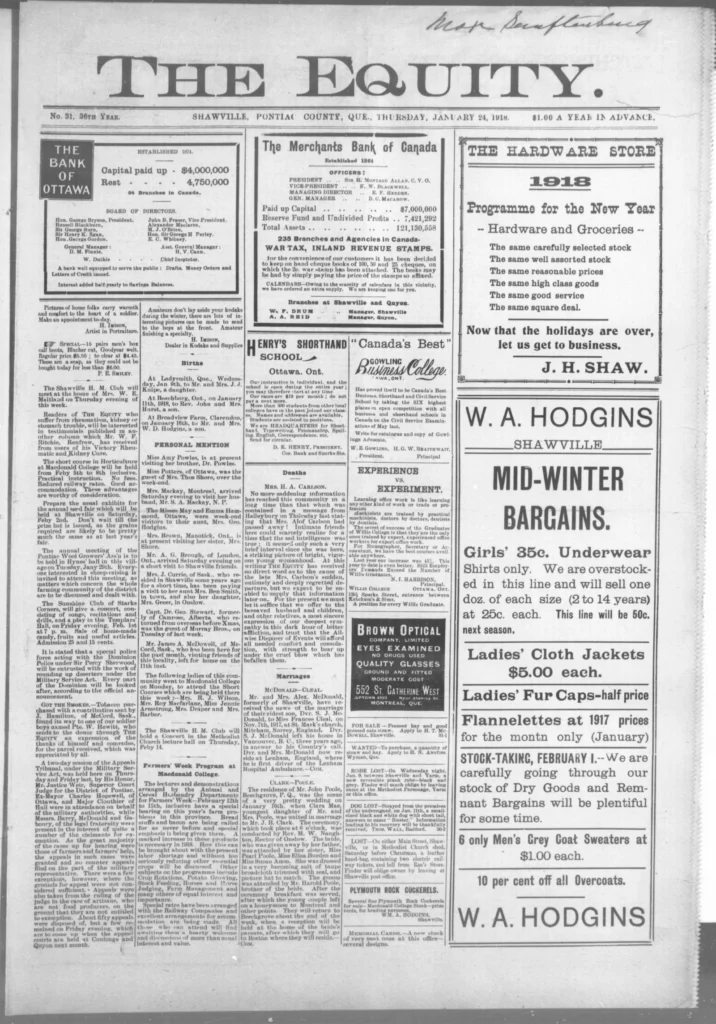
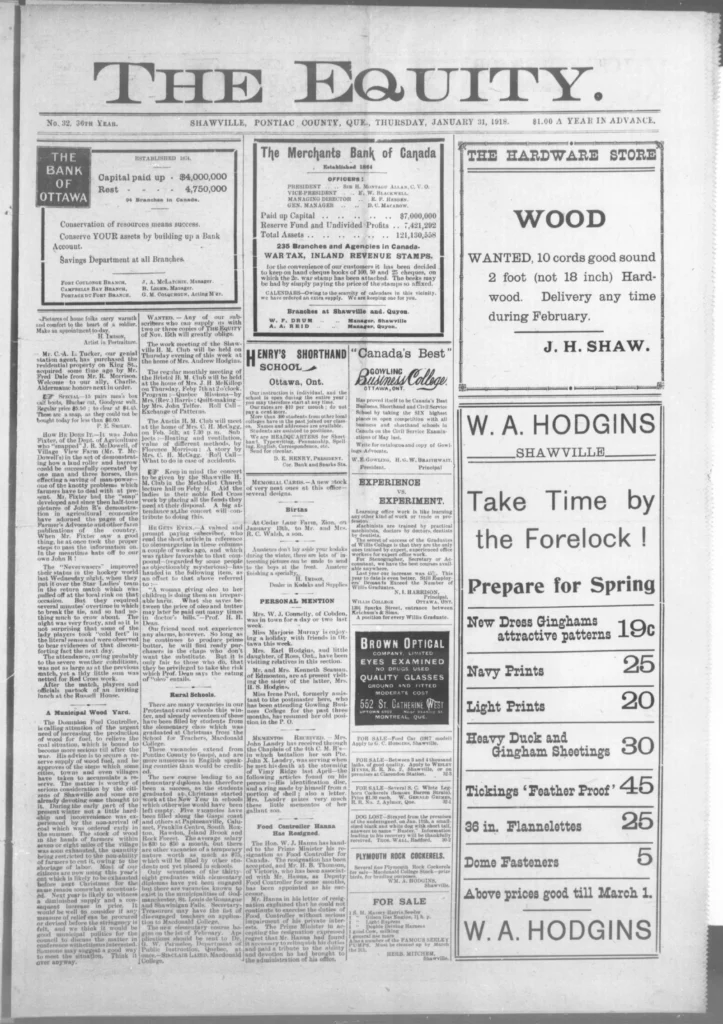
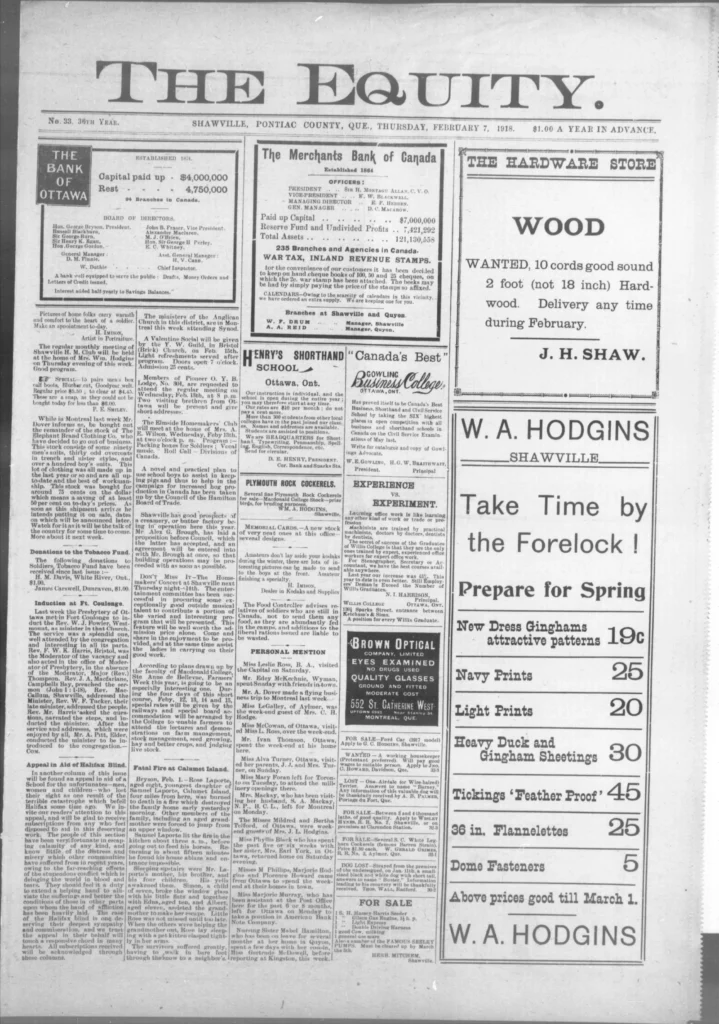
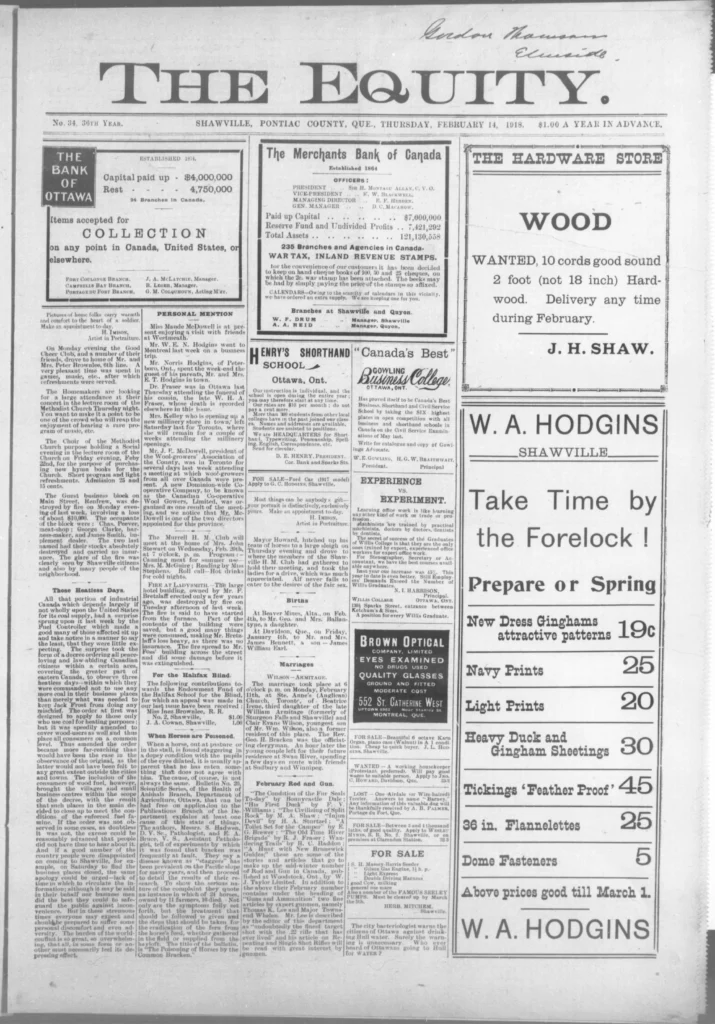
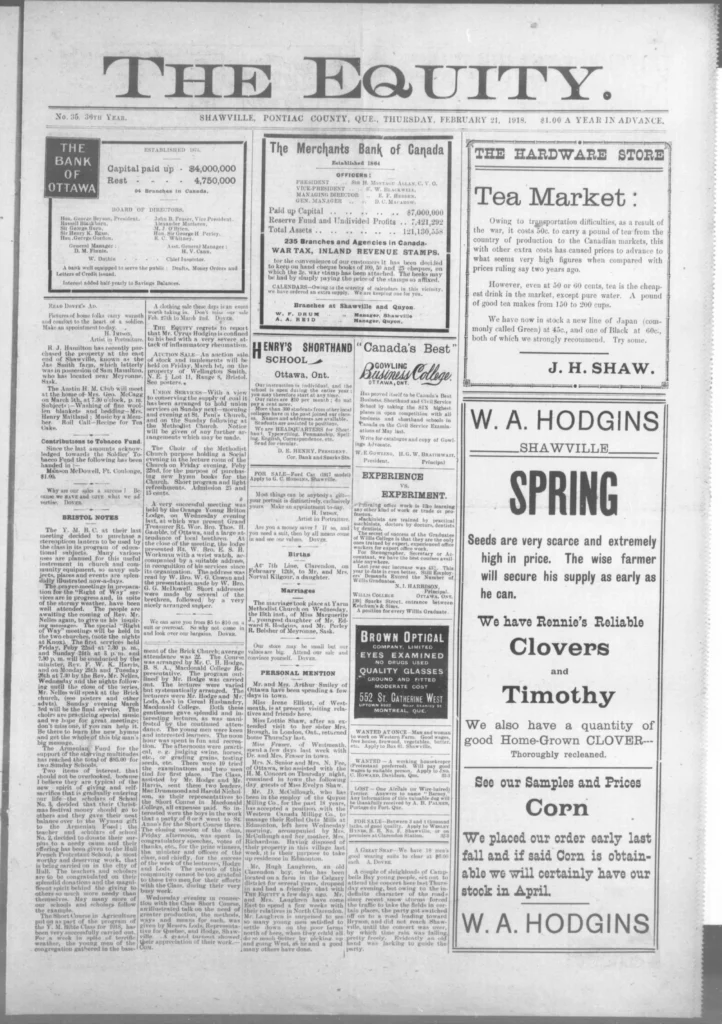
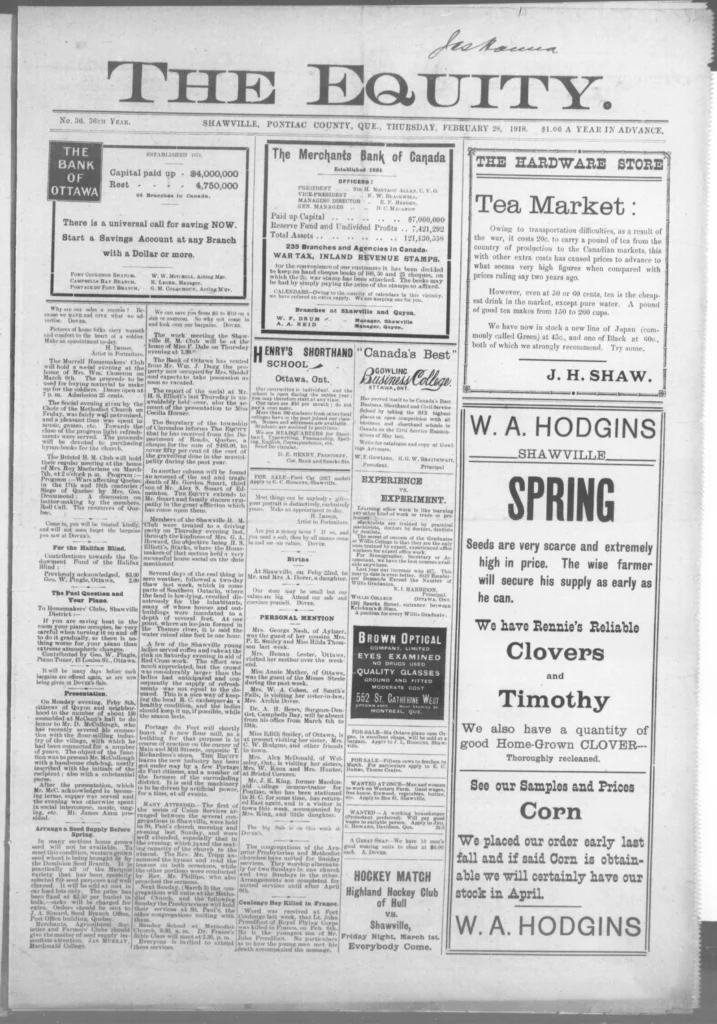
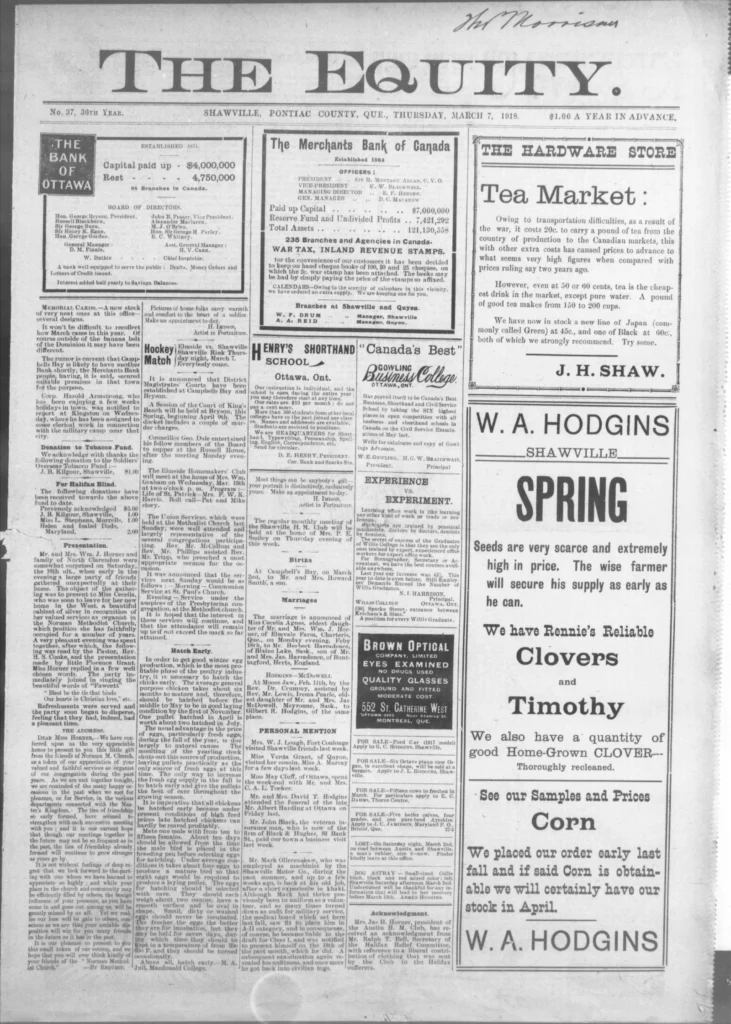
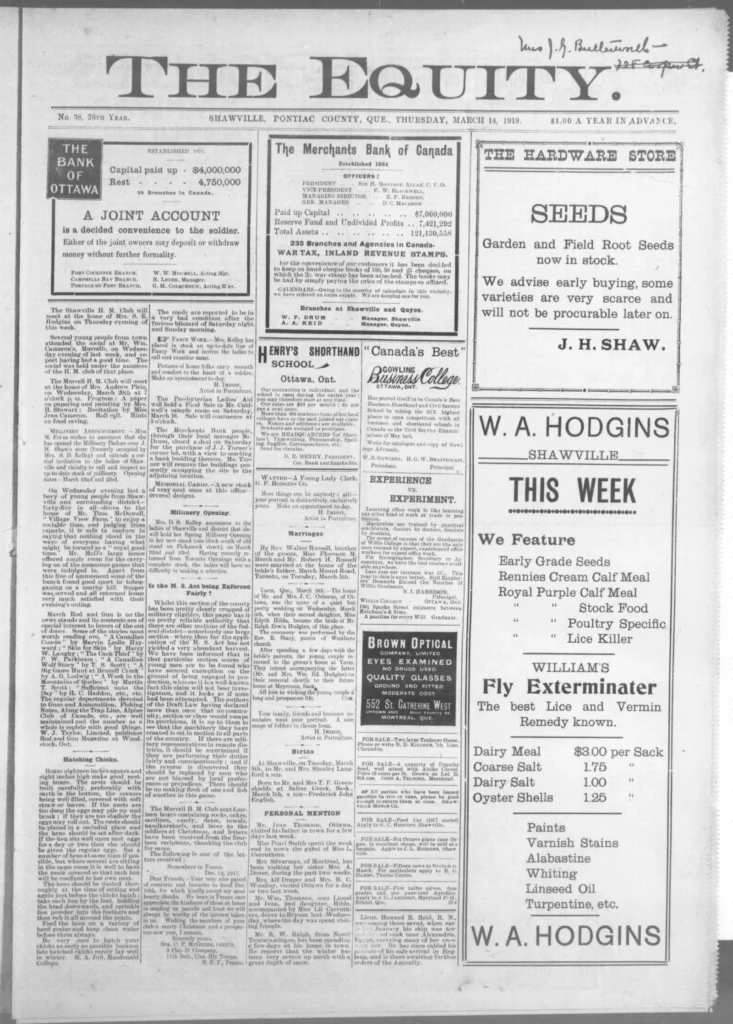
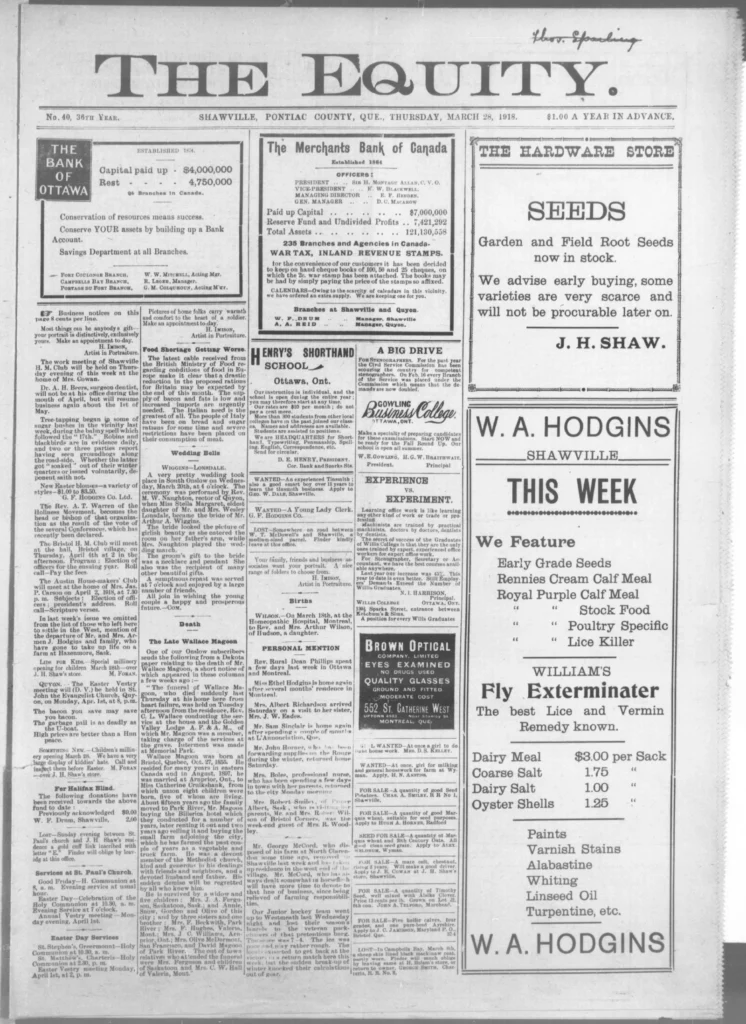
Below are the original copies of The Equity from this part of the War. Click any of them to download a PDF copy.