Winter 1916

The winter of 1916 in Pontiac County and the surrounding regions was exceptionally severe. The season set in heavily when “the heaviest snowstorm known for years fell on Christmas day.”  Extreme temperatures were recorded across the country; letters from former residents out West reported that it was “the coldest winter for thirty years,” with the thermometer registering 34 degrees below zero.

The harsh realities of the First World War were highly visible in the community as news of casualties arrived from the front. The community frequently mourned local men killed in action, holding memorial services for soldiers like Private David H. Hodgins. 

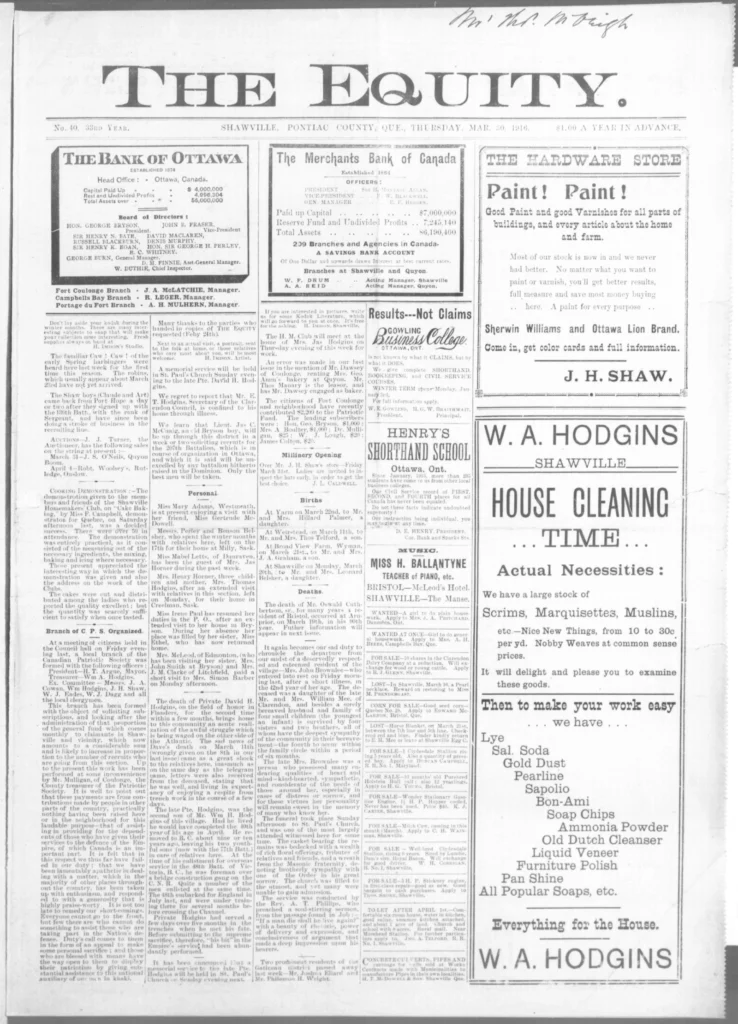
The death of Private David H. Hodgins, on the field of honor in Flanders, for the second time within a few months, brings home to this community an acute realization of the awful struggle which is being waged on the other side of the Atlantic. The sad news of Dave’s death on March 11th (wrongly given on the 8th in our last issue) came as a great shock to the relatives here, inasmuch as on the same day as the telegram came, letters were also received from the deceased, stating that he was well, and living in expectancy of enjoying a respite from trench work in the course of a few days.

The late Pte. Hodgins, was the second son of Mr. Wm H. Hodgins of this village. Had he lived he would have completed the 40th year of his age in April. He removed to B. C. about nine or ten years ago, leaving his two youthful sons (now with the 77th Batt.) in care of relatives here. At the time of his enlistment for overseas service in the 48th Batt. of Victoria, B. C., he was foreman over a bridge construction gang on the C. N. R. Quite a number of the men enlisted at the same time. The 48th embarked for England in July last, and were under training there for several months before crossing the Channel.

Private Hodgins had served a few days over five months in the trenches when he met his fate. Before submitting to the supreme sacrifice, therefore, “his bit” in the Empire’s service had been abundantly performed.

— The Equity, March 30, 1916

The papers also detailed the horrific nature of the combat and the sacrifices made by the troops, recounting stories such as that of Private James Harty, who gave his life in a “death of deliberate self-sacrifice” when he left his dug-out under heavy fire to rescue a wounded comrade.

On the home front, local residents organized to support the war effort through donations and continuous labor. The Homemakers’ Clubs were highly active in producing necessary clothing for the troops; the Bristol branch alone contributed “15 pairs wristlets… 60 handkerchiefs, 20 flannel shirts,” and numerous other hospital supplies. 

Citizens also sent regular financial contributions to the Red Cross and the Patriotic Fund. Furthermore, continuous appeals were made to the public to donate to the Over-Seas Club’s tobacco fund to provide “smokes for our Canadian soldiers,” with organizers warning that the shortage of tobacco in the trenches was “appalling.”

Recrutiment advertisement, February 3, 1916

The military actively addressed the county’s population through highly organized, localized recruiting campaigns. Recruiting officers, such as Captain Fisher, Lieutenant Bray, and Sergeant McLean, frequently visited the area to secure recruits for various overseas units, including the 130th and 136th Battalions. These efforts were marked by enthusiastic public gatherings, such as a heavily attended meeting at the Russell House, where organizers sought out “picked men” for specialized roles like painters, cyclists, and dispatch riders. 

The military also leveraged local connections to encourage enlistment, sending Lieutenant James C. McCuaig, a former Bryson resident, to solicit volunteers for the 207th Battalion. Specialized units canvassed the region as well; for instance, recruiters for the Forester’s battalion came to Shawville and Campbell’s Bay looking for men experienced in cutting timber to assist with overseas trench and bridge building.

Simultaneously, the military recognized the linguistic and cultural divide by forming specific French-speaking units to appeal to French-Canadian patriotism. Lieutenant Alban de Loderriere, representing the 57th French-Canadian Battalion out of Hull, actively canvassed the Fort Coulonge vicinity and successfully enrolled local men for his unit. 

On a broader provincial scale, the war effort even temporarily bridged sharp political divides. The press noted the prominent example of Olivar Asselin, a “brilliant advocate of the Nationalist creed” and former editor of Le Nationaliste, who put aside his political differences to raise and lead a French-Canadian fighting unit known as the 163rd, or “Asselin’s Battalion”. 

Sketch from The Equity, January 13, 1916 (Cleanedup with AI). Caption: THE Boy on the Rails: 'i Jellicoe! If you're going down again, you might 'ave a look fer my knife, will yer? It's got two blades an' a brown 'andle.—London Sketch.

Despite the toll of the war and the harsh winter, routine civic and agricultural life persisted. Local towns maintained an organized hockey league, and farmers gathered at the Shawville Seed Fair to inspect exhibits of “Red and White Fife Wheat” and “Banner Oats,” ensuring they had clean, high-quality seed ready for the spring planting.

Soldiers Mentioned in The Equity

These names  have been extracted from copies of The Equity by AI and may have mistakes.  Please let us know if you catch any at jon@theequity.ca.

Mentioned Soldier / Personnel Status / Details
Jan 6, 1916 Norman & Ben Smith Sons of Ben Smith; enlisted together in Ottawa with the 77th Battalion.
Jan 6 / 27, 1916 Orval Armstrong Son of Silas Armstrong; enlisted with 120th Battalion. Later served with Army Service Corps, Toronto.
Jan 6, 1916 "Nick" Carter Celebrated local lacrosse player ("The Rocks"). Died of meningitis at Salisbury training camp.
Jan 6, 1916 Capt. Leon Curry 42nd Battalion. Killed by a German shell within two minutes of entering the trenches for the first time.
Jan 27, 1916 Pte. R. V. Anderson 21st Battalion (Front). Wife notified that his eyes were badly affected by enemy gas.
Feb 3, 1916 Pte. James Harty Died in an act of self-sacrifice, leaving cover under heavy fire to reach a wounded comrade.
Feb 3, 1916 Mid. Howard E. Reid Portage du Fort; serving on H.M.S. "Berwick." Returned home for holiday.
Feb 10, 1916 Dr. Henry Argue Medical officer to a Canadian unit at the front in Flanders.
Feb 24, 1916 Lieut. F. V. Murtagh Recruiting officer for the 156th Battalion.
Mar 2, 1916 Rev. Jas A. Elliott Former Shawville resident; serving as Chaplain of the 136th Battalion.
Mar 9, 1916 Erwin Hodgins Enlisted with the 136th Battalion in Cobourg; honored with a surprise party by friends.
Mar 16, 1916 136th Batt. Recruits Large group of Pontiac men (36 listed including W. Buck, G. Munro, C. Reaney) signed with Capt. Fisher.
Mar 23, 1916 Lt. A. de Loderriere Enrolled 15 men from Fort Coulonge for the 57th French-Canadian Battalion.
Mar 30, 1916 C. & A. Shaw Brothers; both Sergeants in the 136th Battalion who returned to Shawville to assist in recruiting.
Mar 30, 1916 Pte. David Hodgins Killed in action in Flanders, March 11. Left a wife and four children after five months in the trenches.
Mar 30, 1916 Emmerson Paul Sent to the front after winning shooting and signalling honors in England.
Mar 30, 1916 R. & G. Horner Sons of J. B. Horner; joined the 101st Battalion, C.E.F.

Listen to our Podcast!

We’ve used Artificial Intelligence to summarize what was covered in The Equity during this part of the Great War. Click the play button to listen.

00:00

Timelines: January - March 1916

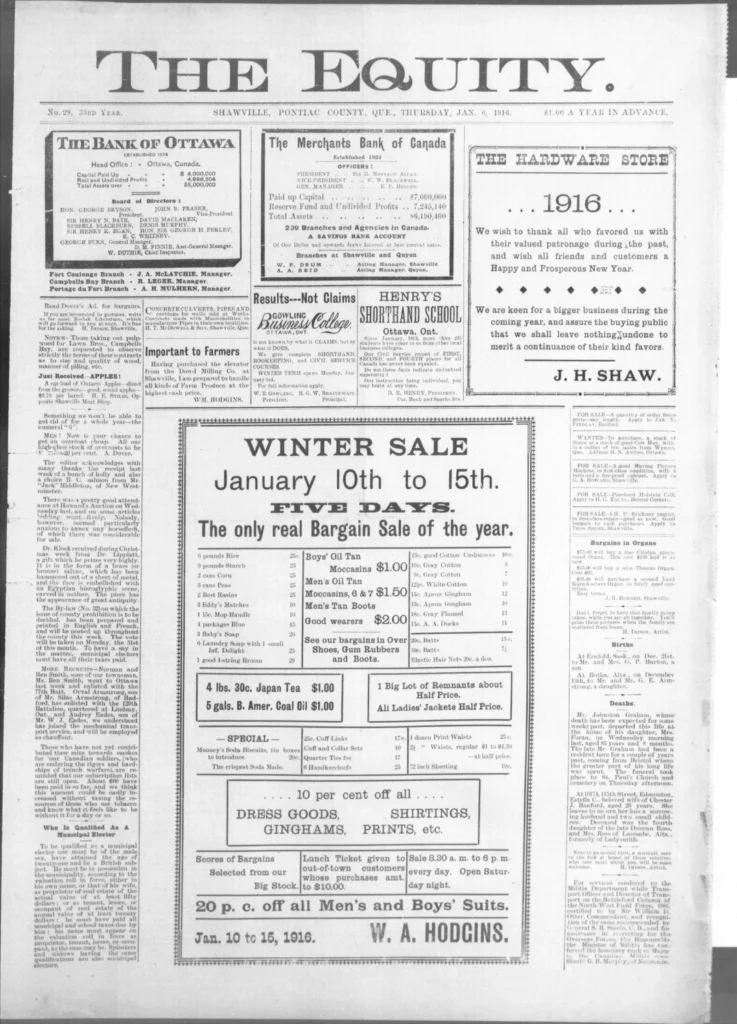
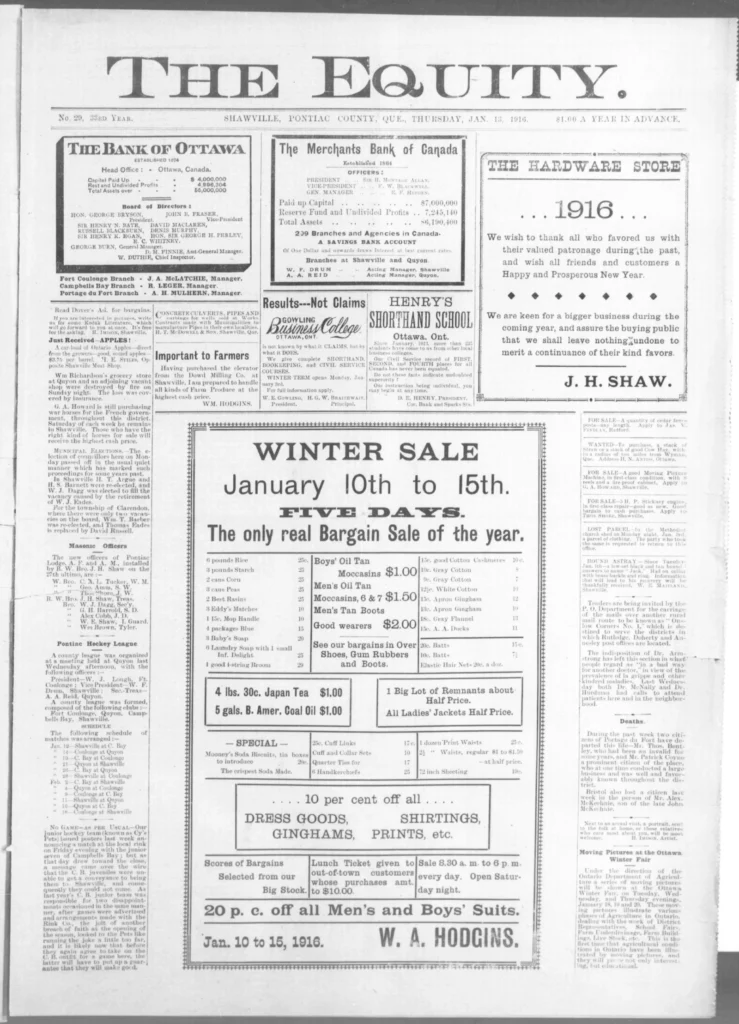
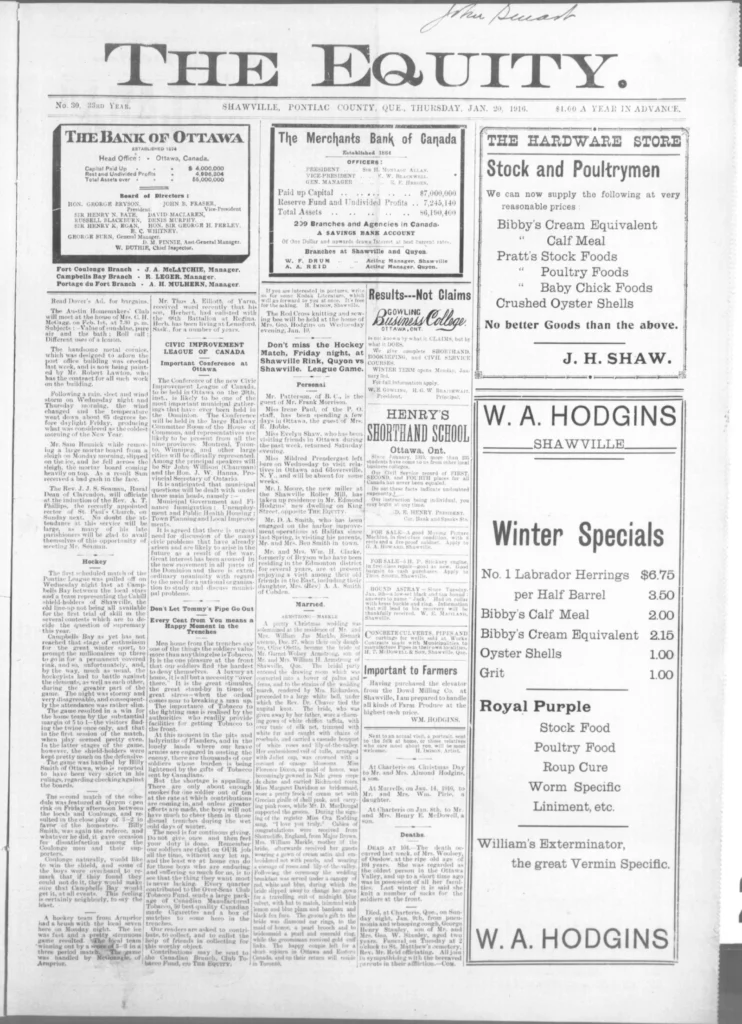
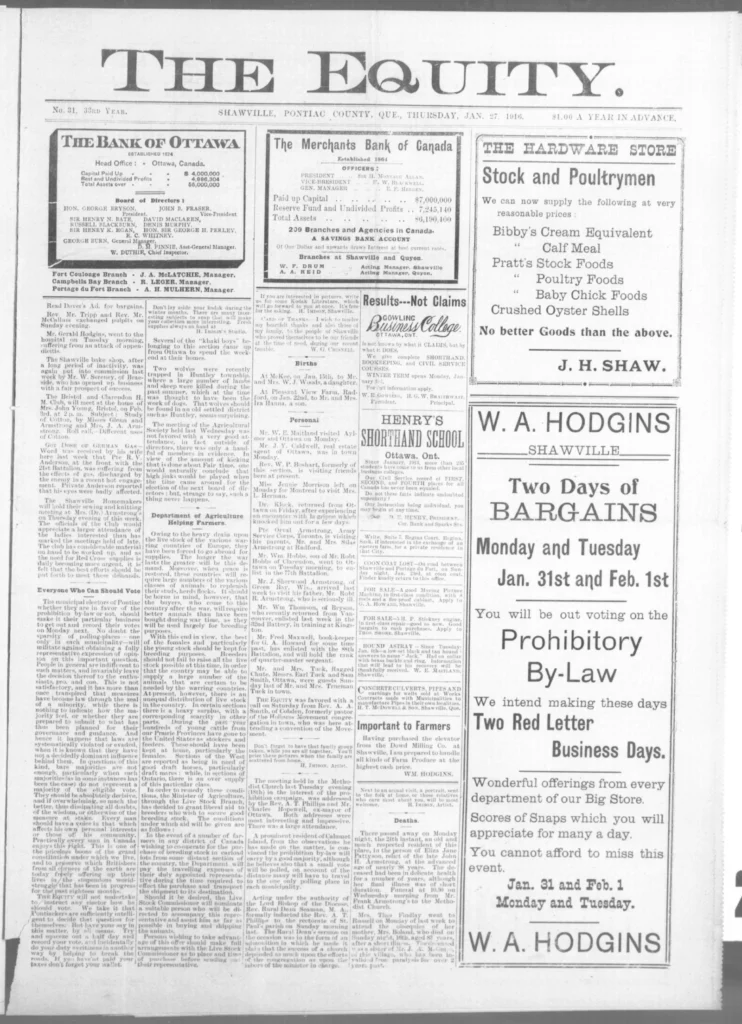
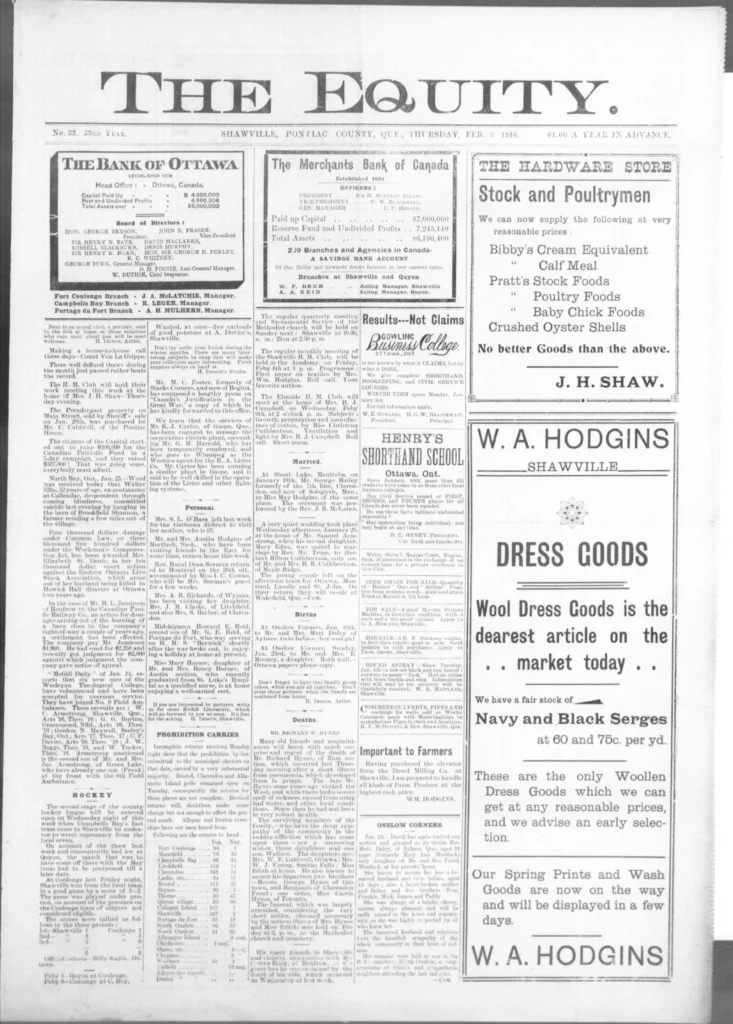
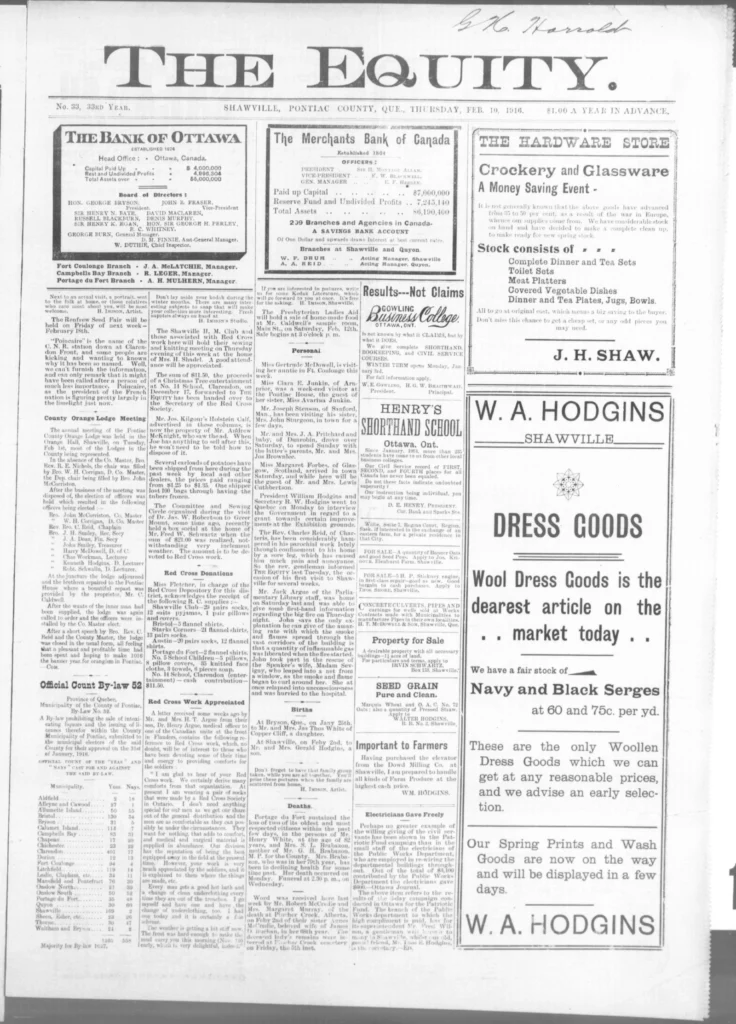
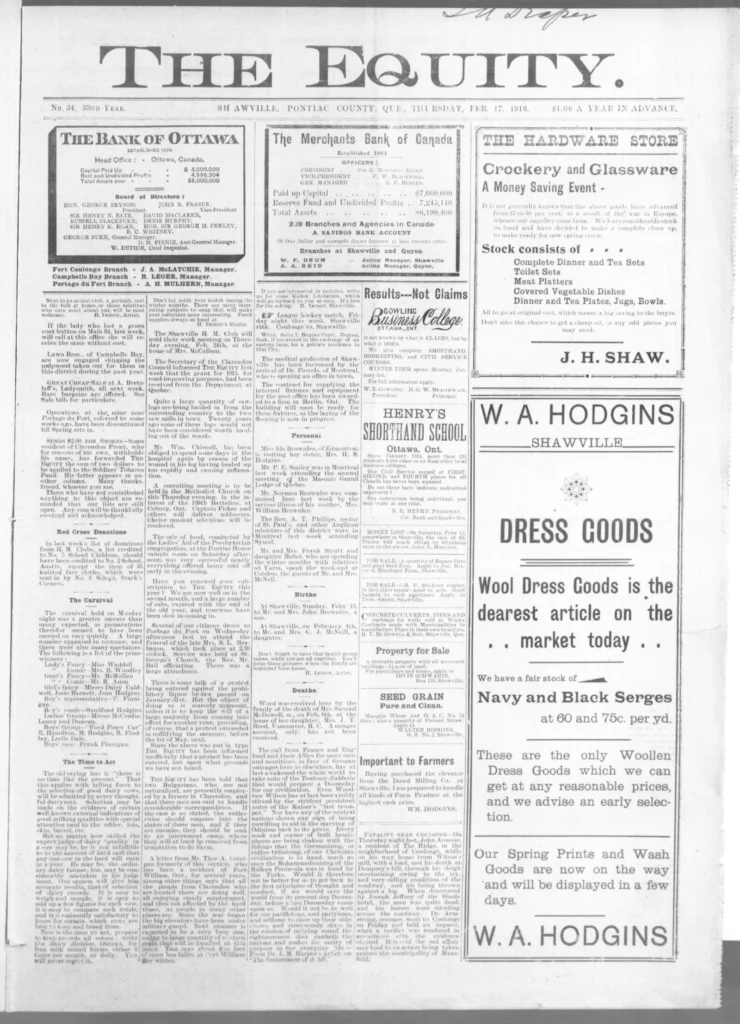
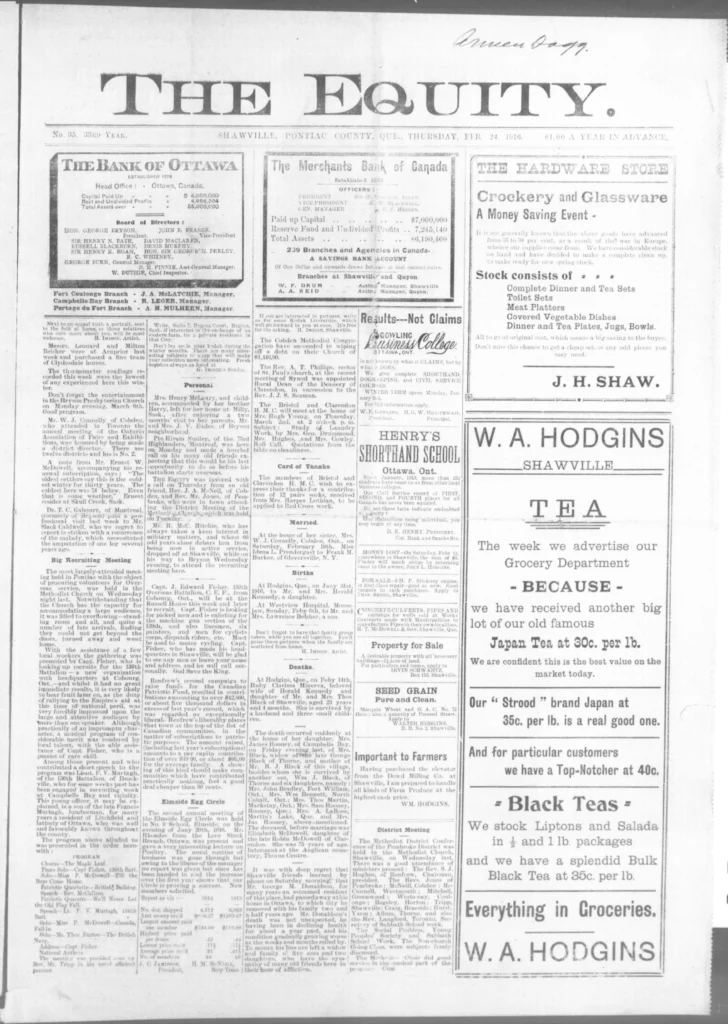
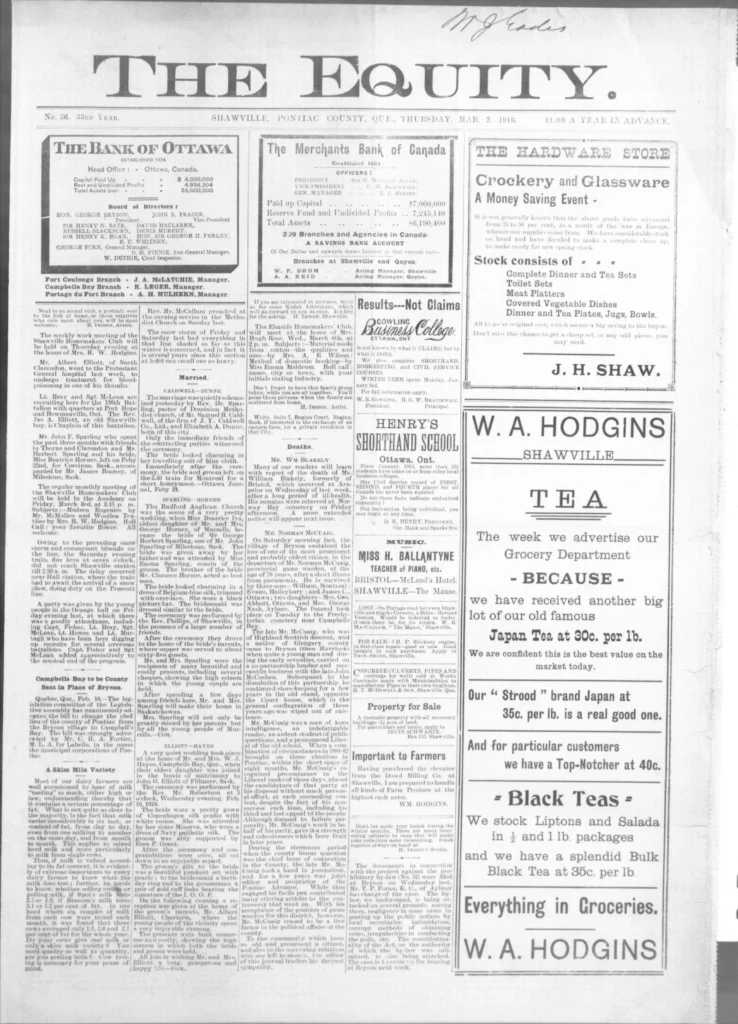
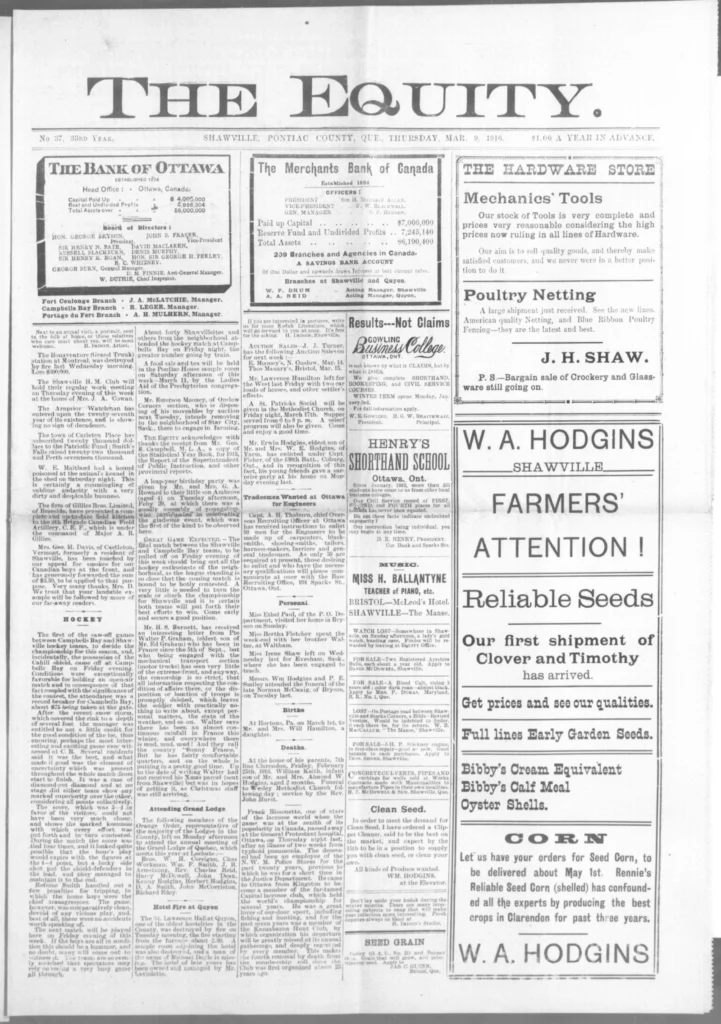
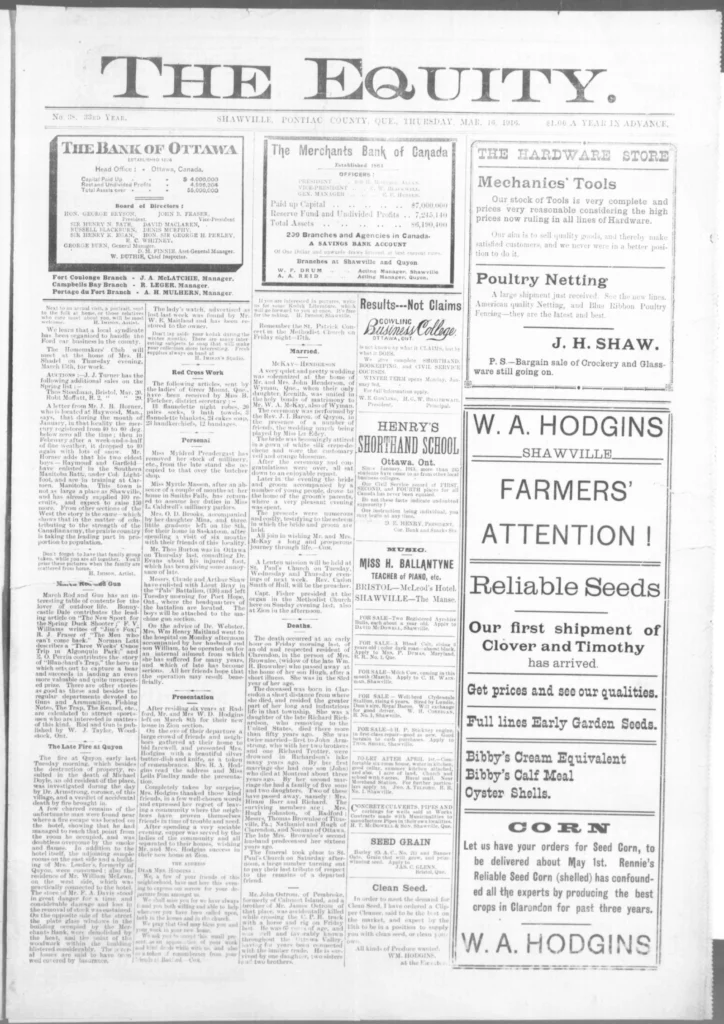
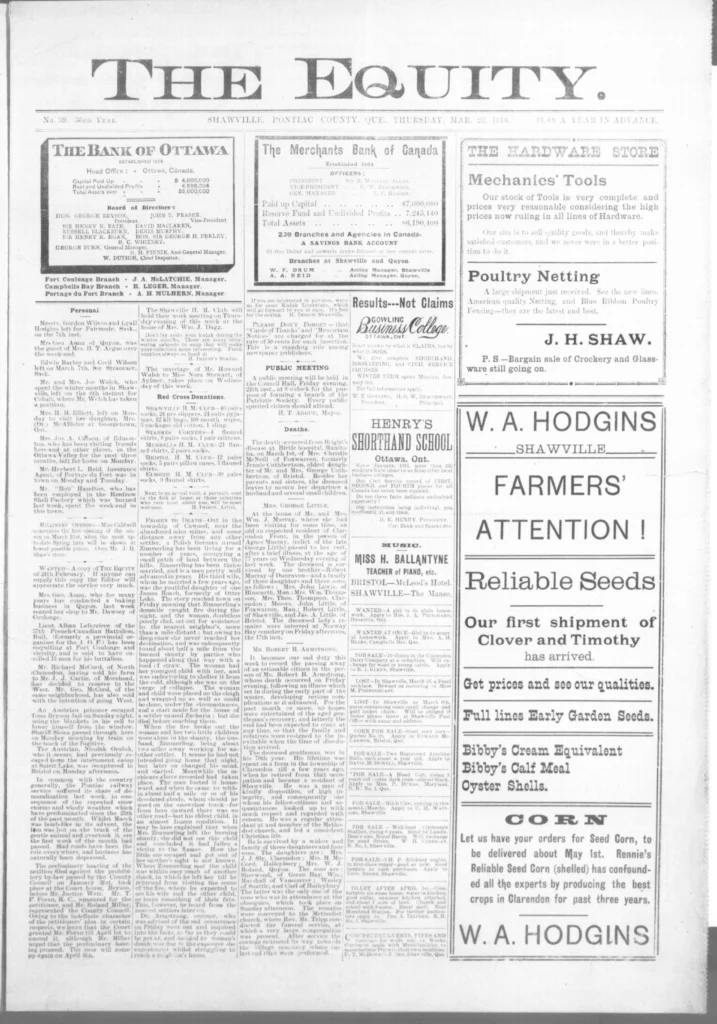
Below are the original copies of The Equity from this part of the War. Click any of them to download a PDF copy.

January 06, 1916

January 13, 1916

January 20, 1916

January 27, 1916

February 03, 1916

February 10, 1916

February 17, 1916

February 24, 1916

March 02, 1916

March 9, 1916

March 16, 1916

March 23, 1916

March 30, 1916

Read More From Our Project