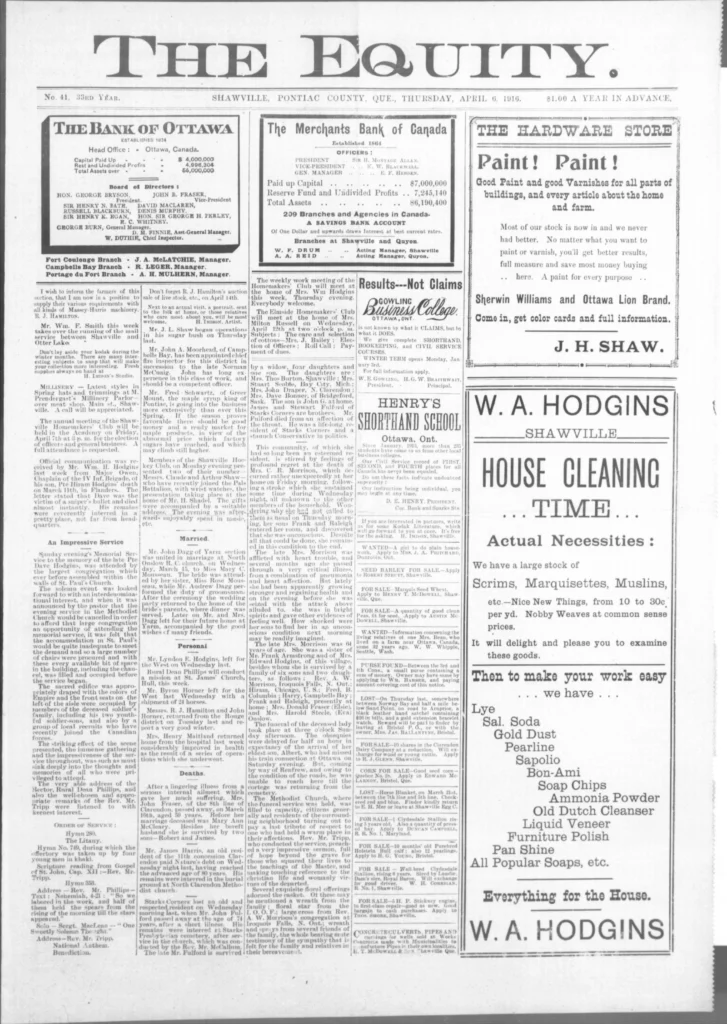
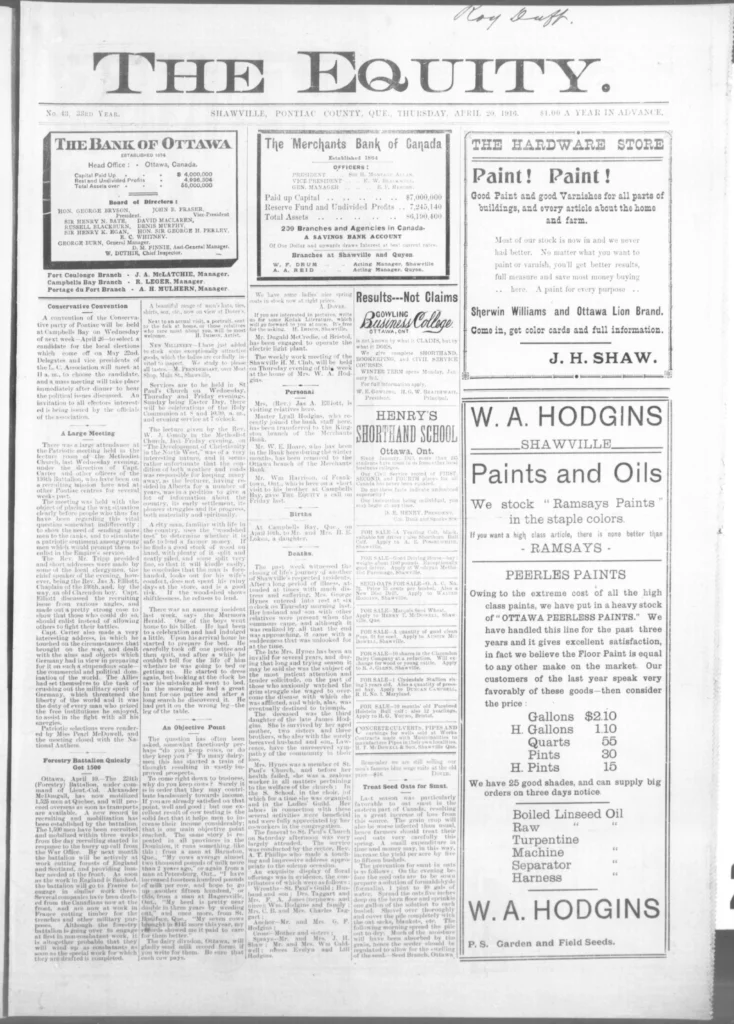
When the harsh snows finally melted, the winter’s localized groundwork blossomed into massive spring recruiting rallies. On April 19, a large patriotic meeting was held in the Shawville Methodist Church, led by Capt. Carter and the Rev. J. A. Elliott, “an old Clarendon boy.”
Shortly after, a massive rally for the 136th Battalion filled the local skating rink, aided by the clarion tones of a 35-piece brass band.
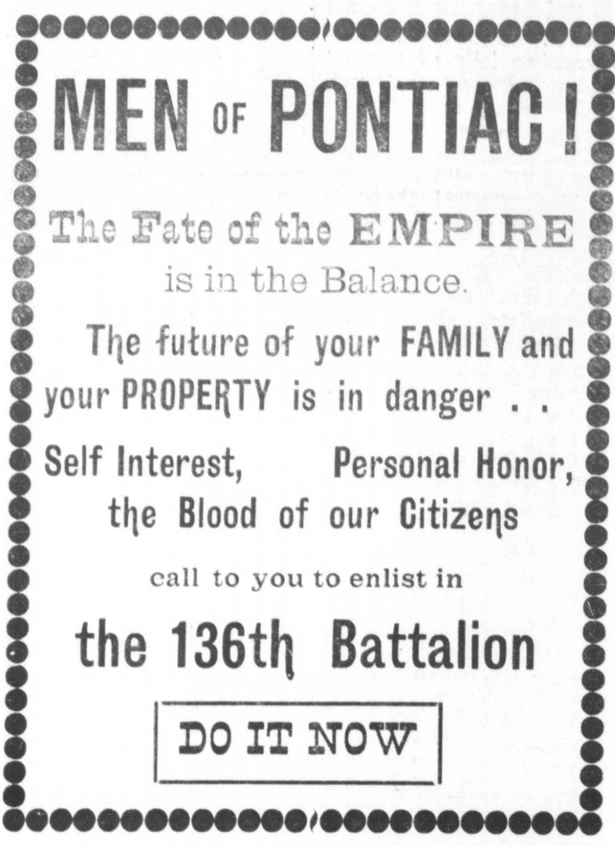
They warned the crowd that if German militarism was not crushed, Canada would be invaded, with Capt. Elliott emphatically stating, “the moment the army is defeated in France, that moment Canada is defeated.”
Major Scobell drove the danger home, shouting to the audience that “were it not for the British navy Germany would be here to-night,” and bluntly told the youth that their comfortable jobs in shops and banks “could be filled just as well by the women.”

Captain Carter echoed this urgency, confronting the crowd with the uncomfortable truth that local enlistment numbers were far too “small in proportion to the population.”
To fill the ranks, the officers also had to actively combat local prejudices and religious divides that were hindering enlistment. Capt. Elliott tackled what he characterized as an “extremely silly” local objection to fighting on the grounds that England “was a Protestant nation.” He argued that “Germany had shown by her teachings and practices that she was largely Pagan” and that “the doctrine of hate now being taught in Germany, had no place in the religion of Christ.”
To further appeal to the community, he asked the audience to imagine the fate of Canada by pointing to the harsh conditions imposed on Alsace-Lorraine, warning that if Germany won, they would abolish native languages (both French and English) in schools and law courts, and force dissenters to leave their possessions behind. Through these impassioned speeches, the recruiters sought to overcome local hesitation and unite the county in a desperate fight to “save civilization from destruction.”
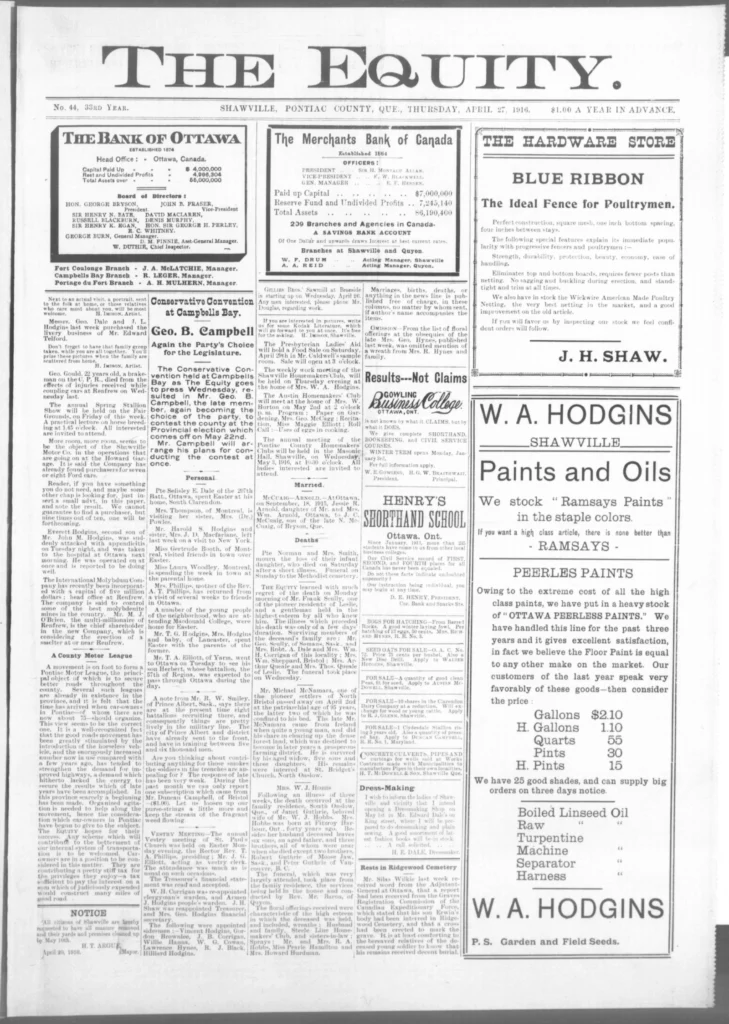
But the call for unity was complicated by the bitter provincial election campaign leading up to May 22, which brought deep linguistic and ethnic divides to the forefront. The Conservative candidate, Geo. B. Campbell, harshly criticized Sir Lomer Gouin’s Liberal government for exploiting the Ontario bilingual school issue for political gain.
Opponents condemned a controversial provincial bill that permitted municipal councils to divert revenues to “assist the agitation against the educational laws of Ontario,” arguing it was fundamentally unfair to force English-speaking minorities to fund a cause they opposed.
Tensions over the war itself also flared when Liberal Senator Choquette caused a sensation by publicly opposing overseas recruiting and speaking “disparagingly of the character of the men who have joined the colors.”
Despite these political storms, the letters arriving from local boys kept the county’s focus anchored to the grim reality overseas. Pte. H. T. Armstrong wrote of his tense April crossing on the Adriatic, describing the profound relief of meeting an escort of British cruisers and torpedo boat destroyers after sailing through a war zone filled with “a swarm of German subs.”
From the trenches, another local soldier wrote candidly to his brother of the psychological toll of the front lines.
Dear Bro:— Just a line to let you know that I am still in France but not in the trenches at present. I have been sent to the hospital after spending about eight days in the trenches. Well, Neil, it was certainly some experience, our first time in the trenches. You can never imagine a person’s feelings when they hear for the first time the roaring of the guns and bursting of the shells. I am quite willing to admit I was so frightened I didn’t know which end was up and I shook as though I had the ague. However, after the first day or so I got rather used to it and didn’t mind it much.
There is not much actual danger from rifle fire if you keep your head below the parapet but at night this is impossible as you are put on sentry duty and must keep a sharp lookout for German scouts or snipers. It is a terrible strain on your nerves at night when you are keeping a lookout straight ahead and it is pitch dark, and presently you begin to imagine all the stumps and trees are walking about. Things will be fairly quiet for awhile and then all of a sudden, bang goes a “whizbang” or else a German machine gun starts to sweep your parapet and, of course, you dodge down, after the bullets have gone whizzing past your head and lodged somewhere back of your trench. It is certainly some exciting.
You would laugh at some of the stunts some of the fellows pull off when a shell bursts near us; it is surprising how quick you can move.
The first night we were there I was sent out with a working party to fill sand bags out in what we call “No Man’s Land.” That is between our trench and the Germans. We got about a dozen sand bags filled when a German machine gun spied us and began to pump the lead into us. We lost no time in dropping behind the sand bags which we had so thoughtfully piled up in case of emergency but they got one fellow,—the first man I saw killed. He was in our company but I didn’t know him. We came off very lucky though, with only three or four casualties.
The weather was very bad while we were there, snow and rain all the time.
***There are a few German prisoners in the hospital that I am in. I don’t think they feel sad at being here either as I think they are well looked after and I guess they would rather be here than facing the British boys in the trenches.
— Private Stanley Reid
On the home front, the women of the county redoubled their efforts to provide comforts. The Elmside Homemakers’ Club forwarded a $50 cheque to the Red Cross in Montreal for surgical supplies, and a garden party at Alex Hodgins’ home raised over $50 more to purchase materials for “knitting socks, sewing, etc.”
Yet, The Equity was forced to scold the general public for neglecting the Soldiers’ Tobacco Fund, noting the response had been “very weak” and reminding citizens of the desperate appeals for “smokes” from the boys in the mud.
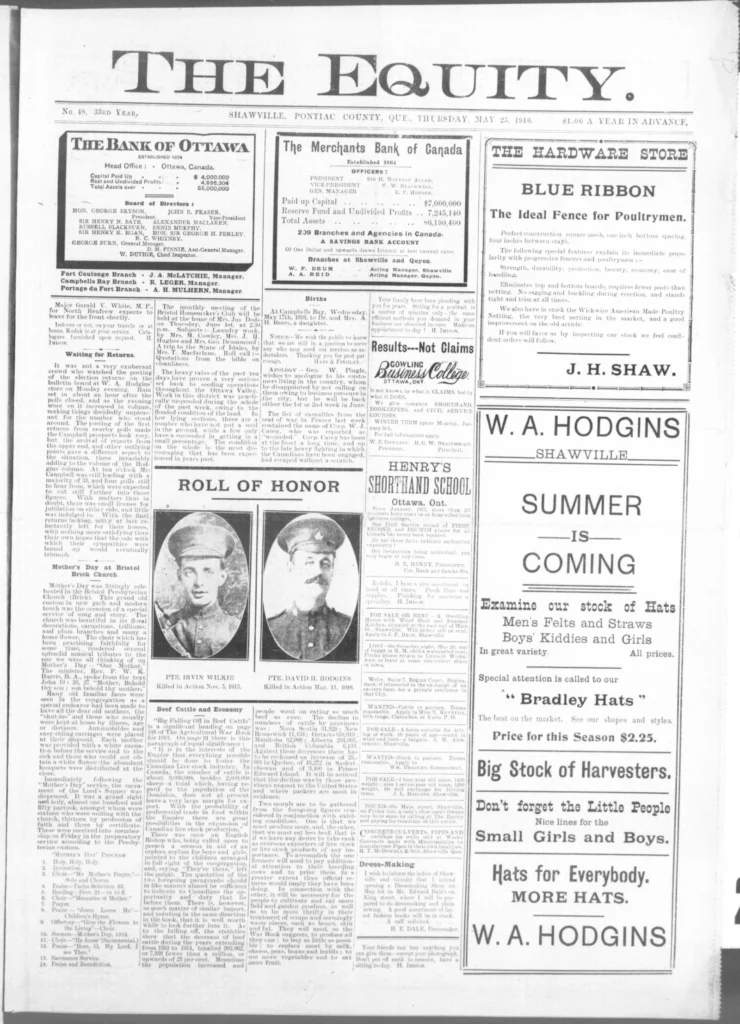
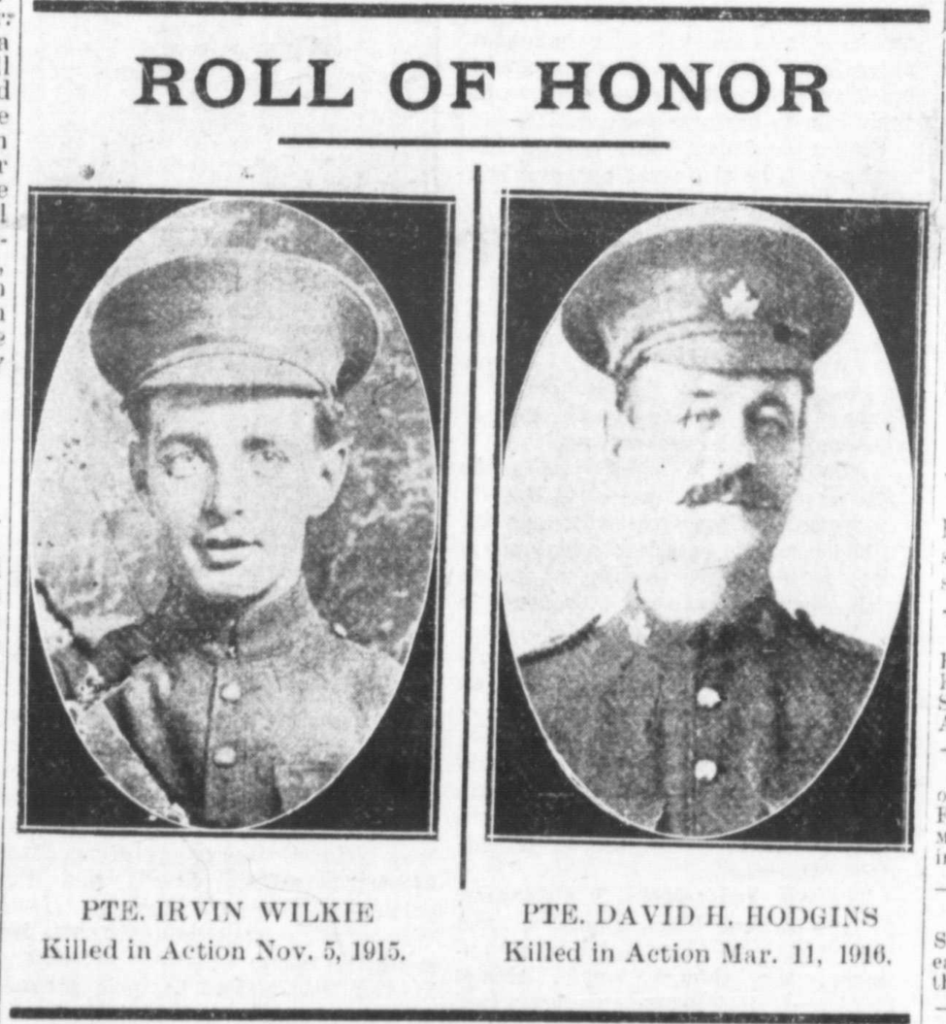
The true cost of the spring offensives soon cast a shadow over these local efforts. In April, official word arrived that Pte. Hiram (Dave) Hodgins had fallen victim to a sniper’s bullet in Flanders and “died almost instantly.”

Above – AI Restored photos of Privates Irvin Wilkie and David H. Hodgins.
The photos, published May 25, 1916, marked the first time The Equity published a photo of a local person and the first photo to appear on their front page.
Shortly after, letters from France brought the tragic news that Pte. Robert V. Anderson, “one of the most popular boys in the company, always willing and smiling,” had been killed in action while standing guard outside a headquarters dugout.
These sacrifices brought profound sorrow to the county, a grief that found poignant expression during a special Mother’s Day service at the Bristol Presbyterian Church. There, amidst beautiful floral decorations of carnations and trilliums, a moving tribute was paid to the enlisted boys as a beautiful Honor Roll was unveiled. Flanked by the flag and maple leaves, it bore the names and photographs of the local boys — a permanent, silent testament to the heavy toll the Great War was extracting from the quiet communities of Pontiac.
Soldiers Mentioned in The Equity
These names have been extracted from copies of The Equity by AI and may have mistakes. Please let us know if you catch any at jon@theequity.ca.
| Mentioned | Soldier / Personnel | Status / Details |
|---|---|---|
| Apr 6 / May 25 | Pte. Hiram Hodgins | Killed in action by a sniper in Flanders, Mar 11. Name placed on Bristol Church Honor Roll. |
| Apr 6, 1916 | C. & A. Shaw | Joined the Pals Battalion; both presented with wrist watches by the Shawville Hockey Club. |
| Apr 6, 1916 | Pte. Duncan Robinson | 59th Battalion; reported in the hospital with measles. |
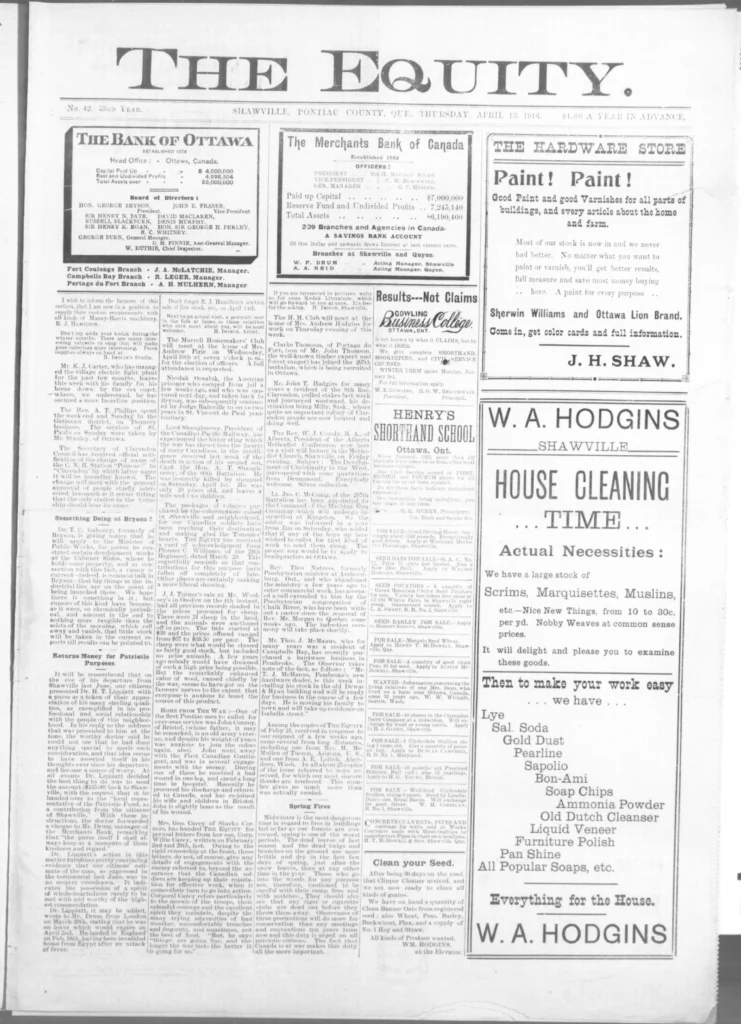
| Apr 13, 1916 | Clarke Thomson | Portage du Fort native; joined the 77th Battalion in Ottawa. |
| Apr 13 / May 4 | Pte. Norman Smith | First Contingent; returned home to Bristol wounded (lame) from the battle at Festubert. |
| May 4 / Jun 1 | Pte. R. V. Anderson | Killed in action, Apr 22. Described as highly popular; died while standing guard at a HQ dugout. |
| May 11 / 25 | Pte. Irvin Wilkie | Killed in action, Nov 1915. Name added to Bristol Brick Church Honor Roll; details of burial rites received. |
| May 11, 1916 | Pte. Everett Hodgins | Joined 130th Battalion; died of illness in a Canadian hospital shortly after enlisting. |
| May 11, 1916 | L., W., & F. Grant | Lawrence (France), Willie (130th Batt.), and Fred (207th Batt. at Fort Hope). |
| May 11, 1916 | Pte. H. T. Armstrong | Sailed to England on the Adriatic; wrote of the submarine escort during the crossing. |
| May 18, 1916 | Pte. Ken Hodgins | Suffered 13 shotgun pellet wounds in the legs due to an accidental discharge during a local house fire. |
| May 25, 1916 | Corp. W. J. Carey | Reported in the official casualty list from France as "wounded." |
| Jun 15, 1916 | Pte. John Landry | 60th Battalion; hospitalized with a thigh wound received on June 3rd. |
| Jun 15, 1916 | Capt. Dave McFarlane | Promoted to Captain; sent to Malta with a British unit. |
| Jun 15, 1916 | Pte. Stanley Reid | Wrote home describing terrifying first experiences with machine guns and "whizbangs" in the trenches. |
| Jun 29, 1916 | Lloyd Pattison | Grandson of Pontiac Advance founder; hospitalized in Flanders suffering from shell shock. |
| Jun 29, 1916 | Arthur Smart | Wounded in the eye; admitted to No. 4 General Hospital in France. |
| Jun 29, 1916 | Gunner K. Macdonald | 15th Battery; killed in action near Ypres on May 31st. |
Listen to our Podcast!
We’ve used Artificial Intelligence to summarize what was covered in The Equity during this part of the Great War. Click the play button to listen.
Timelines: January - March 1916
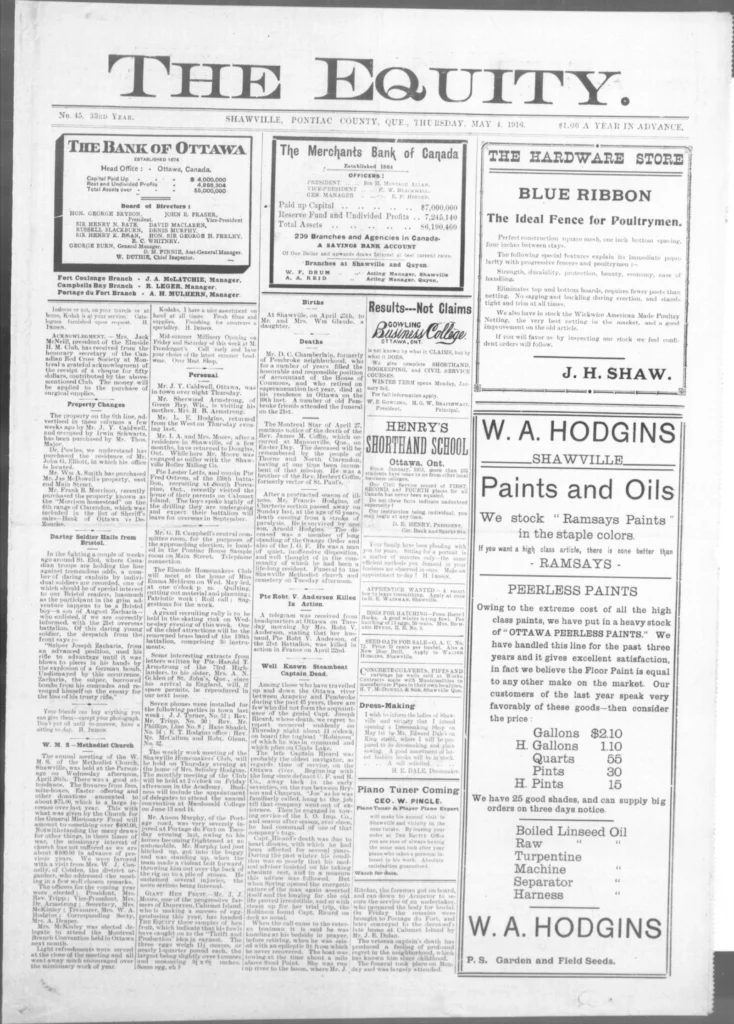
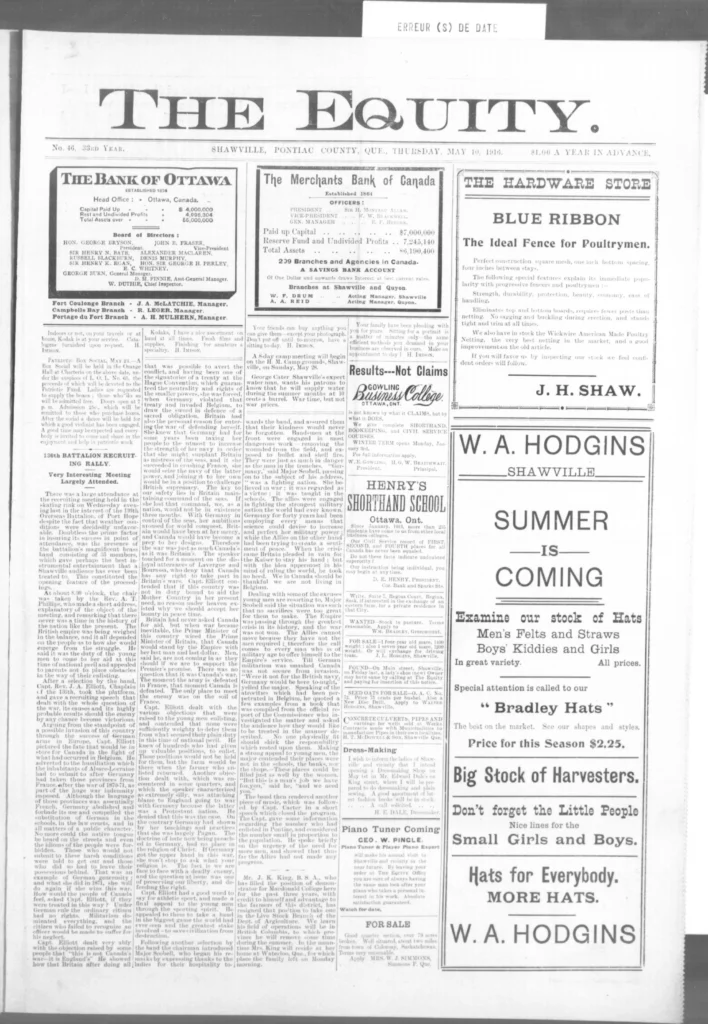
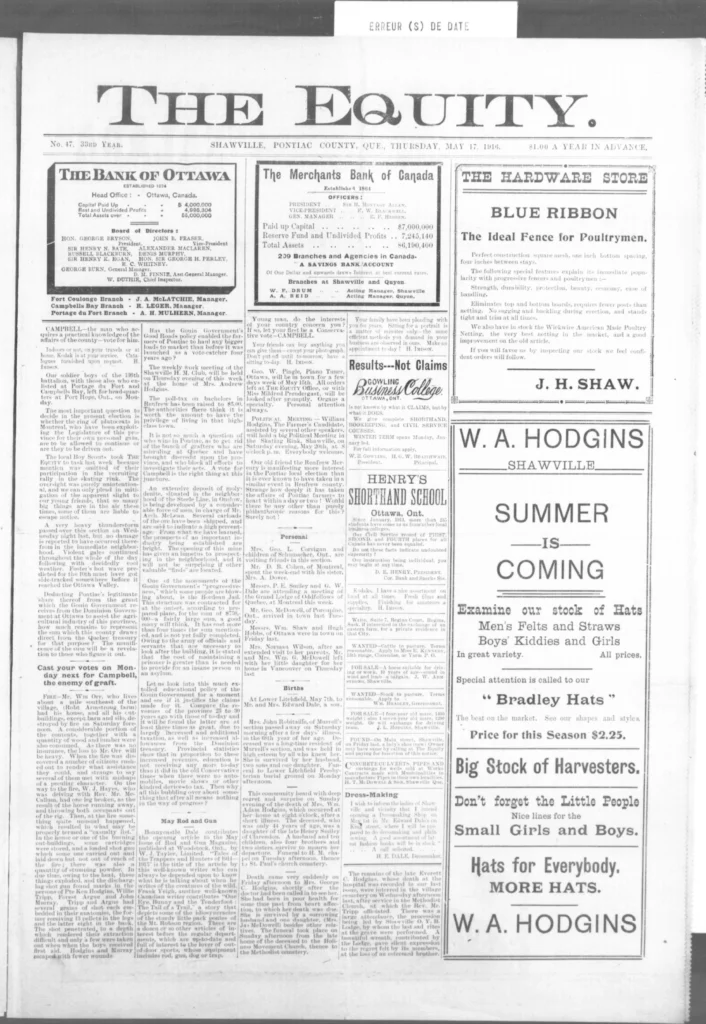
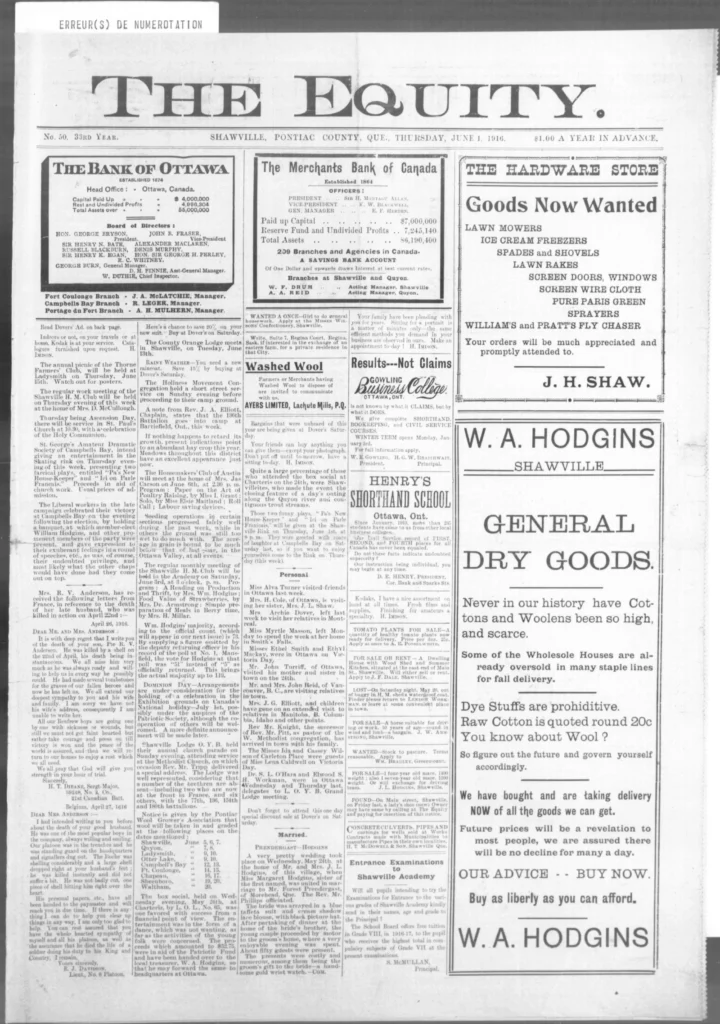
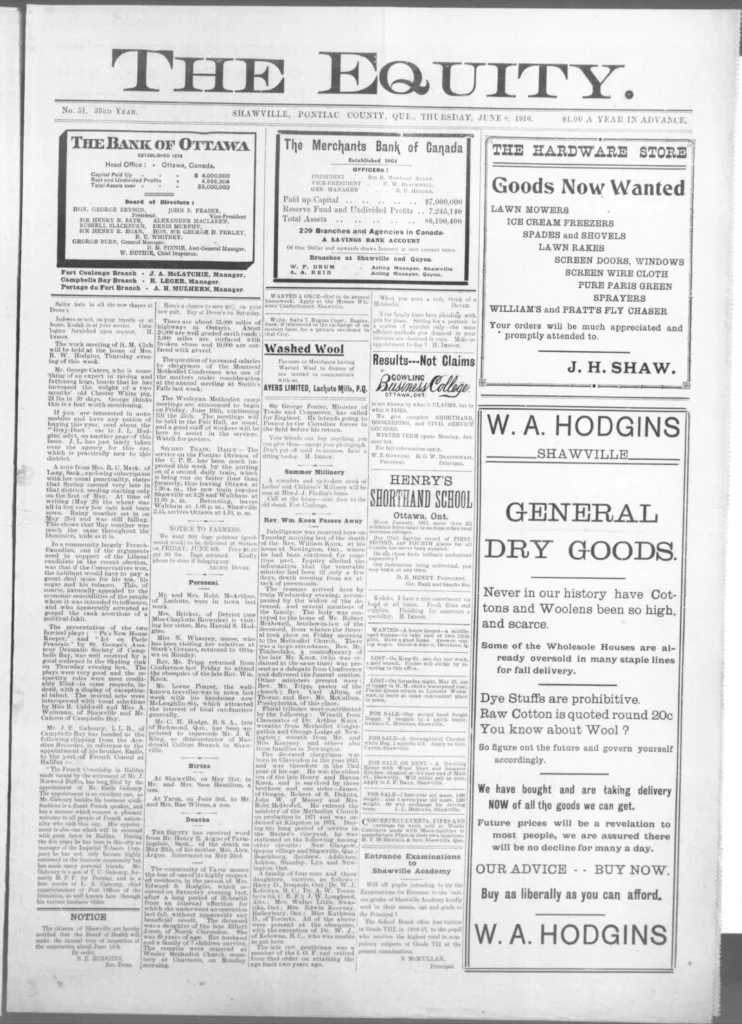
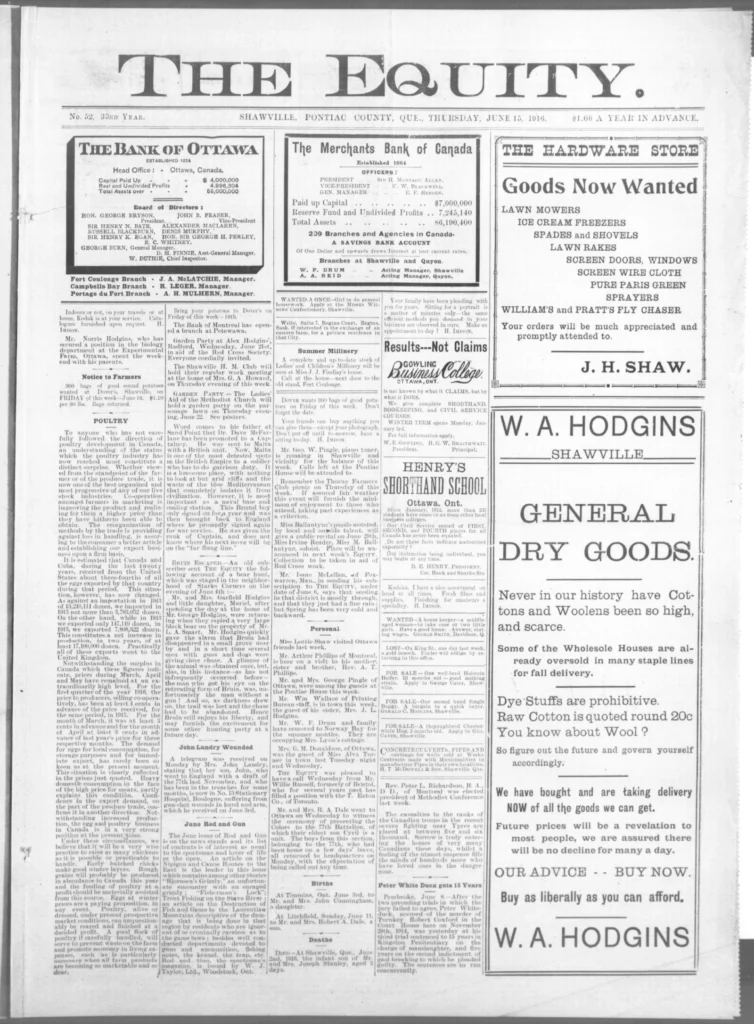
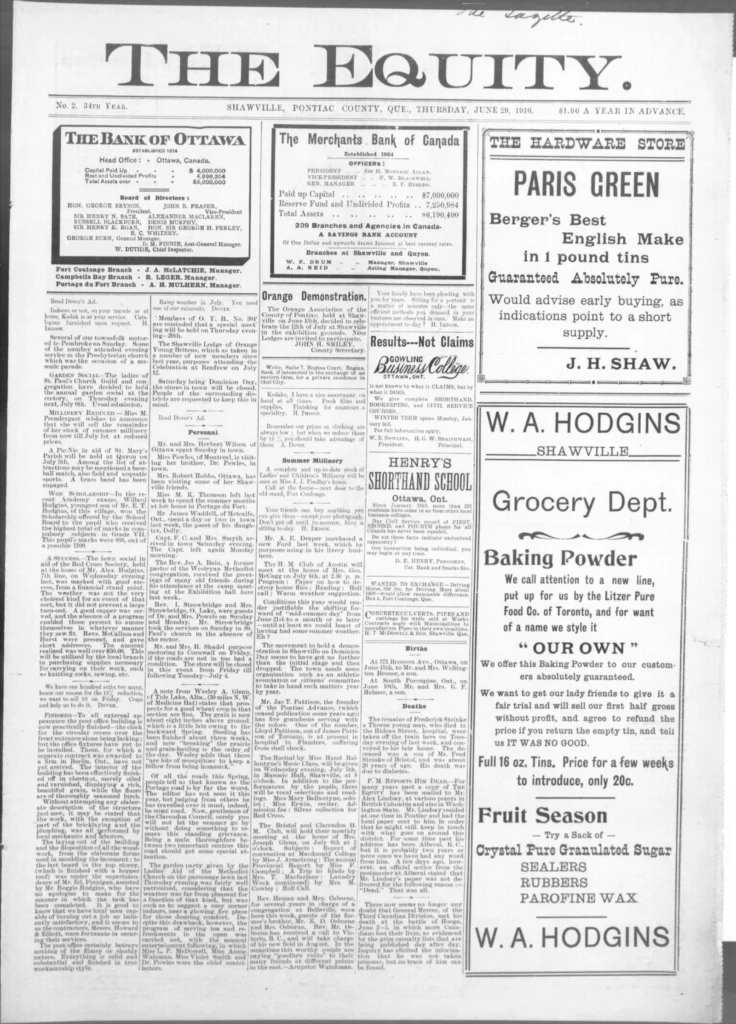
Below are the original copies of The Equity from this part of the War. Click any of them to download a PDF copy.