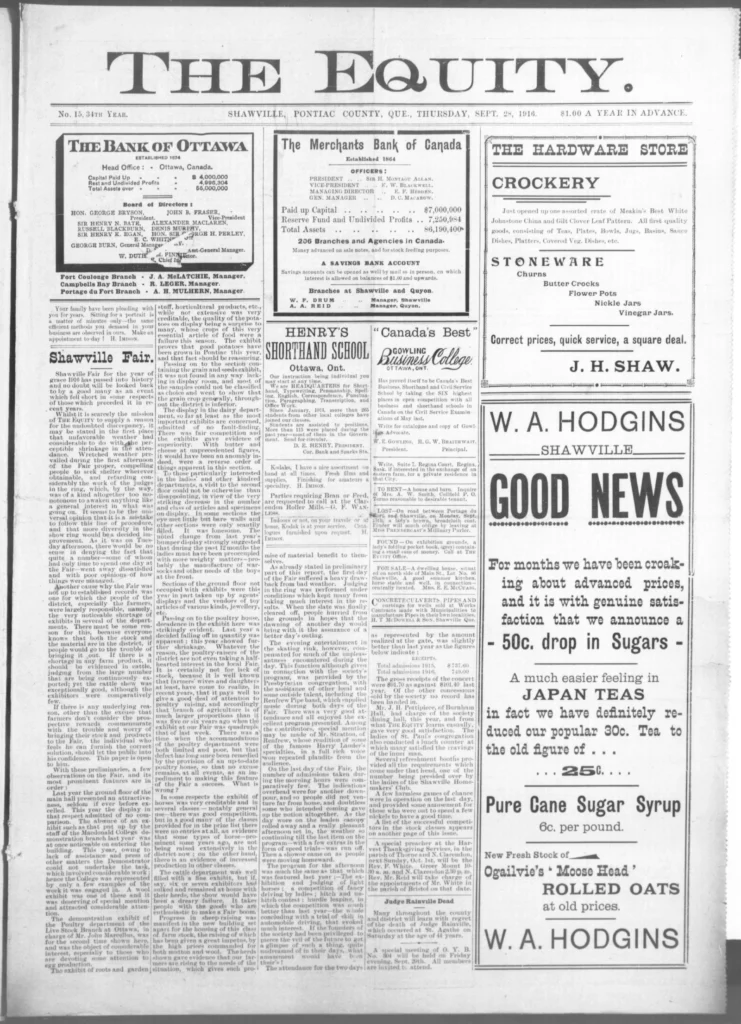
In the summer of 1916, the citizens of the Pontiac lived a dual existence. While the rhythms of rural life continued with agricultural fairs, strawberry picking, and harvest excursions, the grim reality of the First World War cast a long shadow over the community.
The pages of The Equity from this period paint a vivid picture of a county mobilizing its resources, anxiously scanning casualty lists, and clinging to the letters sent home by its boys in the trenches.
The war’s impact was felt in the daily mechanics of local life. By early July, the paper reported that “the scarcity of female help is becoming a serious matter in this section of the country,” as native domestics were nearly impossible to procure, likely due to women shifting into wartime industries.
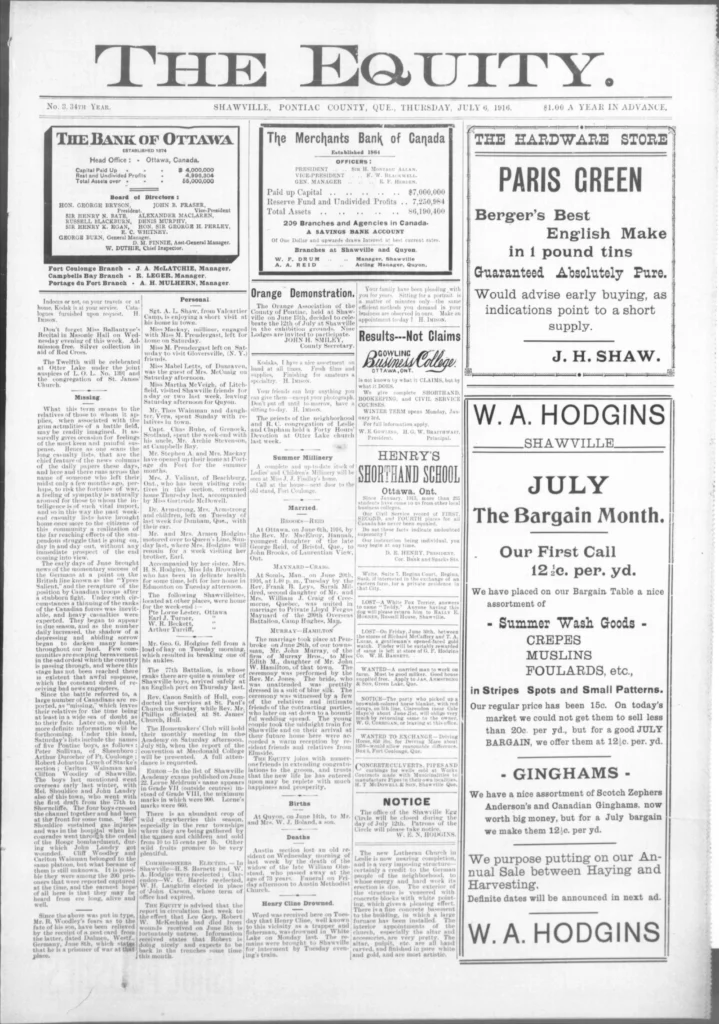
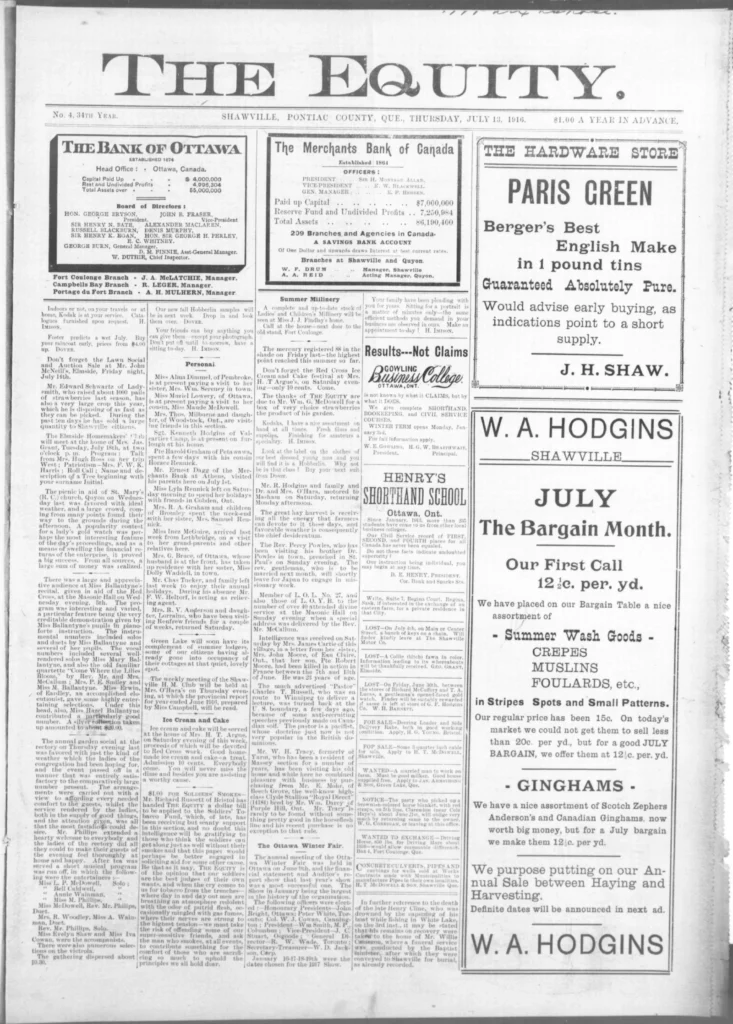
To support the war effort, the community threw itself into relentless fundraising. Local social events were repurposed for the cause, from a recital by Miss Ballantyne (July 6), to a garden social at the local rectory featuring “Good home-made Ice cream and cake” (July 13), to a magic lantern show at Murrell’s hall (September 7).
The Shawville Patriotic Fund campaign was particularly active; it was reported that a highly successful canvas brought in $634.00 in a single day, helping them achieve a goal of $2,000 to assist the dependents of Canadian soldiers.

However, the war also strained the political and cultural fabric of Quebec. Tensions surrounding the French-English language issue and differing attitudes toward the war effort occasionally bubbled to the surface. The July 13th issue noted a report from the Toronto World claiming that “His Holiness the Pope has given explicit orders in this province that henceforth they must neither speak or write a word touching the language issue in Canada.”
Furthermore, the August 10th issue mentioned a political meeting in St. Hubert where French-Canadians were urged to resist the Conservative party, causing “a good deal of trouble” for the government.
A major source of local heartbreak that summer was the fate of the 77th Battalion, which contained a large number of Pontiac’s young men. The August 3rd issue reported the disappointing news that upon arriving in England, the battalion had been “broken up to fill the gaps in other units whose ranks have been decimated in the severe fighting.”
This administrative decision stripped local men of their familiar officers and separated lifelong friends. In the August 10th issue, a soldier identified as “N.J.” wrote from Bramshott Camp: “The 77th Battalion has been all broken up… Jack Foot and I are with the Seaforth Highlanders… The morning we broke up I never saw such a parting. All the officers had tears in their eyes.”
The transition to Scottish Highland regiments brought its own unique complaints. In a letter published on September 14th, Pte. Raymond G. Telford—who was tragically killed in action just days after writing it—told his mother: “You will be surprised to hear that we are in a Scotch Battalion now. Our poor knees will get it now. This is awful. It really takes the heart out of everything when we are split up… we cannot even wear one of our 51st badges.”
Private Telford ends his letter: “Don’t worry about me for I will come out alive anyway and I will be home again.”
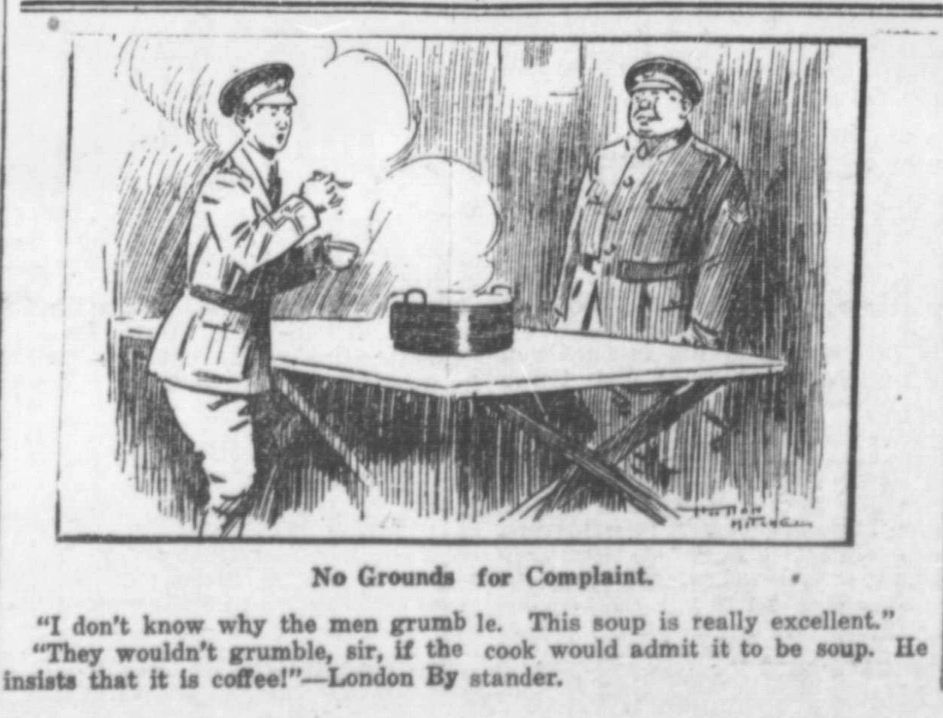
Despite the hardships, letters home often displayed a resilient, sometimes cheerful spirit. Writing on July 3rd (published August 24th), Cpl. Stanley Grant of Elmside described grueling 35-mile route marches and thrilling sham battles with blank ammunition that sounded “just like the real, live stuff.”
Dear Brother,—Hello, lad! How is everything going with you at present? I am getting along fine here; but they are working us rather hard now, as our period of military training is almost finished. We were busy all last week doing long route marches, and parading for general inspection. On Tuesday last we marched thirty-five miles between seven o’clock in the morning and eight o’clock that night, and had both dinner and supper away from camp.
On Wednesday we marched out to Chapel Commons, about eight miles away, to be inspected by Major General Sir Archibald Hunter, and the whole division of 24,000 troops was there, including the Division Artillery from Whitley Camp. On Thursday we went out to Borden for a brigade field day. We had a sham battle out there. The 44th and 50th battalions defended a splendid position, which the 46th and 47th battalions tried their best to take, but were unable to get near us. It was just like a regular battle, as we used machine guns, signallers, scouts, snipers and had several big guns; but, of course, we used blank ammunition, which is quite safe and makes a report just like the real, live stuff. It was a splendid day, but every one was tired out when we reached camp again.
Friday was the best day of the week, and it was pay day, and I drew £2-10s, which is about $12.50. It won’t last very long, I can tell you. Then on Saturday, which was July 1st—Dominion Day, the whole of the Fourth Canadian Division was inspected by the King and Queen on Hankley Common, which is about ten miles from Bramshott.
This is the second time the Canadians have been inspected by King George since I came to England. He looks particularly well at present, and was accompanied by an enormous staff as a life guard of fifty troopers and the Canadian guard of honor. With him were Sir John French and Sir William Robertson, Sir Archibald Hunter and Brigadier-General Lord Brooke, who is in command of our brigade, which is the 10th Brigade Canadian Inf. When he inspected us by riding down the line, which was a long one (for 25,000 men reach a long way even if they are formed up in mass), he was surrounded by the Imperial Staff followed by the Royal Standard Bearer and Body Guard. Then between the Body Guard and the Guard of Honor rode the King’s two grooms, dressed in black and with big silk hats. It was a splendid procession and well worth seeing. After they rode down the line the division marched past the “saluting base,” the artillery first, at the gallop, as if it were going into action, and then the infantry in close column of half company, with fixed bayonets, the King and Queen receiving the salute as we passed. Then at 1.30 p.m., when all were passed, the Royal procession climbed into their cars and motored back to London, which is only forty miles from here.
… Divisional sports day was a splendid day and a grand success. The 50th won a large number of prizes and mine was a gold wrist watch, won as first prize for putting up wire entanglements.
Now, I must close for this time, George, and hope to hear from you soon. Give my regards to Janet and Annie and all the rest.
Your soldier brother,
Stanley
In the August 10th issue, Pte. Benny Smith wrote earnestly to his mother about finding comfort in religion, describing an open-air service led by a Salvation Army captain who preached a gospel “that will save men’s souls.”
For some Pontiac families, the summer brought the agonizing news that their sons had been captured. The July 6th issue shared that Mr. R. Woodley’s fears for his son were relieved by a postcard stating he was a prisoner of war at Dulmen, Germany. By August 3rd, a letter from Pte. Clifton Woodley of Quyon arrived from the same Dulmen camp, stating he was suffering from deafness and a slight wound, but expected to be alright.
In the September 7th issue, Lieut. Gerald D. Murphy of the 28th Battalion wrote from a hospital in Munich: “I am wounded and a prisoner of war… doing nicely and expect to be sent to a prison camp.”
Ultimately, the local papers were anchored by the somber duty of reporting those who would not return. The July 6th issue noted the “depressing and abiding sorrow” darkening homes as five Pontiac boys appeared on Saturday’s casualty list alone.
The September 28th issue mourned the loss of Lt. Horner of South Clarendon, a university graduate and trained athlete, who was killed by a shell fragment.
Perhaps the most poignant reflection of the community’s grief and pride was found in the September 14th issue, which printed a chaplain’s letter to the widow of George Alfred Thomas. Seeking to offer comfort, the chaplain wrote: “He died not alone, but with hundreds of his fellows, in one of the biggest fights the Canadians have ever been in… First of all, he died in a great cause—the cause of righteousness, truth and final triumph was his side, and for that cause he gave up his life.”
Soldiers Mentioned in The Equity
These names have been extracted from copies of The Equity by AI and may have mistakes. Please let us know if you catch any at jon@theequity.ca.
| Mentioned | Soldier / Personnel | Status / Details |
|---|---|---|
| Jul 6, 1916 | Sullivan, Durocher, & Lynch | Peter Sullivan, Arthur Durocher, and Robert Johnston Lynch appeared on Saturday's casualty list. |
| Jul 6, 1916 | L-Cpl. R. McKechnie | Reports of death untrue; recovering from June 5th wounds and expected back in the trenches soon. |
| Jul 6, 1916 | Pte. M. V. Day | Sniper/Pioneer in France/Belgium; returned to England after being gassed. |
| Jul 13, 1916 | Sgt. K. Hodgins | On furlough at his home from Valcartier Camp. |
| Jul 13, 1916 | Pte. Harold Graham | Stationed at Petawawa; visited his cousin for a few days. |
| Jul 27, 1916 | Pte. Lome Lester | 207th Battalion (Ottawa); visited his mother in town. |
| Aug 3, 1916 | Pte. Benny Smith | Wrote home describing an outdoor church service before preparing for the trenches. |
| Aug 3, 1916 | Soldier N. J. & Jack Foot | Transferred from 77th Battalion to the Seaforth Highlanders after the unit was broken up. |
| Aug 3, 1916 | Sergt. Lewis | Transferred from the 77th Battalion to the 87th Grenadier Guards at Bramshott Camp. |
| Aug 10, 1916 | Pte. Raymond Telford | Died of wounds on June 9th after only three days in the trenches. |
| Aug 10 / Sep 7 | Capt. P. C. Smyth | Visited Shawville while stationed at Camp Borden. |
| Aug 17, 1916 | Cpl. Stanley Grant | Wrote of 35-mile marches and an inspection by King George at Bramshott Camp. |
| Aug 17, 1916 | Lieut. Gerald Murphy | Missing at Hooge; confirmed wounded and held as a POW in Munich, Germany. |
| Aug 17, 1916 | Pte. Salisley Dale | 207th Battalion; visited town over the weekend. |
| Aug 17, 1916 | Sgt. A. L. & C. E. Shaw | Transferred from 136th Battalion to 73rd Battery in Kingston. |
| Aug 24, 1916 | Gordon Harold Main | Princess Patricia's (Renfrew); died from wounds in a German prison hospital. |
| Aug 24, 1916 | Capt. (Dr.) Lippiatt | Promoted to Captain; serving on ambulance trains in England. |
| Aug 24, 1916 | Clifton Woodley | POW at Dulmen, Germany; reported deafness and a slight wound. |
| Aug 24, 1916 | C. Wainman & J. Landry | Fates reported as unknown by fellow prisoner Clifton Woodley. |
| Aug 24 / Sep 7 | Emerson L. Thomson | Wounded by a sniper (shot through the arm); recovering in Leeds, England. |
| Aug 31, 1916 | Pte. Frank Armstrong | 5th Field Ambulance (France); received a delayed Christmas parcel of "comforts." |
| Aug 31, 1916 | Lt.-Col. McDougall | Promoted to Brigadier-General to command a brigade. |
| Aug 31, 1916 | Lt.-Col. Gerald White | Succeeded Lt.-Col. McDougall in command of the 224th Forestry Battalion. |
| Sep 7, 1916 | Pte. James McLarnon | Name appeared in the casualty list as wounded in action. |
| Sep 14, 1916 | Sgt. Lorne Smiley | 136th Battalion; made a farewell visit home to Quyon. |
| Sep 14, 1916 | Chas. Smiley | Trained at Camp Hughes, Manitoba; visited parents in Clarendon before going overseas. |
| Sep 14, 1916 | Rev. J. A. Elliott | Chaplain of the 136th Battalion; noted as not going overseas. |
| Sep 14, 1916 | Lieut. Horner | University graduate/athlete from South Clarendon; killed in action by a shell fragment. |
| Sep 21, 1916 | George Alfred Thomas | Killed in action, June 5, 1916. "Died with his face to the foe." |
Listen to our Podcast!
We’ve used Artificial Intelligence to summarize what was covered in The Equity during this part of the Great War. Click the play button to listen.
Timelines: July - September 1916
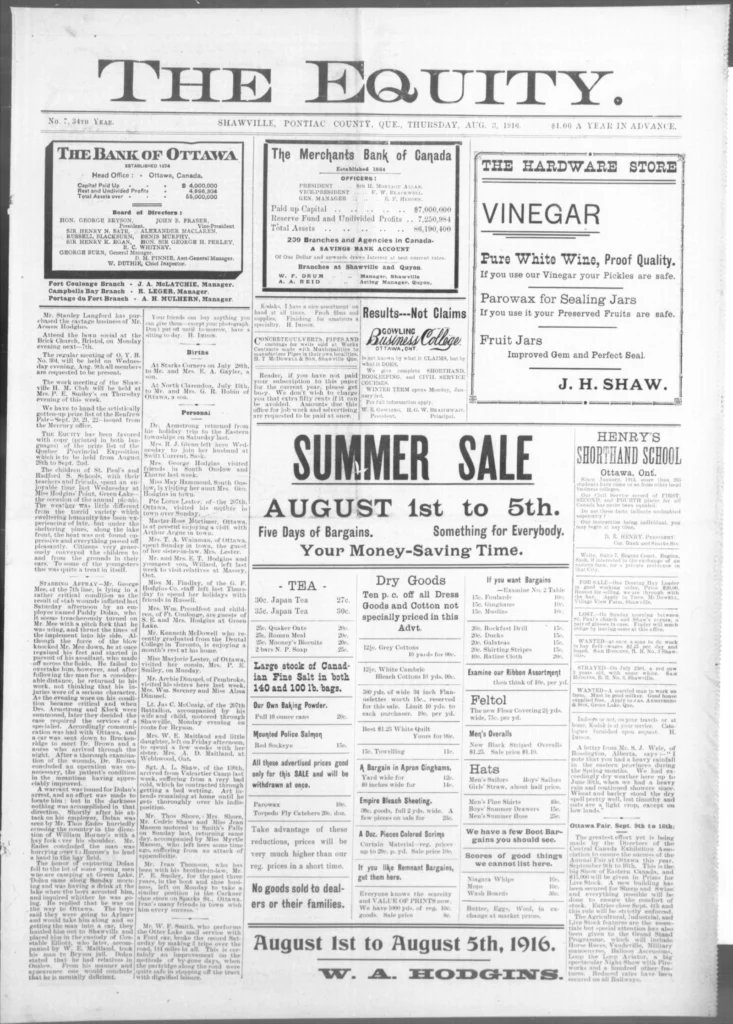
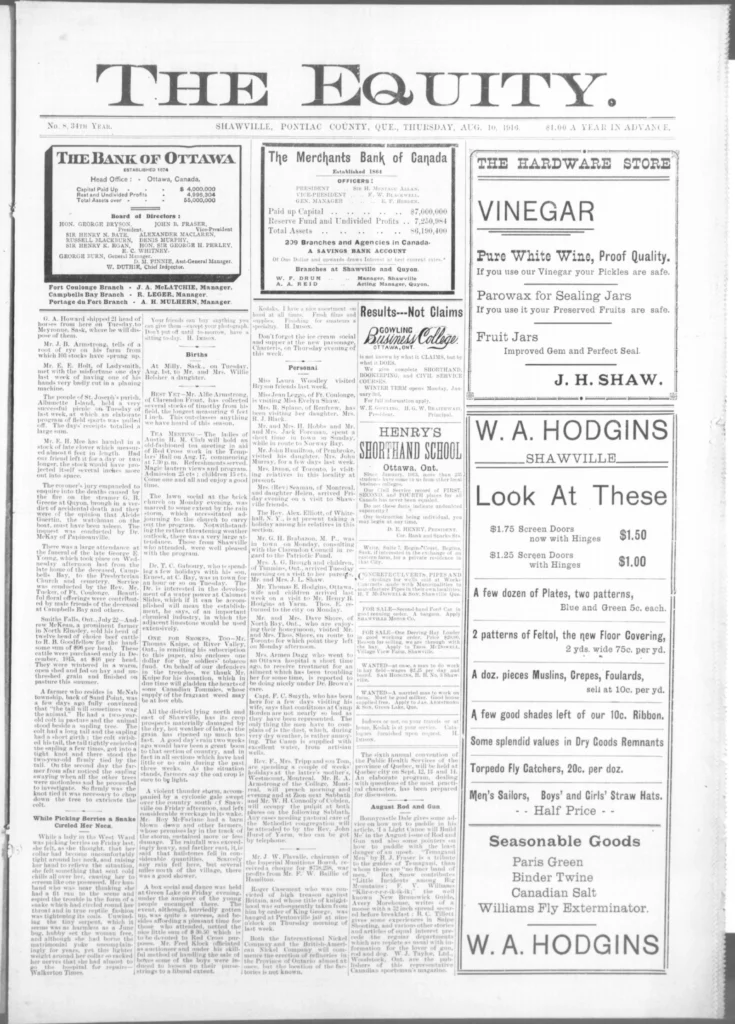
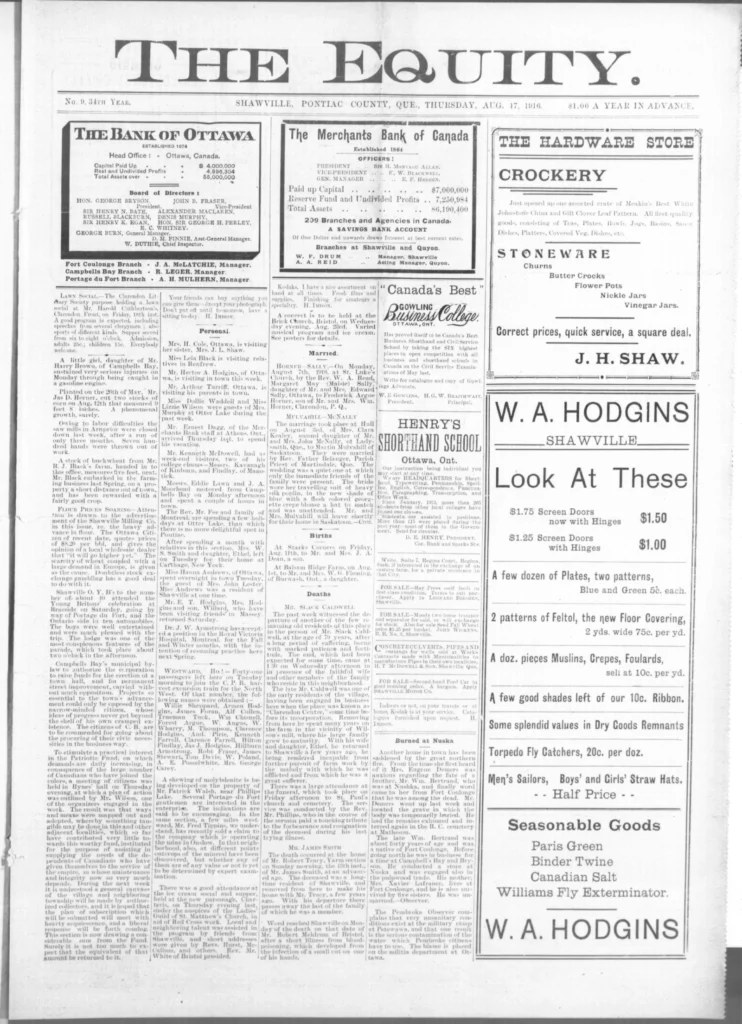
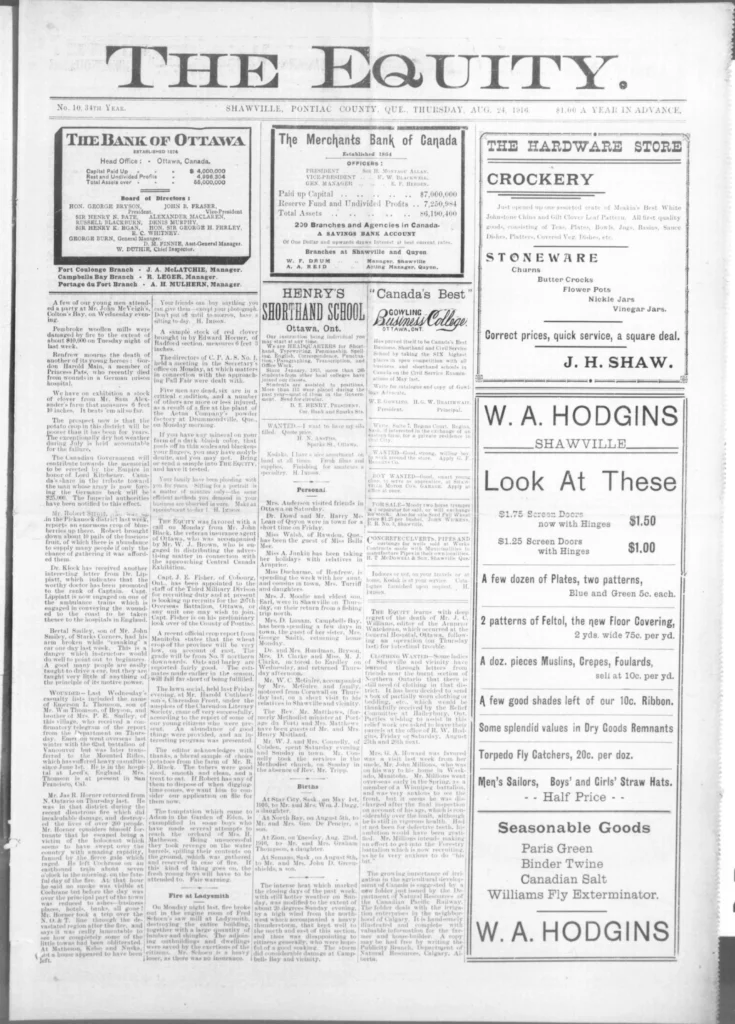
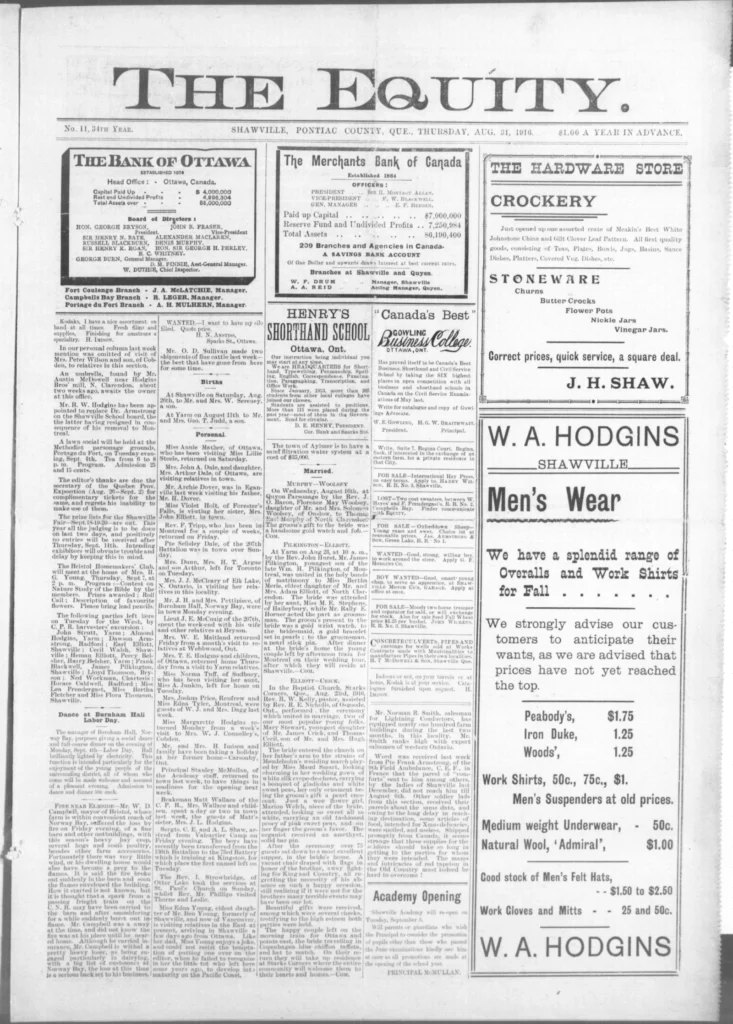
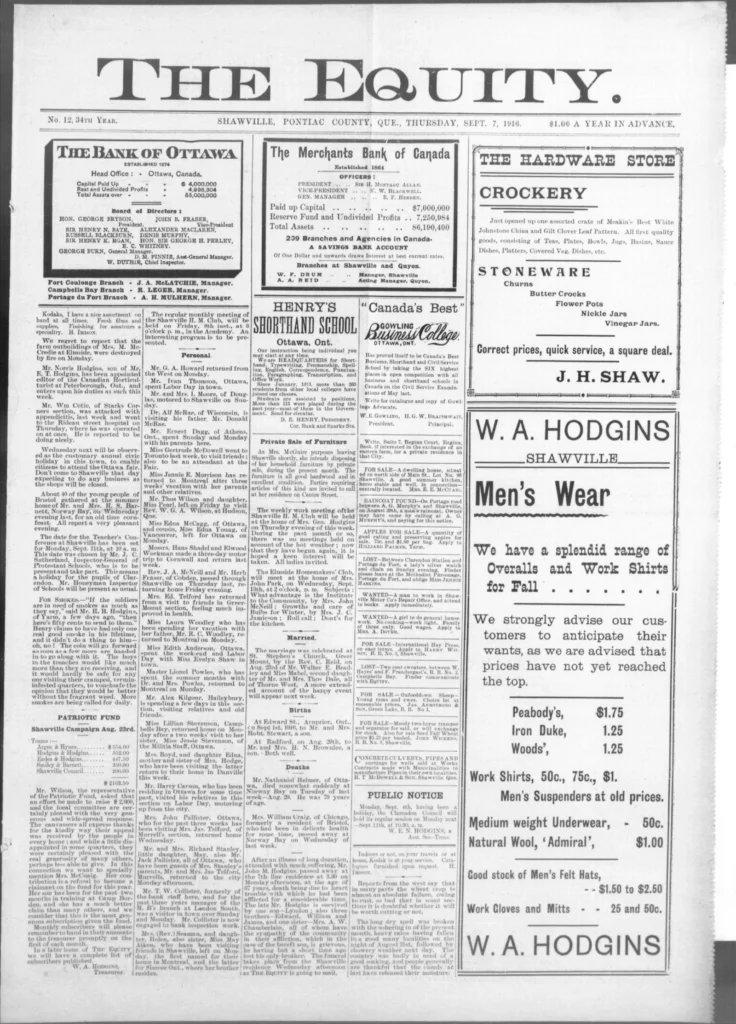
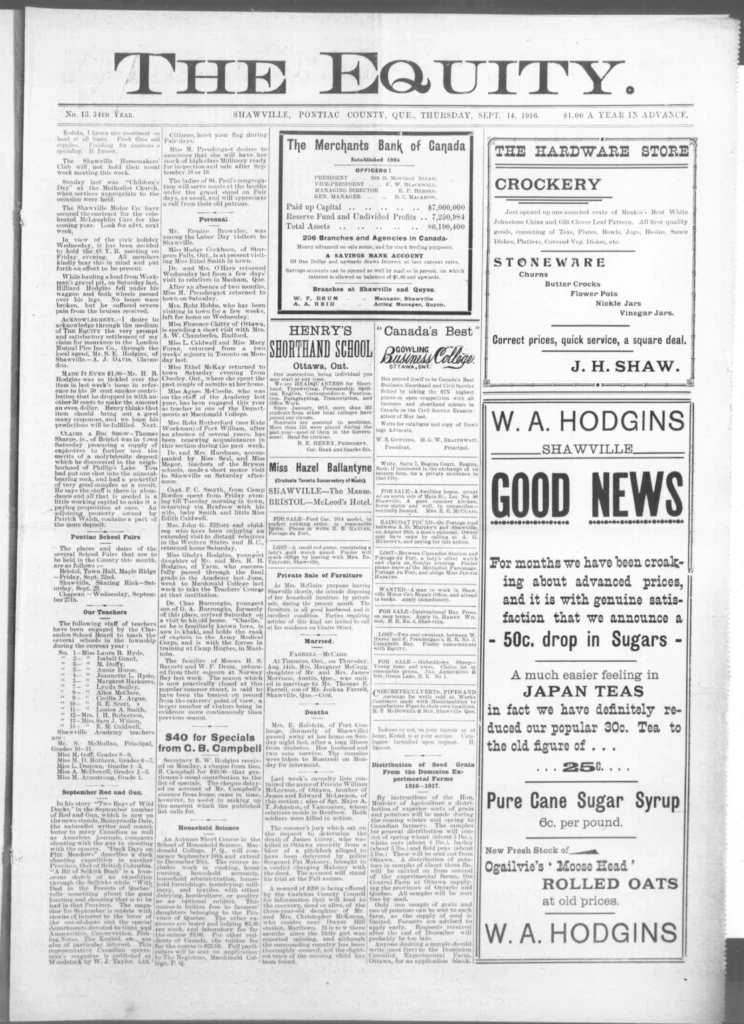
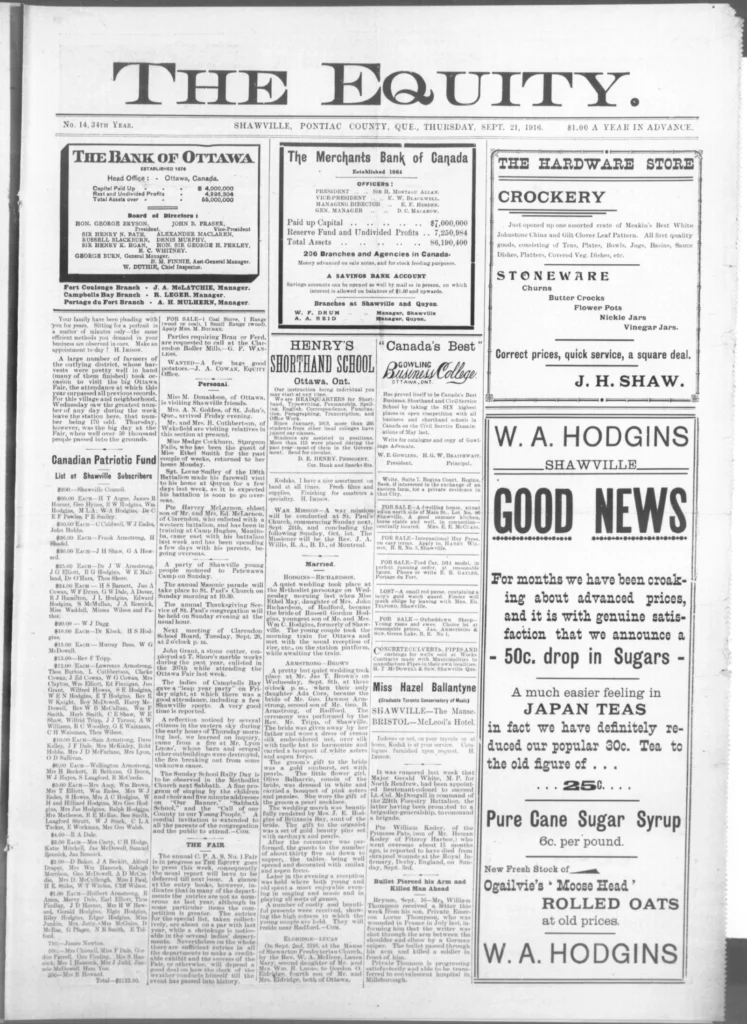
Below are the original copies of The Equity from this part of the War. Click any of them to download a PDF copy.