Spring 1915

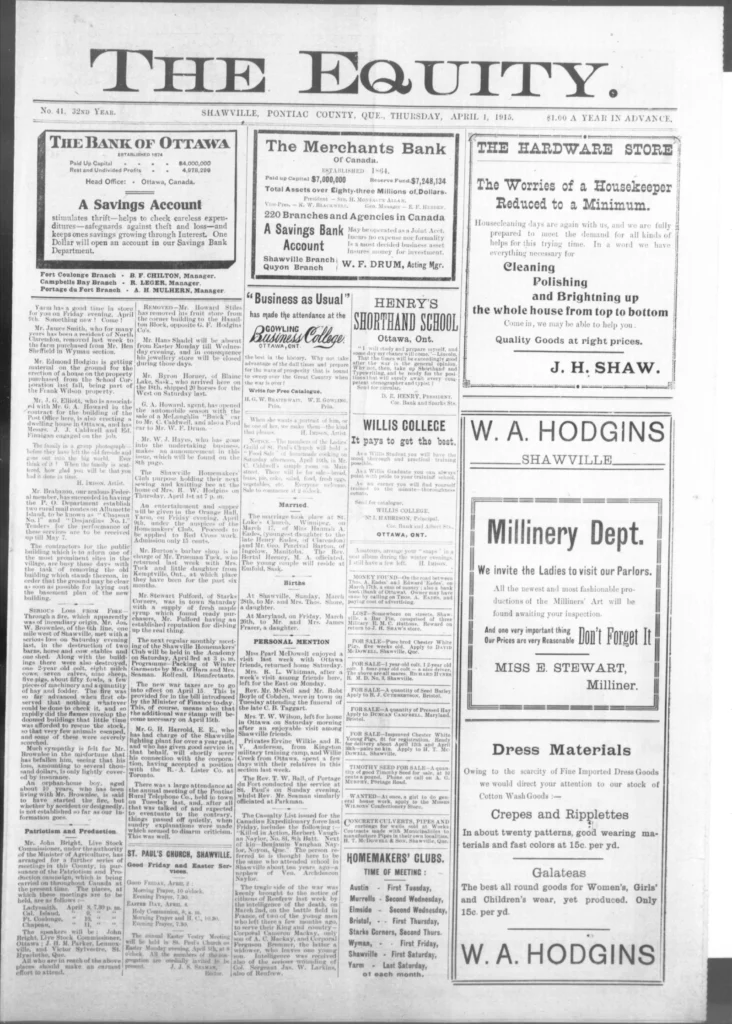
Spring had come to the Pontiac region of Quebec in 1915, but the usual chatter of seed time and maple syrup was overshadowed by the booming echoes of a world tearing itself apart. Through the pages of the The Equity,  these months see the First World War unfold not as a distant European quarrel, but as a deeply personal tragedy that reached right into the farmhouses and shops of the Ottawa Valley.

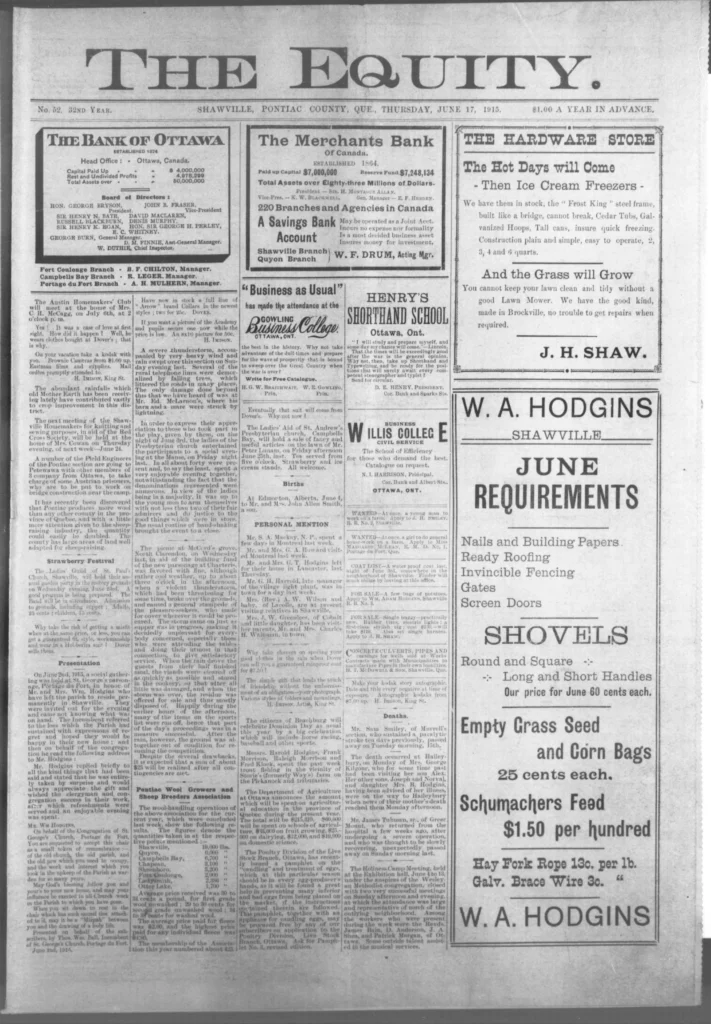
The paper captures the beating heart of a proud Anglophone community living within a Francophone province. The editorial voice of The Equity championed the British Empire, taking immense pride in the belief that Canada’s destiny was to be the “Granary of the Empire” or the “Bread Basket of the World,” as noted in the April 29, 1915, issue. Yet, the dual linguistic and cultural identity of the region regularly spilled onto the pages. For example, the June 17, 1915, issue reported that Prime Minister Sir Robert Borden branded statements made by Francophone Liberal politician Hon. Rodolphe Lemieux regarding the war and elections as an “unqualified falsehood”

.

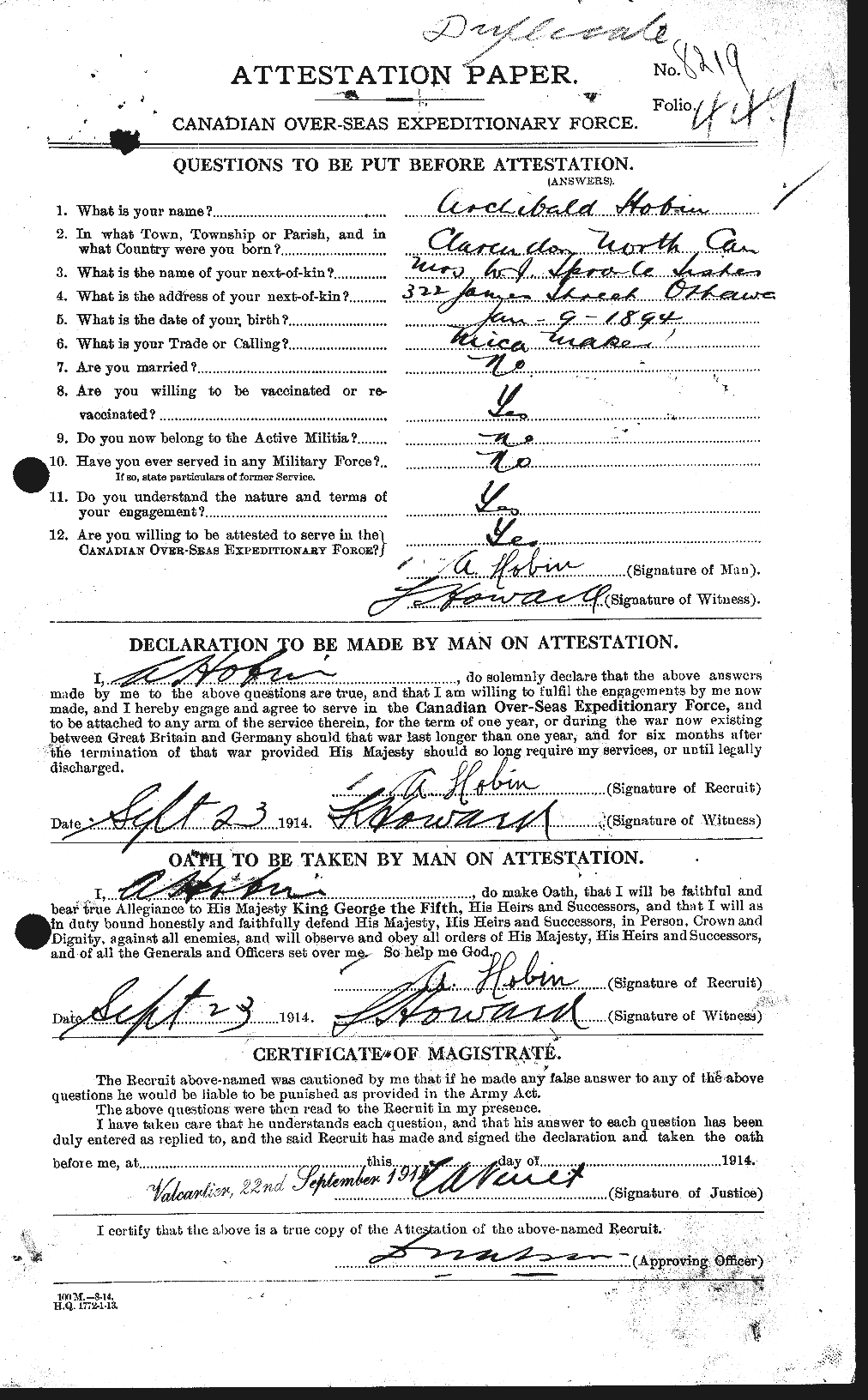
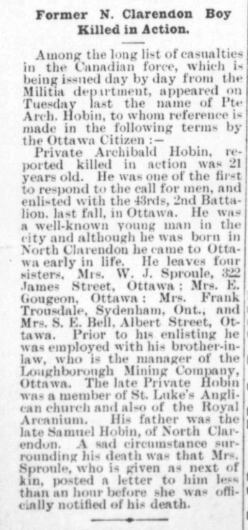
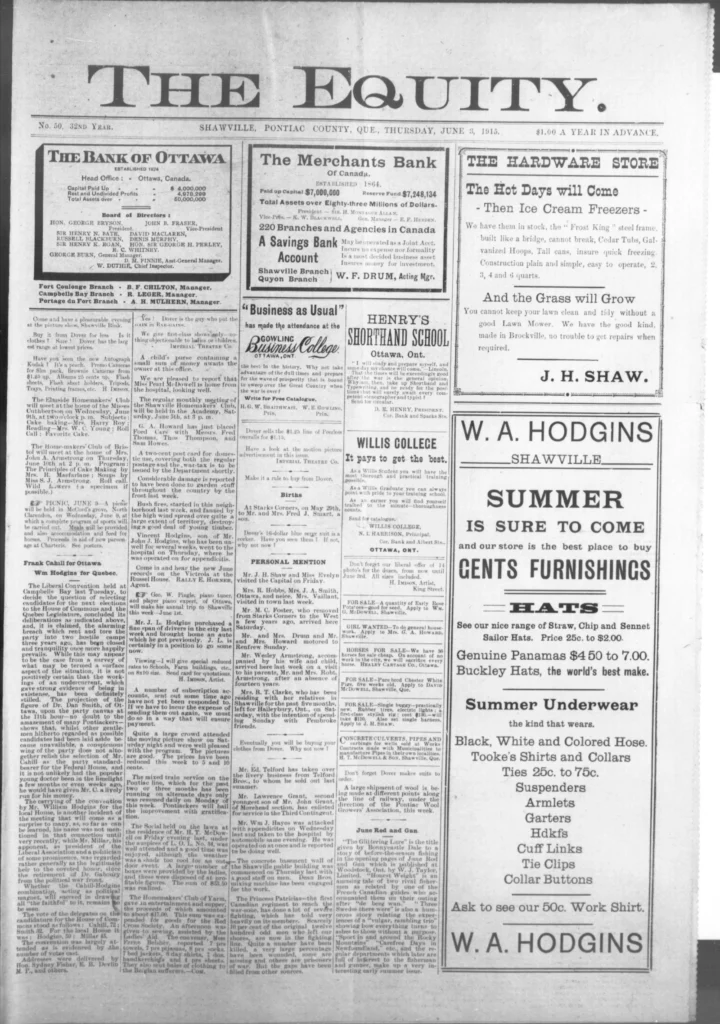
But the true, unifying story found in the columns of The Equity is one of local sacrifice. The war was no longer just headlines; it was the boys from the local townships bleeding in the mud of Flanders. Readers were met with the heartbreaking story of Private Archibald Hobin, a North Clarendon native, who fell in battle, reported on June 3, 1915. The tragedy was magnified by the haunting local detail that his sister had mailed him a letter less than an hour before receiving the official notification of his death.


Attestation paper for Archibald Hobin.
The Equity, June 3rd 1915

The community also read with horror of the enemy’s new weapon during the struggles near Ypres, with a May 13, 1915, report detailing that “poisonous gases added in no small measure to the death roll among the Canadians”

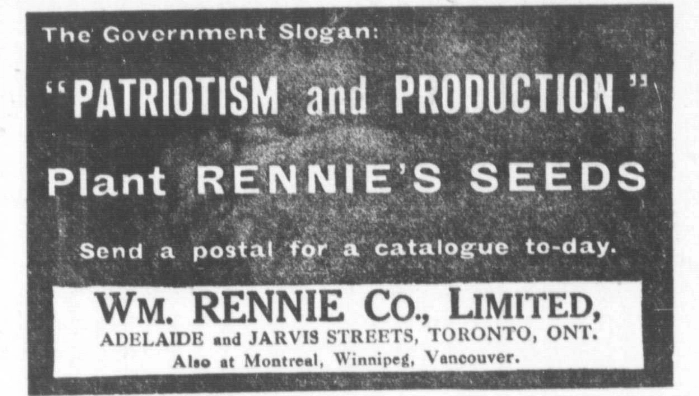
Back home in Pontiac, the war transformed daily life. The government launched a massive “Patriotism and Production” campaign, holding agricultural conferences on April 8, 1915, in towns like Ladysmith, Fort Coulonge, Calumet Island, and Chapeau to urge farmers to increase their yields for the war effort.

Patriotism and Production

The community also read with horror of the enemy’s new weapon during the struggles near Ypres, with a May 13, 1915, report detailing that “poisonous gases added in no small measure to the death roll among the Canadians”

Back home in Pontiac, the war transformed daily life. The government launched a massive “Patriotism and Production” campaign, holding agricultural conferences on April 8, 1915, in towns like Ladysmith, Fort Coulonge, Calumet Island, and Chapeau to urge farmers to increase their yields for the war effort

There was an urgent realization that Canada’s most vital contribution was to feed the dependent millions of England. But the locals sent more than just grain. In a uniquely Canadian gesture, the Red Cross pleaded for donations of maple syrup and sugar, noting in the May 6, 1915, issue that the boys at the front went “fairly crazy with delight” when a few cakes of local maple sugar arrived in the trenches. 

The women of Pontiac mobilized with equal fervor. The Homemakers’ Clubs of Yarm, Shawville, and Elmside turned their social gatherings into industrious knitting bees. The Yarm club, for instance, gave a supper to buy materials and spent the afternoon sewing, turning out pyjamas, bed jackets, socks, and sheets for the Red Cross, as reported on June 3, 1915

Even local entertainment, like lawn socials and the new “moving picture shows” at the Shawville rink, became avenues to raise funds for the patriotic cause

When the Lusitania was torpedoed without warning in May, the shockwaves rocked Pontiac County. On May 13, 1915, The Equity reported the disaster with fierce indignation, quoting Theodore Roosevelt to call it “piracy on a vaster scale of murder than any old time pirate ever practiced.”

Through the lens of these weekly dispatches, the timeline of World War I becomes the story of the soul of a community. Anglophone farmers and their Francophone neighbors were bound by the terrifying demands of history, sending their sons across the ocean and turning their quiet Quebec fields into the lifeline of an Empire.

Soldiers Mentioned in The Equity

These names  have been extracted from copies of The Equity by AI and may have mistakes.  Please let us know if you catch any at jon@theequity.ca.

Mentioned Soldier / Personnel Status / Details
Apr 1, 1915 Cpl. Cameron Mackay Only son of S. A. Mackay (Shawville); First Contingent. Killed in action.
Apr 1, 1915 Pte. Donald L. Kemp Son of John Kemp. Reported seriously wounded in action.
Apr 1, 1915 Lieut. Thacker 1st Brigade, Canadian Field Artillery. Reported wounded.
Apr 1 / 15, 1915 L-Cpl. H. V. Naylor Nephew of Ven. Archdeacon Naylor; former Shawville student. Killed in action.
Apr 1 / May 13 I. Wilkie & R. Anderson Shawville men with the 21st Battalion; trained at Kingston before leaving for France.
Apr 1 / Jun 24 Pte. Willie Creek 38th Battalion; trained at Barriefield before leaving for the front.
Apr 1 / 8, 1915 Col. Farquhar et al. Officers of the P.P.L.I. (including Rivers Bulkeley and Newton). Killed in action.
Apr 8, 1915 Sgt. Arthur Harrold Canadian Field Engineers; former Shawville Electric manager. Honored by comrades.
Apr 8, 1915 Bell-Irving Canadian Engineers. Officially reported killed.
Apr 8, 1915 H. Hammond et al. Macdonald College graduates (Robinson, Green, Ness) left with No. 3 General Hospital.
May 13, 1915 Fred H. Hodgins Son of W. H. Hodgins; enlisted in the 48th Battalion, C.E.F. at Victoria, B.C.
May 20, 1915 Pte. Archibald Hobin 24-year-old from North Clarendon; 43rd Battalion. Killed in action.
May 20 / Jun 24 Miss Mabel Hamilton Daughter of William Hamilton (Quyon); sailed on the Metagama to serve as a nurse.
May 27, 1915 Lts. Plummer & Arnoldi Field Comforts Commission; distributed gifts to Canadian troops from Amesbury, England.
May 27 / Jun 17 Dr. A. A. Mackay Medical officer with No. 4 General Hospital; honored by C.A.S.A. before departure.
Jun 3, 1915 Major Gordon Wright 3rd Field Co. Engineers; killed in action during engagement near Ypres.
Jun 3, 1915 Lawrence Grant Son of John Grant (Morehead); enlisted for service in the Third Contingent.
Jun 3, 1915 Sgt. Michael O'Leary Irish Guards (V.C. recipient). Reported killed in action.
Jun 17, 1915 Tierney & Lederoute First soldiers from Arnprior to fall on the battlefield in France; First Contingent.
Jun 17, 1915 Pontiac Field Engineers Local detachment sent to Petawawa to oversee Austrian prisoners on bridge construction.
Jun 24, 1915 McKeown & Amyot Medical personnel (U of T) established a 1,040-bed Base Hospital in France.

Listen to our Podcast!

We’ve used Artificial Intelligence to summarize what was covered in The Equity during this part of the Great War. Click the play button to listen.

00:00

Timelines: April - June 1915

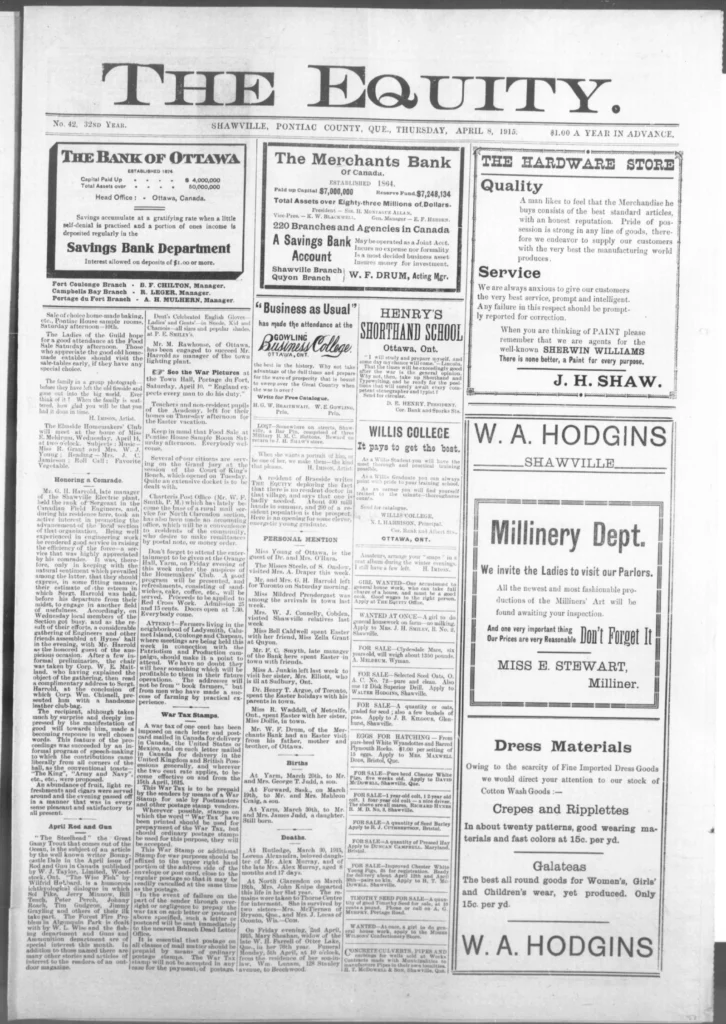
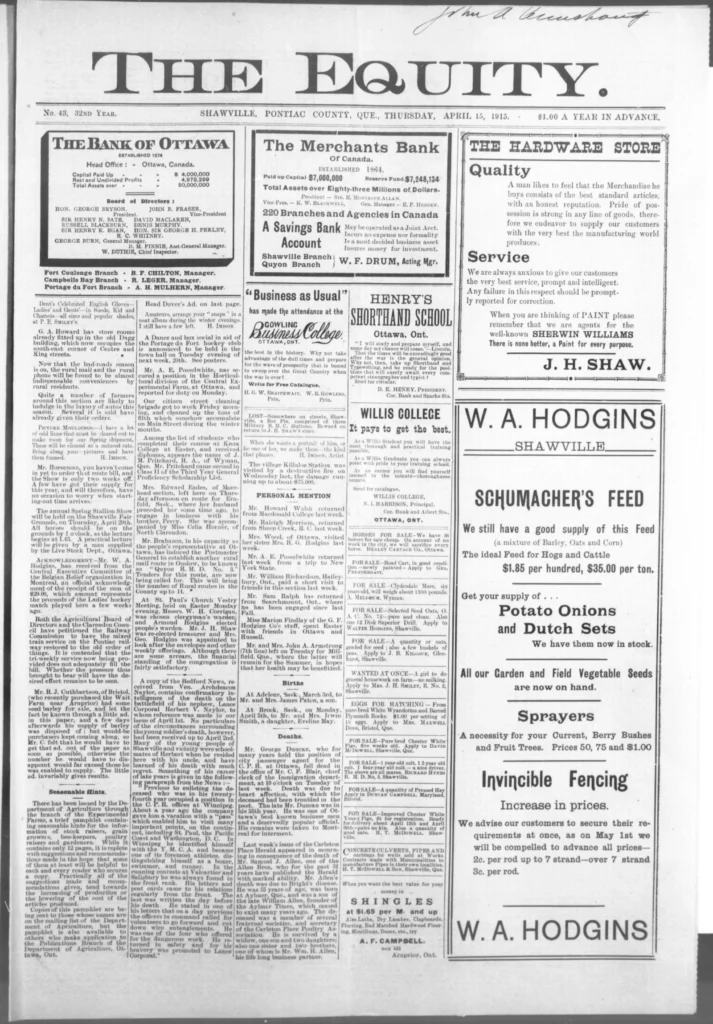
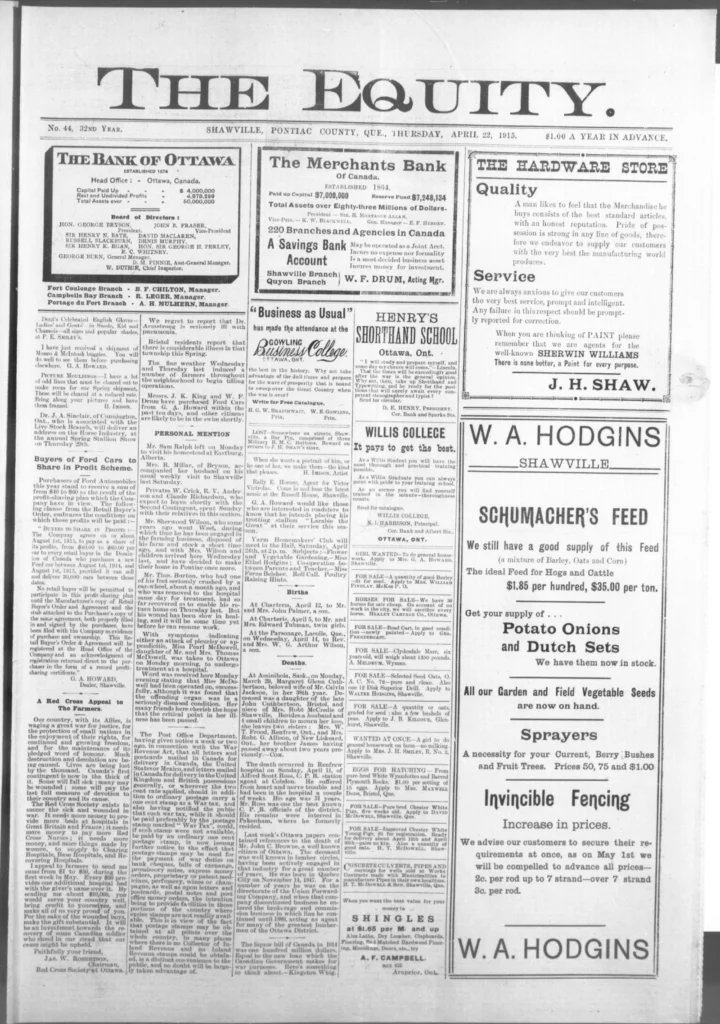
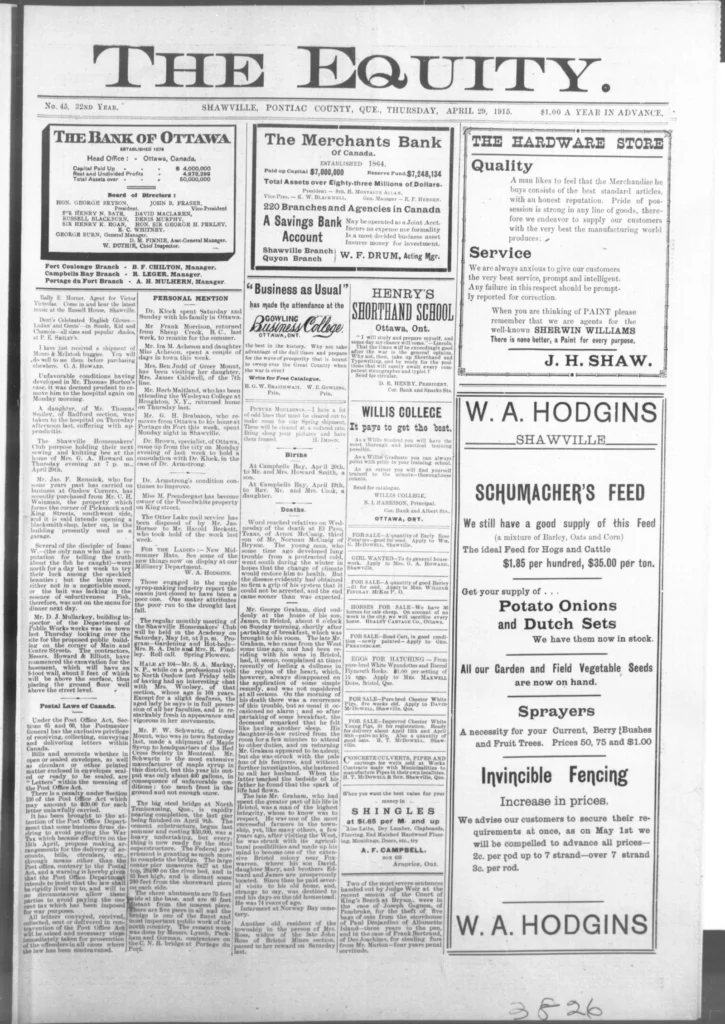
Below are the original copies of The Equity from this part of the War. Click any of them to download a PDF copy.

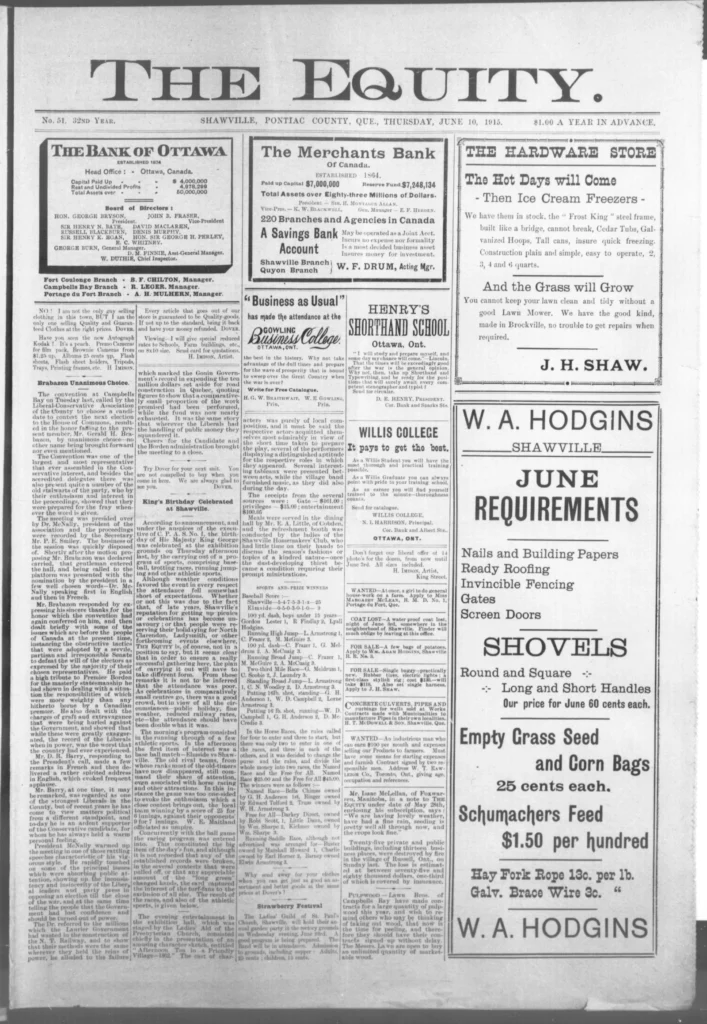
April 1, 1915

April 08, 1915

April 15, 1915

April 22, 1915

April 29, 1915

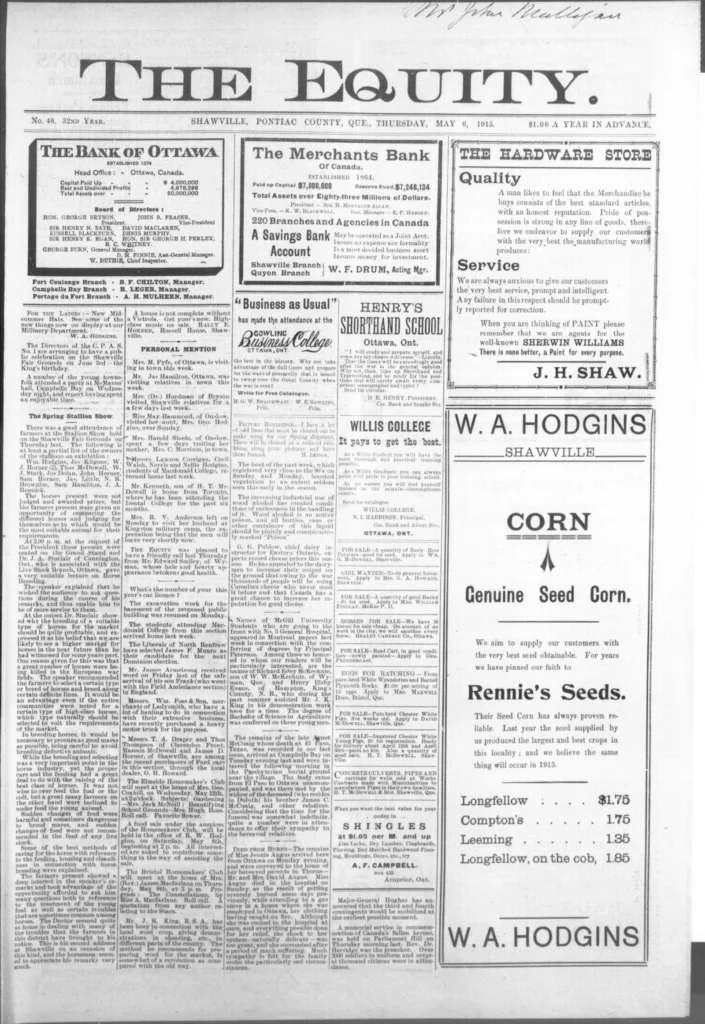
May 06, 1915

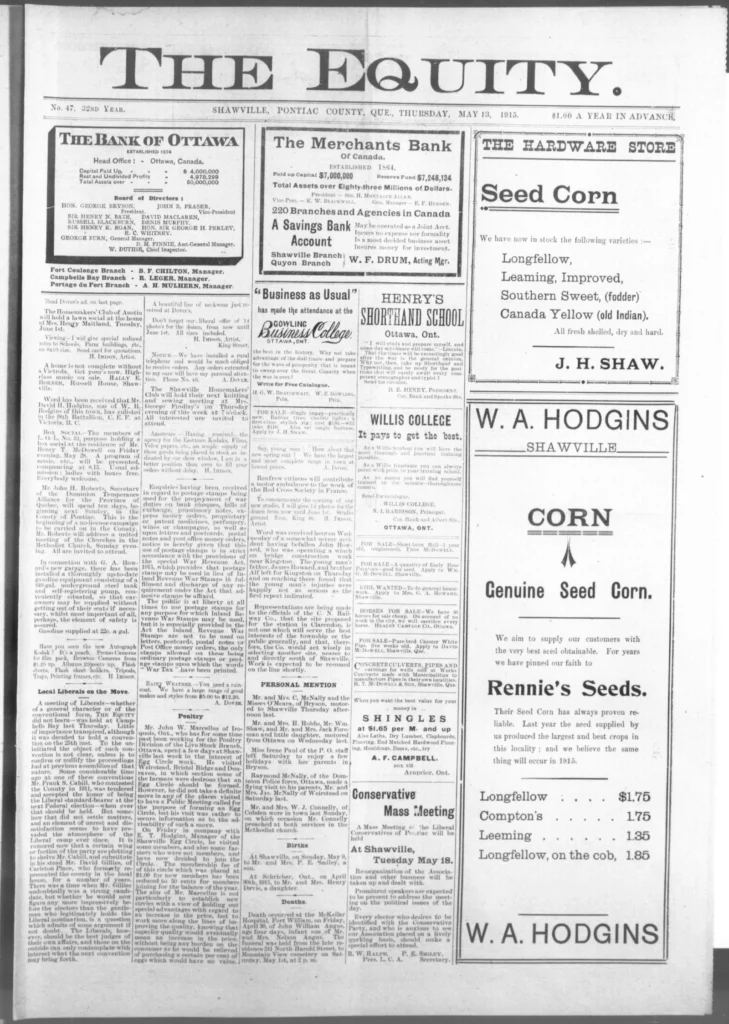
May 13, 1915

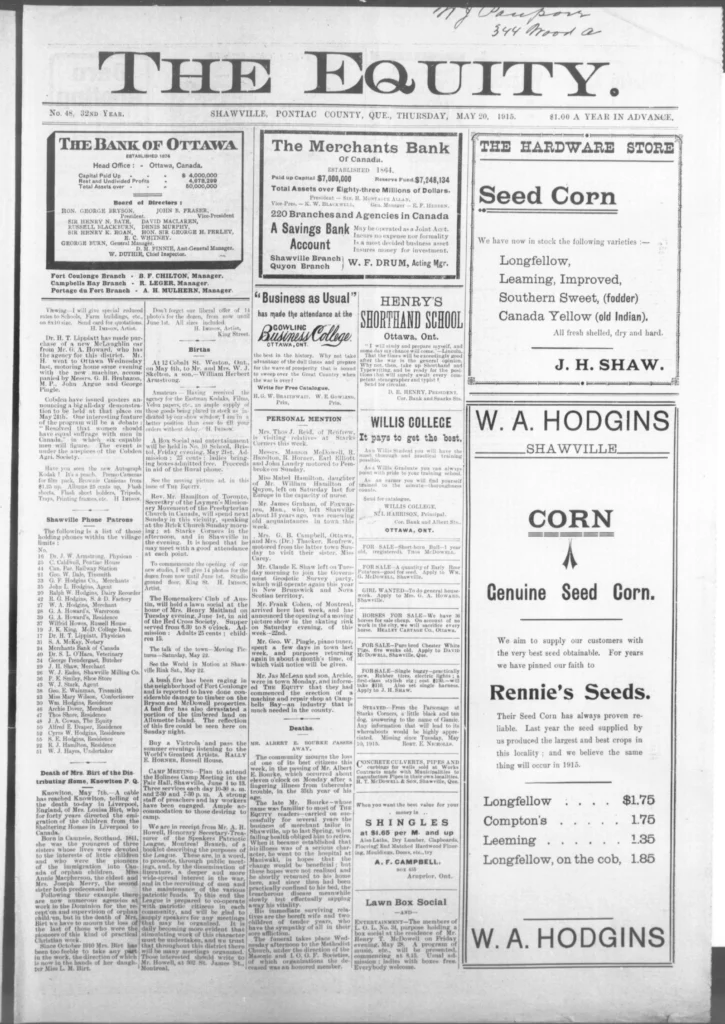
May 20, 1915

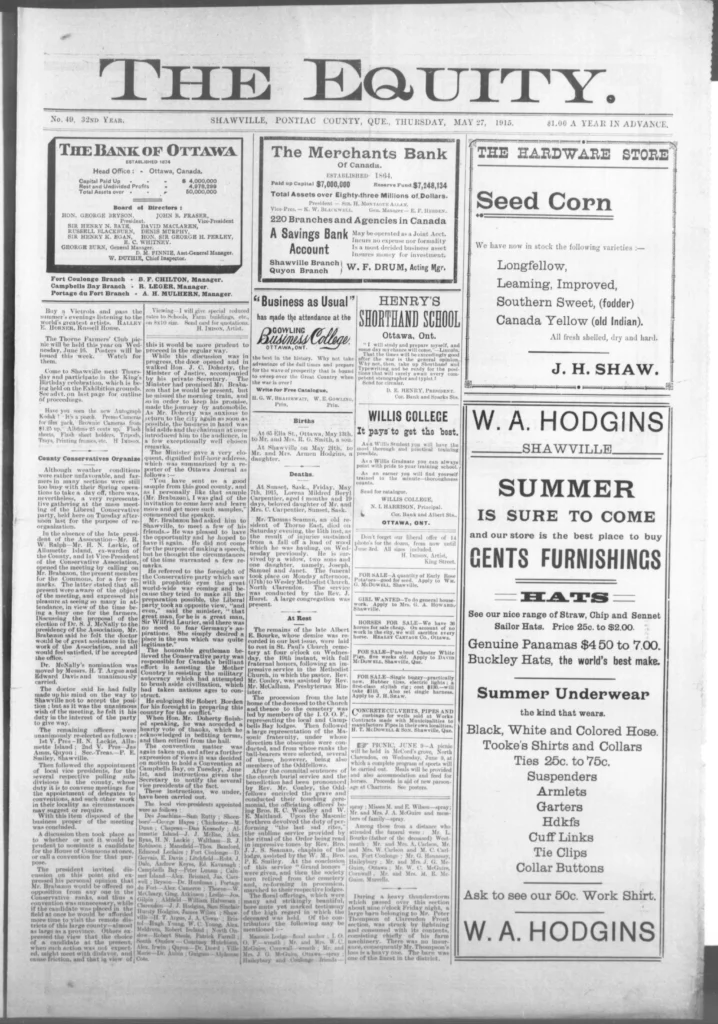
May 27, 1915

June 3, 1915

June 10, 1915

June 17, 1915

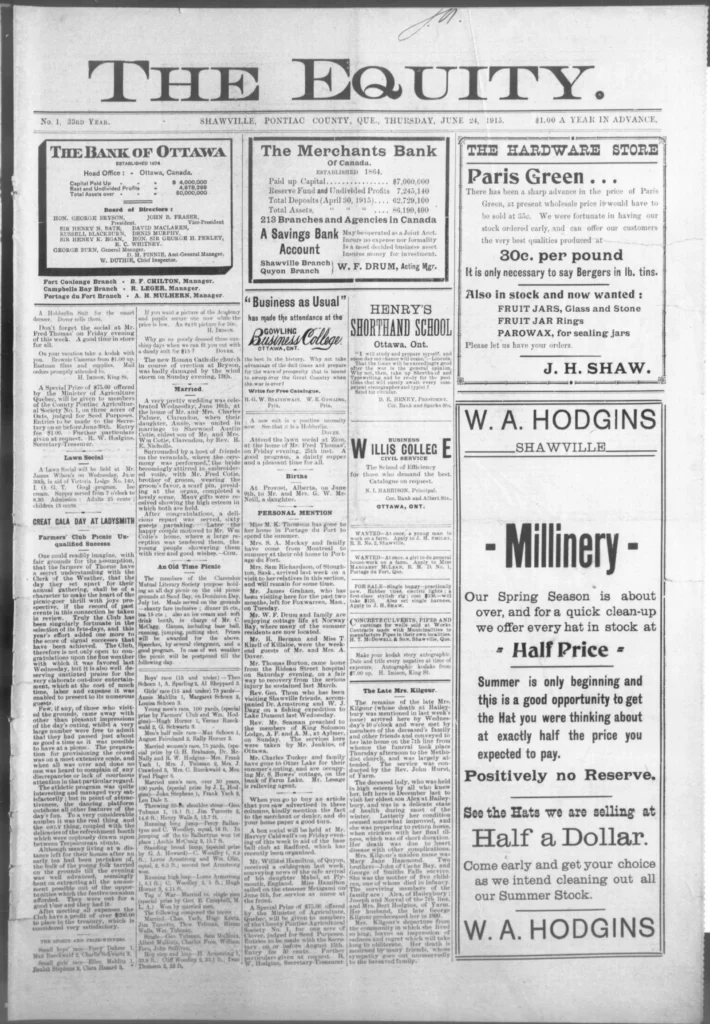
June 24, 1915

Read More From Our Project