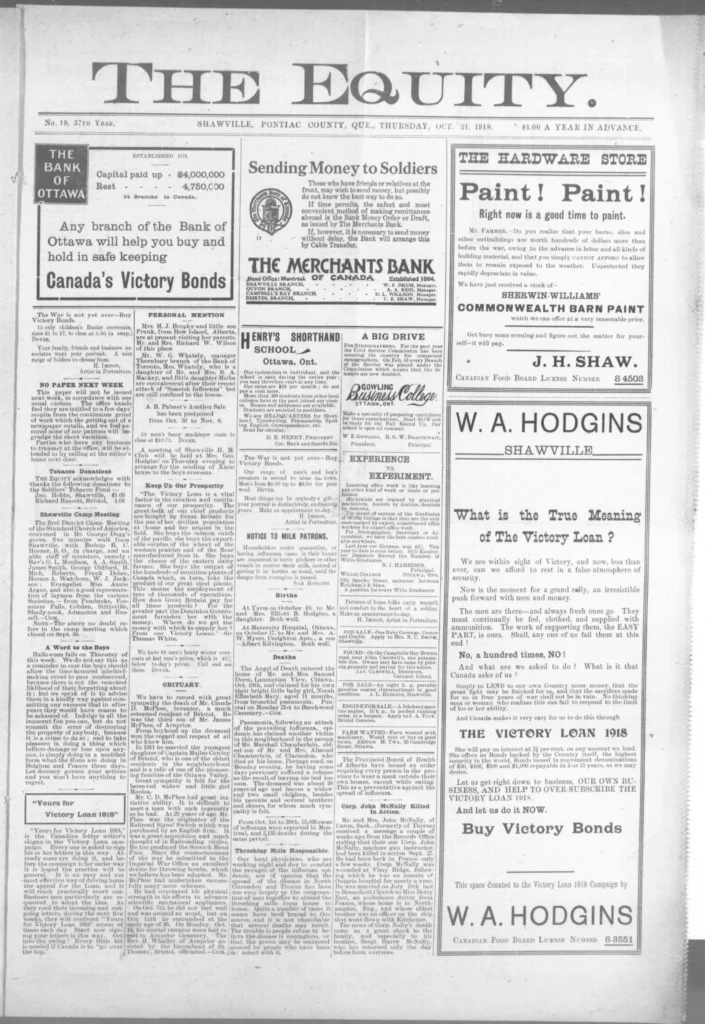
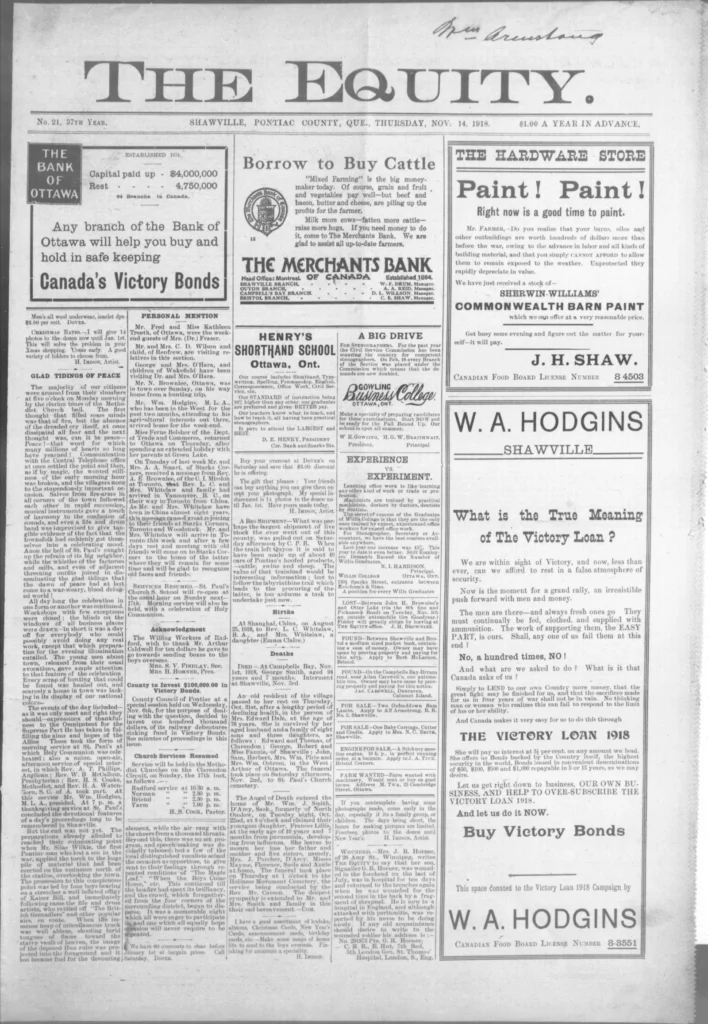
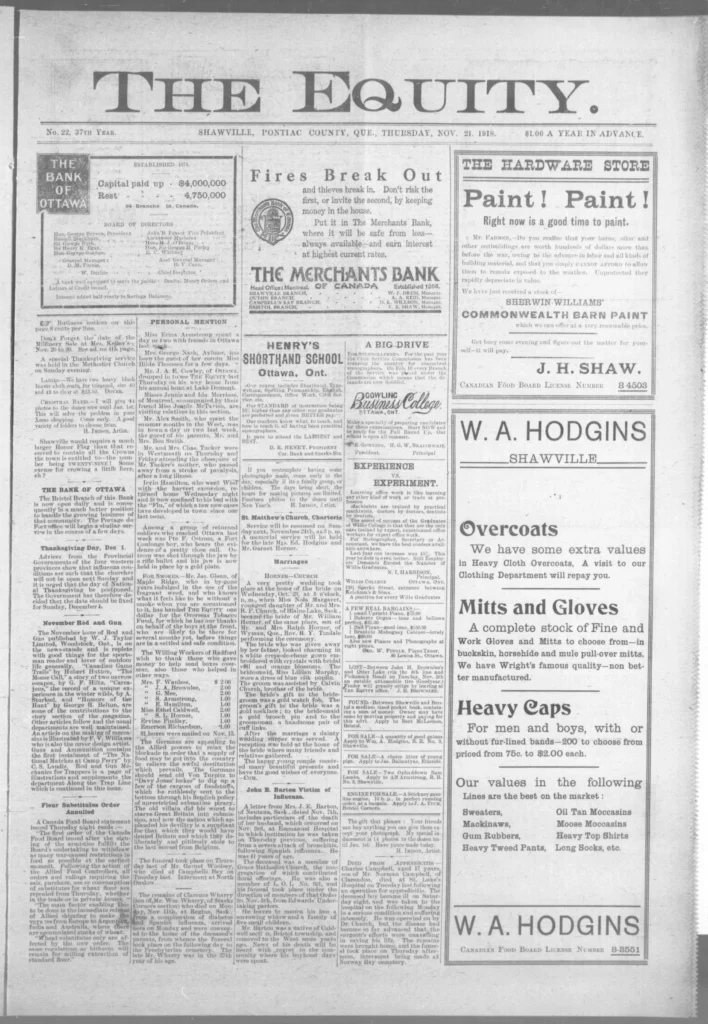
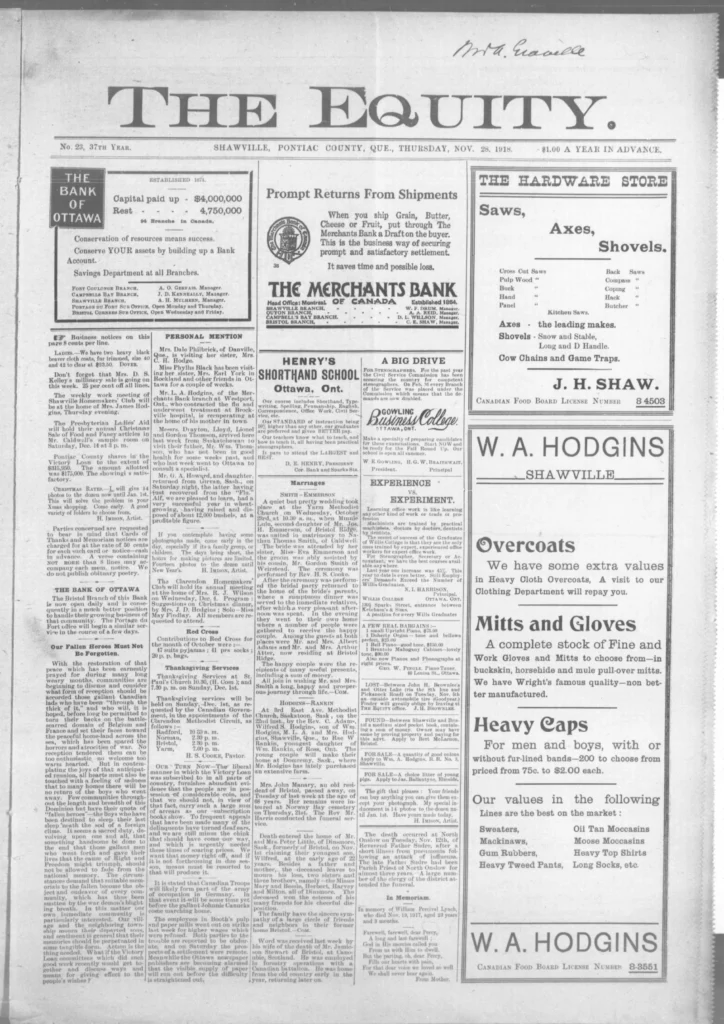
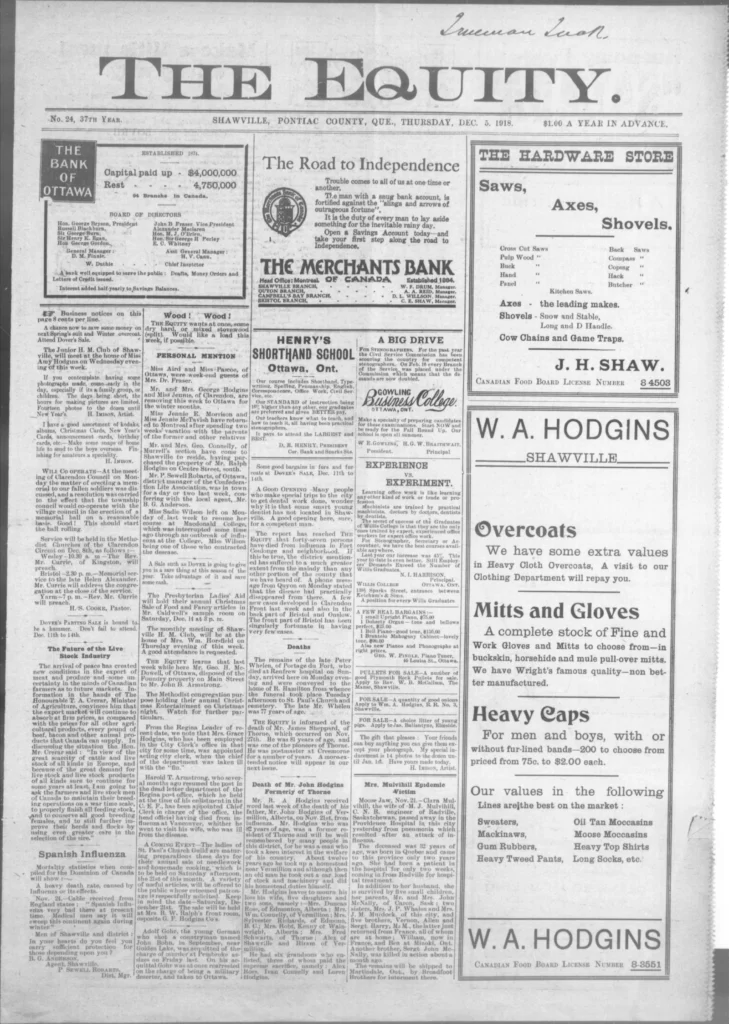
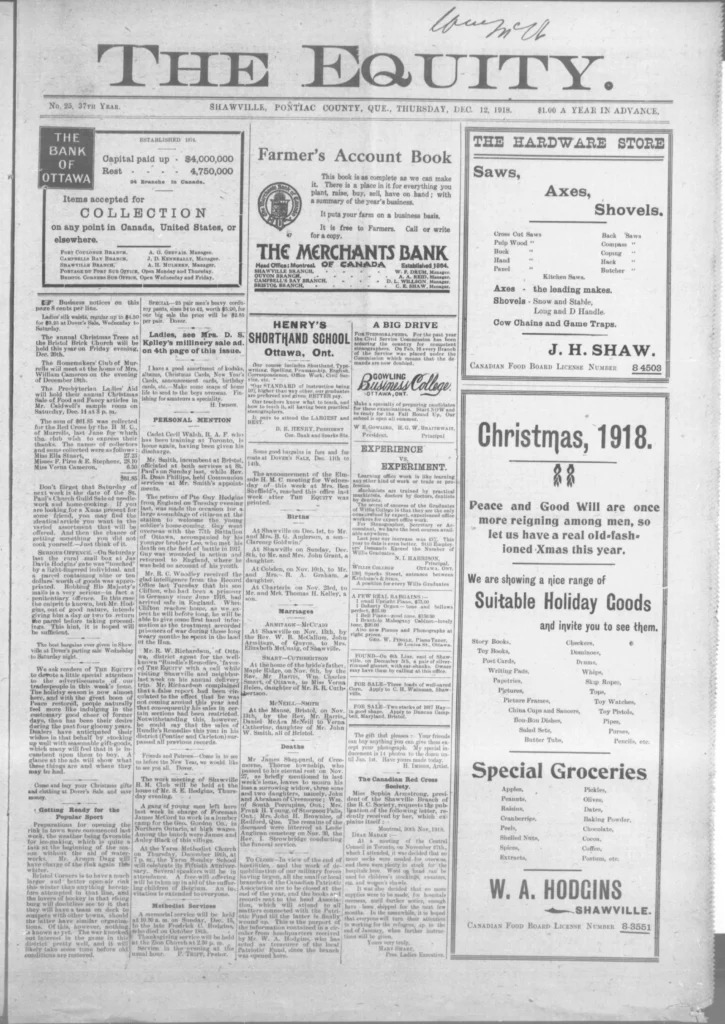
The final months of the First World War brought both triumph and tragedy to the Pontiac — a season marked by unrelenting home-front effort, deep personal loss, and the first wave of the deadly Spanish Influenza.
As Allied armies advanced toward victory in Europe, local citizens of the Pontiac were called upon to match that momentum through renewed patriotism, sacrifice, and self-discipline. The 1918 Victory Loan campaign became the centerpiece of that effort. The county responded with remarkable vigor, surpassing its quota of $175,000 to raise $315,050, a figure that reflected both loyalty and confidence.
Even the Pontiac County Council joined in, investing $100,000 on behalf of the community. The campaign was framed as more than financial obligation — it was a promise that Canada would sustain Britain’s ability to buy Canadian grain and produce, ensuring both the war effort and the local economy endured together.
Yet the human cost of that war pressed heavily on the region. Families received heartbreaking telegrams from the front during the final push toward Cambrai. Local soldiers such as Wilfred Tripp wrote home of the desperate fighting, describing heavy losses among officers and comrades.
I was wounded just west of Cambrai in one of the biggest fights that we Canadians have been in. The two days previous to my being wounded we went over the top and were doing fine until the evening of the second day. Fritz seemed to concentrate on us, and we were almost cut to pieces. All our officers were either killed or wounded. Among them was Lieut. Anderson, of Renfrew—a brother of R. V. Anderson of Shawville, who was killed some time ago, and, oh, my, it was the saddest thing of my life. He was such a fine chap, and we were great pals; we chummed a lot together. I was sent back to headquarters to report that nearly all our officers were either killed or wounded, and was resting along with about fifteen other men in a big hole that the Germans had used for ammunition, when a big German shell came right among us. Five of the number were killed and the rest wounded. I happened to be one of the lucky ones, unless a man is killed here he is counted lucky. I was hit in two places—on the left leg just above the knee, and on the left foot have lost part of a toe, and also just below the ankle on the left foot. On my right leg I was hit in two places—just below the knee. So you see I have been pretty well laid up, but consider myself very fortunate to get out with my life at all. Don’t worry, mother; I expect to come out of it O. K., and according to reports the war may be over before I am able to go back again, and old Fritz will be badly beaten as he richly deserves.”
Wilfred Tripp, published November 21, 1918
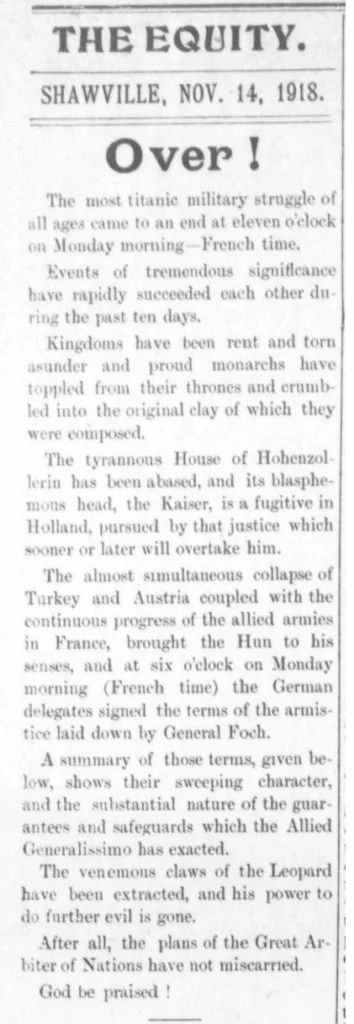
Throughout the autumn of 1918, The Equity shifted toward discussing an imminent Allied victory. The paper noted that the “smashing, ceaseless blows” delivered by Allied forces had finally turned the tide against Germany. As Central Powers like Bulgaria collapsed, the publication confidently declared the failure of the Kaiser’s “deep-laid plans,” asserting that a rapid succession of military triumphs had brought the end of the war into clear view. This optimism even permeated the paper’s commercial space, as advertisements began to reflect the prevailing sense of impending peace.
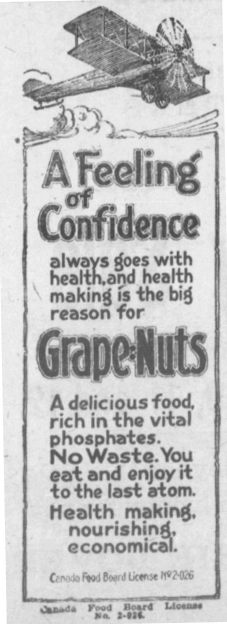
Political and legal tensions continued to ripple through the province even as victory drew near. Notices in The Equity reminded readers that exemptions from conscription were being canceled and that even farmers must seek permits for winter work such as lumbering or munitions.
The newspaper followed the controversy closely, noting a Quebec judge’s ruling that challenged the federal order-in-council — a decision quickly overturned by the Supreme Court of Canada. The dispute underscored Quebec’s uneasy relationship with conscription to the very end. Even foreign nationals were not exempt: American citizens residing in Canada were required to register for military service under Dominion law.
As the war reached its closing weeks, another crisis arrived. The Spanish Influenza swept into the Pontiac, forcing municipal authorities to take drastic action. Councils in Clarendon and Bristol ordered the closure of schools and churches, while public gatherings were banned outright.
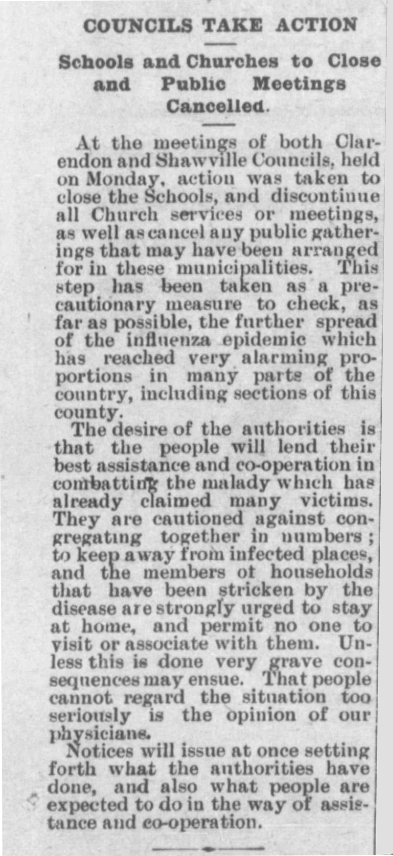
Entire families fell ill, and the disease spread quickly through threshing crews and communal work sites. Health officers imposed quarantines, requiring medical certificates for anyone entering from infected areas. The pandemic, arriving just as the war seemed nearly won, cast a dark shadow across a weary county.
On November 11, word of the Armistice reached the Pontiac. Factory whistles blew, shops closed, and crowds filled the streets in spontaneous celebration. Flags waved from every building as church bells rang for the first time in years without sorrow.
As the guns fell silent, local communities turned their focus toward honoring the “gallant Canadian lads” returning from the front. The prevailing sentiment was that no tribute could be “too enthusiastic” and no reception “too great” for those who had survived the horrors of the Great War. These homecomings, however, were often marked by a poignant blend of jubilation and grief.
When Pte. Guy Hodgins returned home to Shawville in December 1918, he was met by a large assembly of local citizens. Behind the celebration lay a heavy family sacrifice: Guy’s father, David Hodgins, had been killed in action in France just a month after Guy and his brother Lee enlisted in early 1915. Both brothers had lied about their ages to serve; Guy was only 15, and Lee was just 13. While Guy eventually made it home, Lee was killed on the battlefield at the age of 14, never having the chance to return.
The physical scars of battle were equally visible. Pte. F. Ostrom returned to Fort Coulonge with a jaw rebuilt by a gold plate—the result of a “close call” with a rifle bullet—while Pte. Willie Dunn bore the permanent marks of the assault on Vimy Ridge. For the McNally family, the timing was particularly cruel; Sergt. Harry McNally arrived home just twenty-four hours before news reached them that his brother, Corp. John McNally, had been killed in action. With the troops finally trickling home, the infrastructure of the home front began to dissolve, signaled by the announcement that local branches of the Canadian Patriotic Association would shutter their doors by year’s end.
Though the guns had finally fallen silent, the impact of the Great War left an indelible mark on the people of the Pontiac, who returned to a world forever altered by the scale of their sacrifice. For our tight-knit community, the landscape of home remained the same, yet the social fabric was permanently reshaped by the grief and hard-won maturity of a generation that had seen too much, too soon.
Soldiers Mentioned in The Equity
These names have been extracted from copies of The Equity by AI and may have mistakes. Please let us know if you catch any at jon@theequity.ca.
| Mentioned | Soldier / Personnel | Status / Details |
|---|---|---|
| Oct 3, 1918 | Pte. T. Harvey Craig | Reported wounded in the right forearm. |
| Oct 3, 1918 | Miles Daley | Reported wounded in action. |
| Oct 3, 1918 | Sergt. Bert Brown | Safe and on active duty in France; recommended for a commission. |
| Oct 3, 1918 | Crawford Dolan | Killed instantly by a German sniper. |
| Oct 3 / Nov 21 | Pte. Fred Ostrom | Initially reported missing; returned home recovering from a severe jaw wound. |
| Oct 10, 1918 | Pte. Ernest E. Murphy, D.C.M. | Awarded D.C.M. and Bar; reported killed in action in France. |
| Oct 17, 1918 | Pte. Willie Dunn | Returned home after being wounded in the leg at Vimy Ridge. |
| Oct 17 / 24, 1918 | Gnr. John Milton Klock | Reported dangerously wounded; later succumbed to his wounds. |
| Oct 17 / Nov 21 | Wilfred Tripp | Wounded in legs and foot west of Cambrai; recovering in hospital. |
| Oct 24, 1918 | Pte. Fred Moore | Deceased; local memorial service held in his honor. |
| Oct 31 / Dec 5 | Corp. John McNally | Reported killed in action. |
| Oct 31 / Dec 5 | Sgt. Harry McNally, M.M. | Awarded Military Medal; returned home from service in France. |
| Nov 14, 1918 | Pte. G. R. Horner | Wounded; recovering in the 5th London General Hospital. |
| Nov 21, 1918 | Lieut. Alfred W. Anderson | Reported recently killed in action. |
| Nov 21, 1918 | Pte. R. V. Anderson | Memorial mention: Killed early in the war. |
| Nov 28, 1918 | Jamieson Stewart | Died in Scotland while serving in forestry operations. |
| Nov 28, 1918 | Pte. Tom R. Farrell | Wounded in both legs; recovering in a hospital in England. |
| Dec 5, 1918 | William McNally | Reported to be on active duty in France. |
| Dec 12, 1918 | Cadet Cecil Walsh, R.A.F. | Returned home and received his discharge. |
| Dec 12, 1918 | Pte. Guy Hodgins | Reported returned home from service in England. |
| Dec 12, 1918 | Lee Hodgins | Memorial mention: Killed in action previously. |
Listen to our Podcast!
We’ve used Artificial Intelligence to summarize what was covered in The Equity during this part of the Great War. Click the play button to listen.
Timelines: October - December 1918
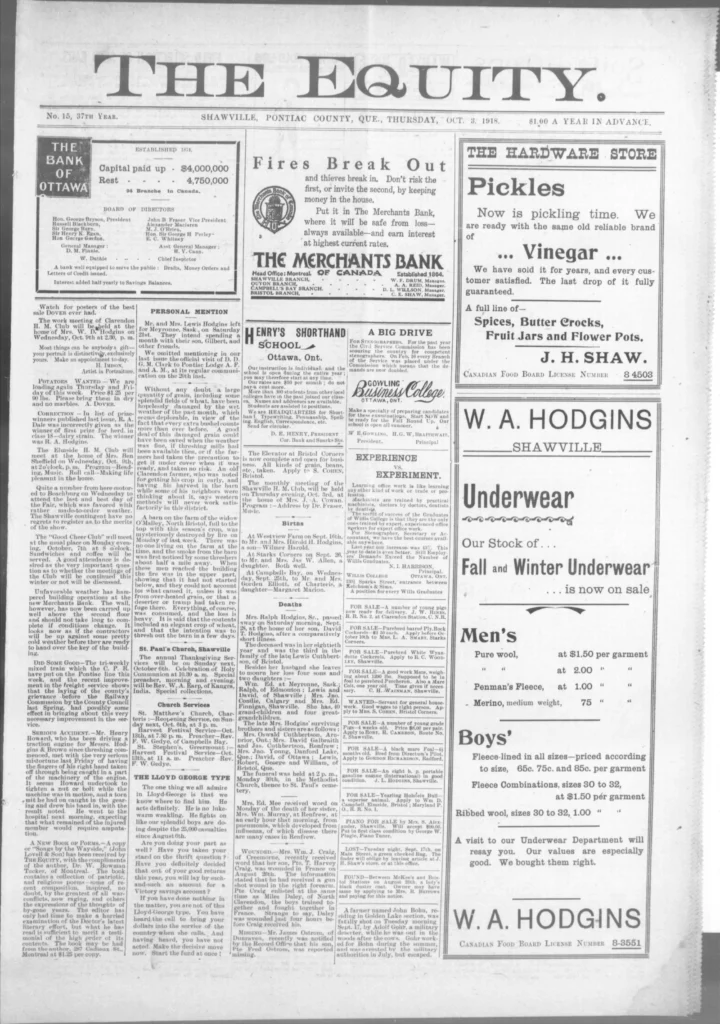
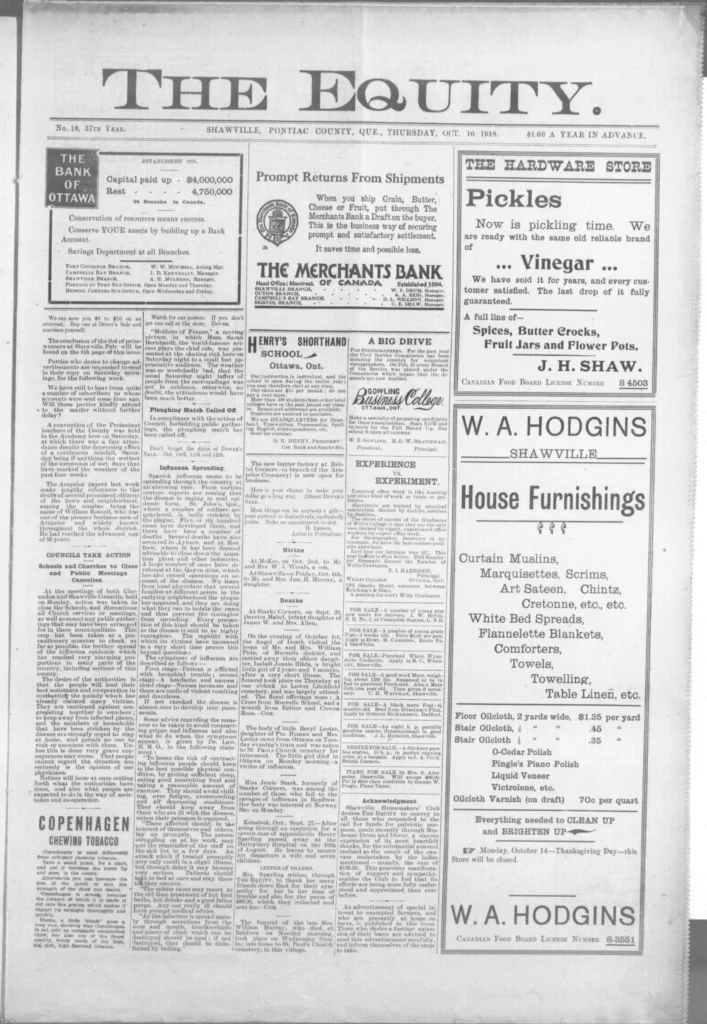
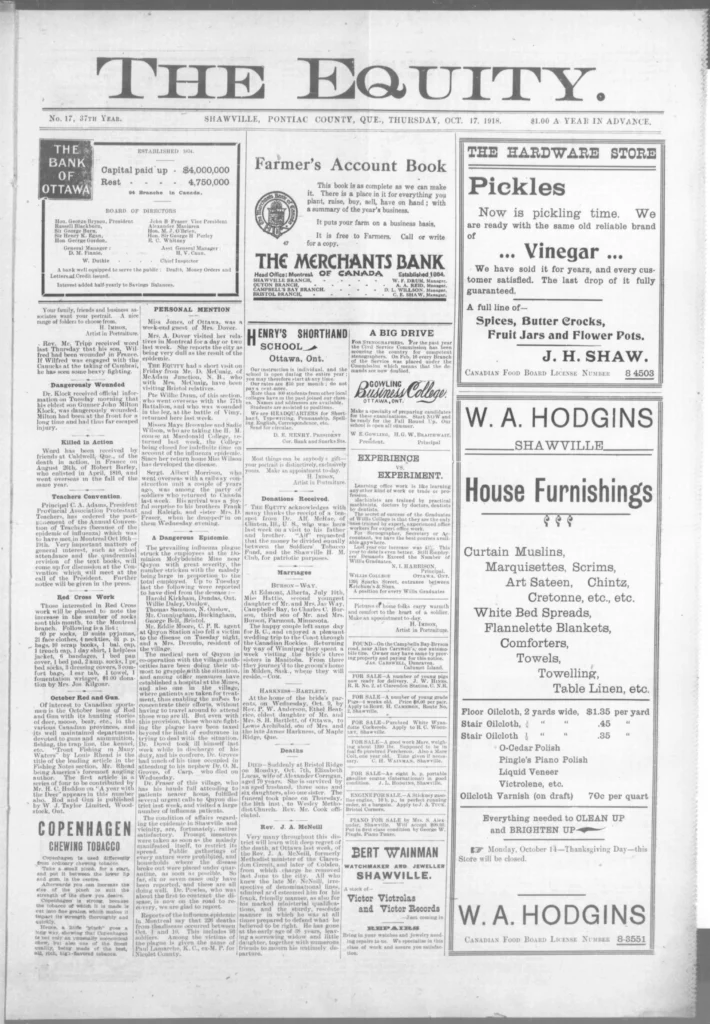
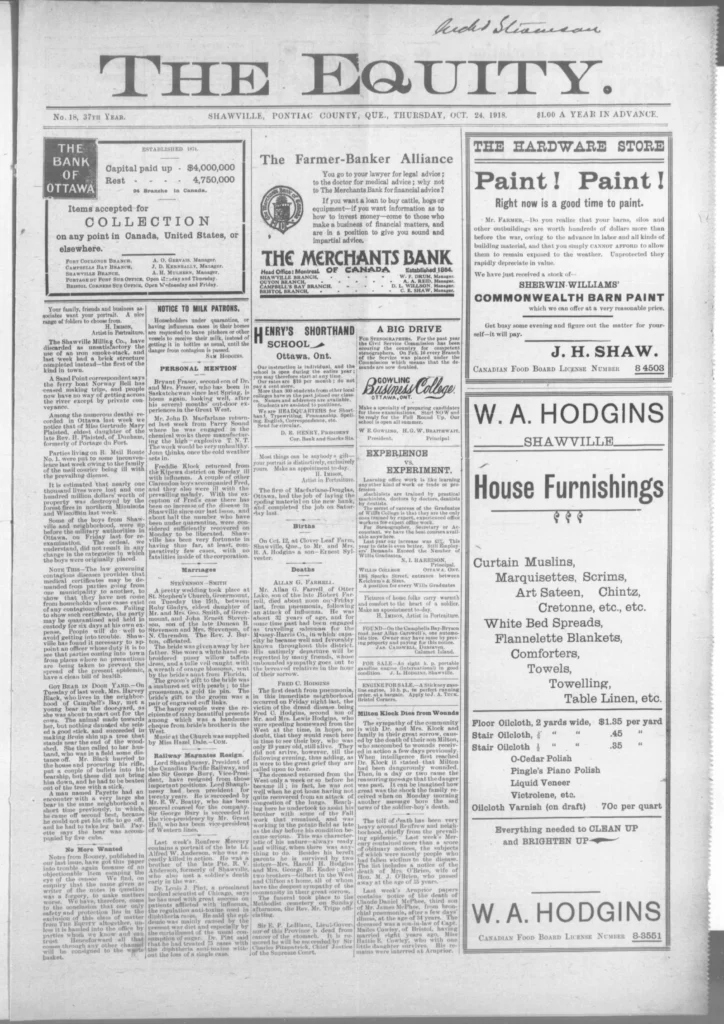
Below are the original copies of The Equity from this part of the War. Click any of them to download a PDF copy.