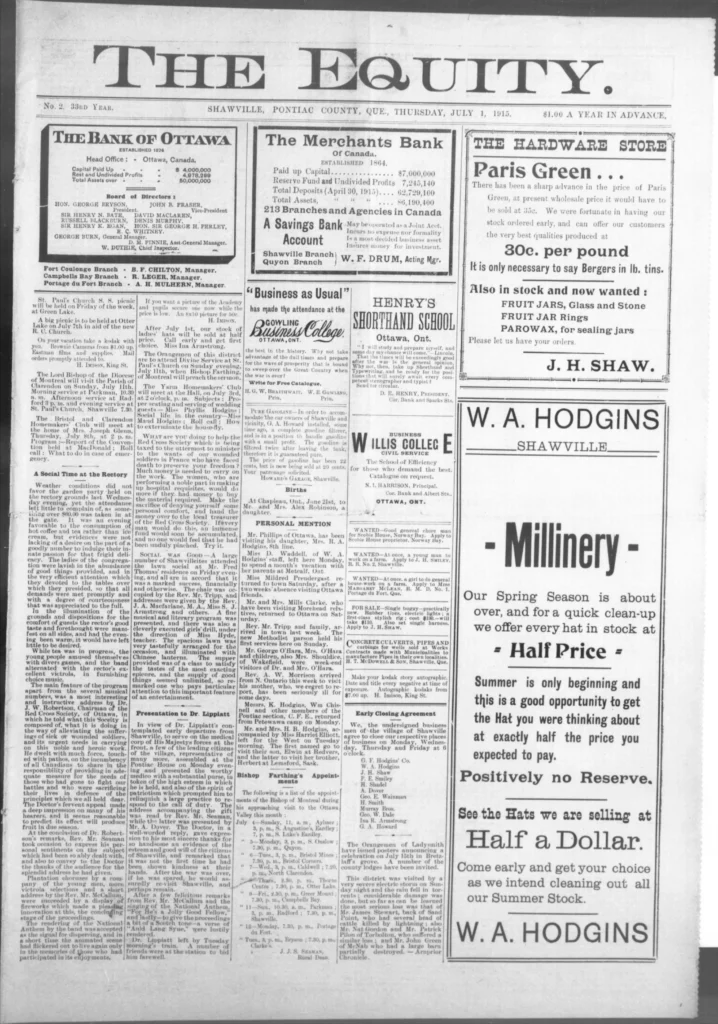
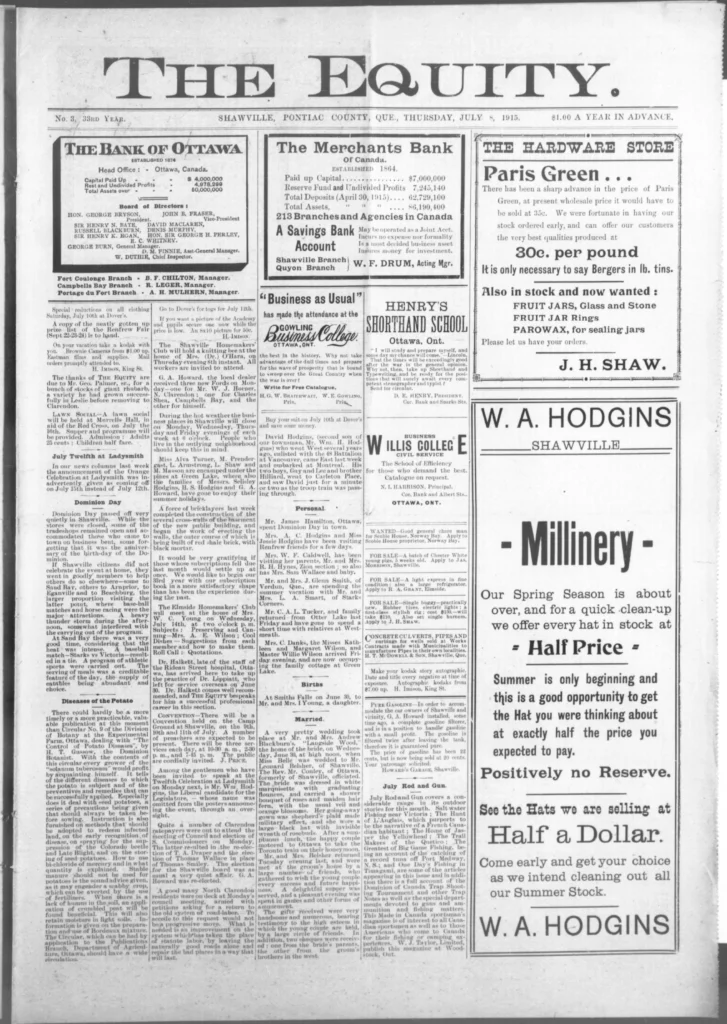
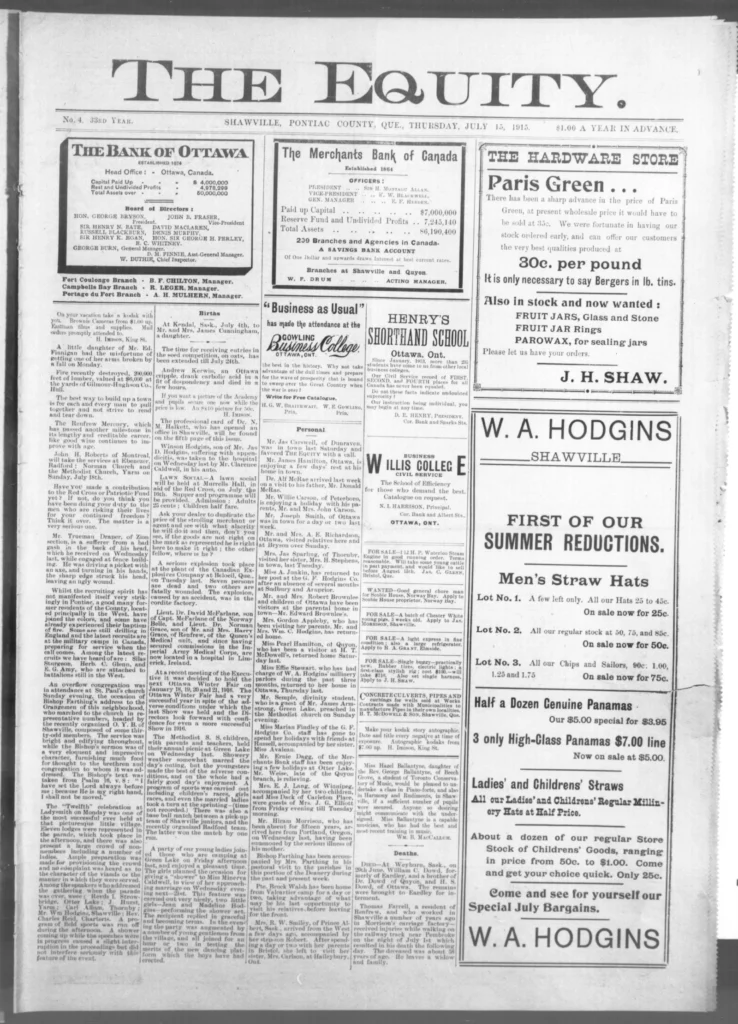
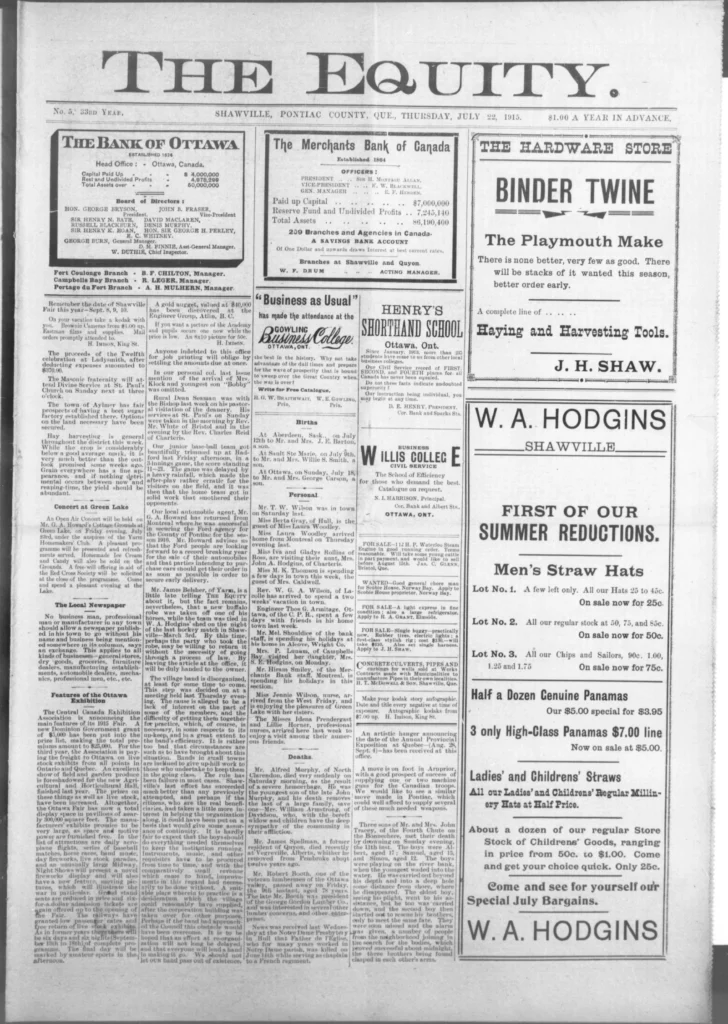
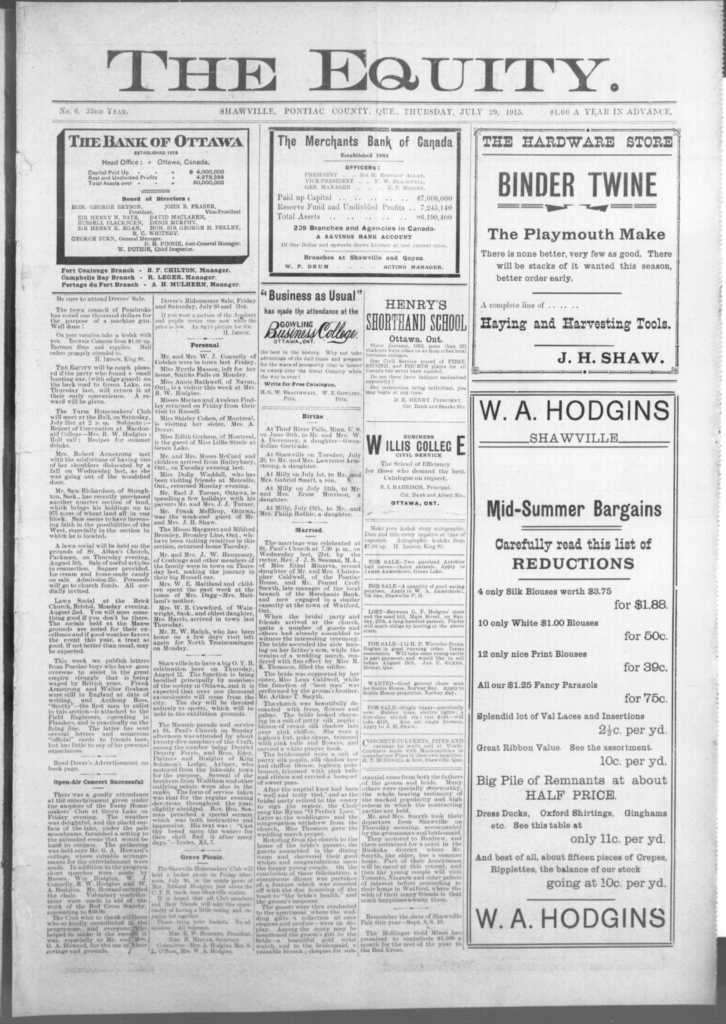
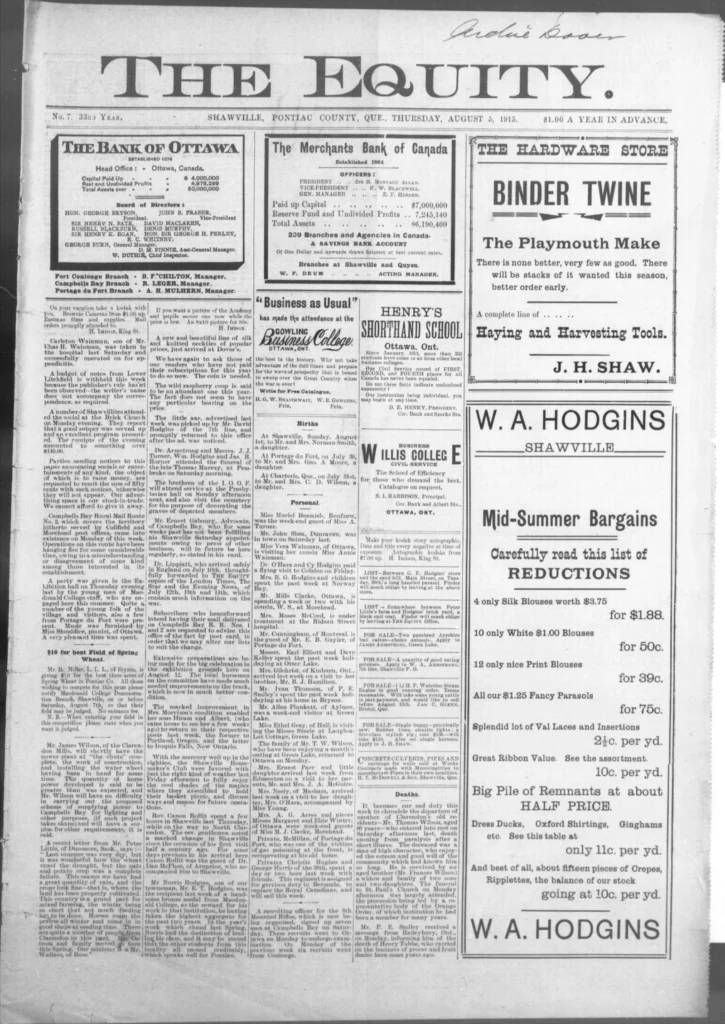
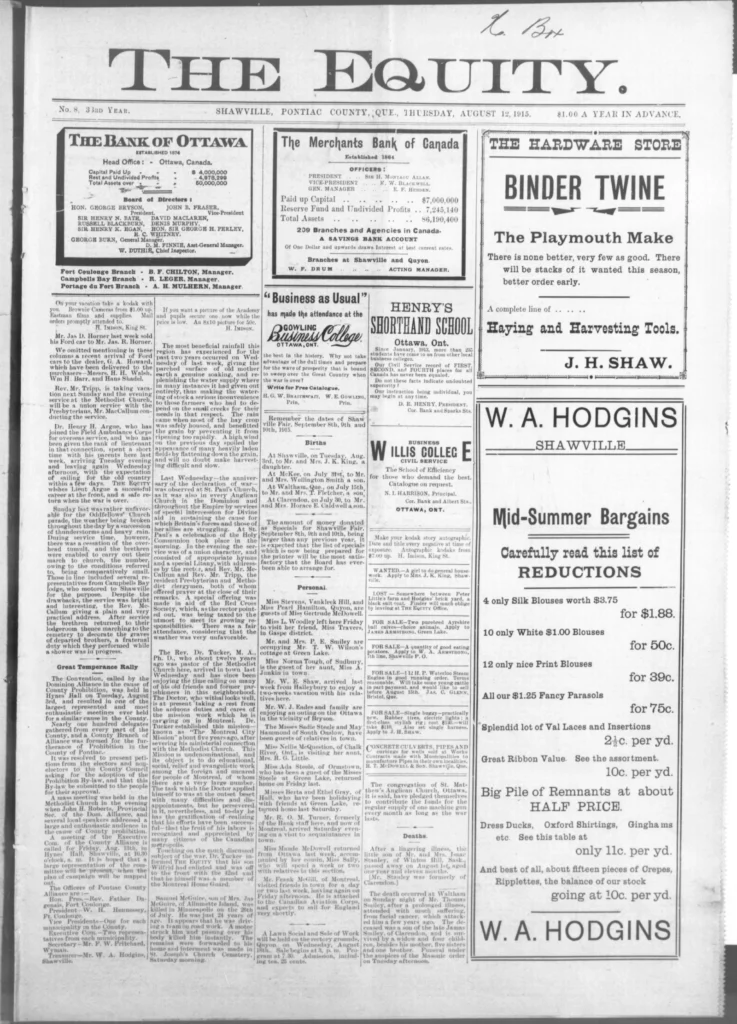
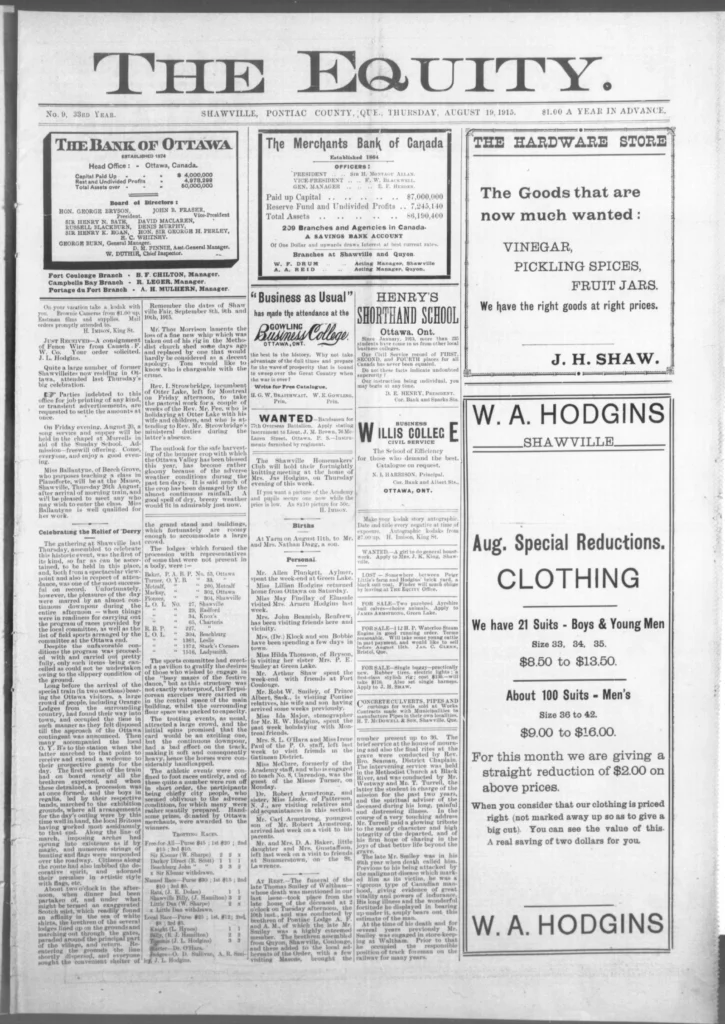
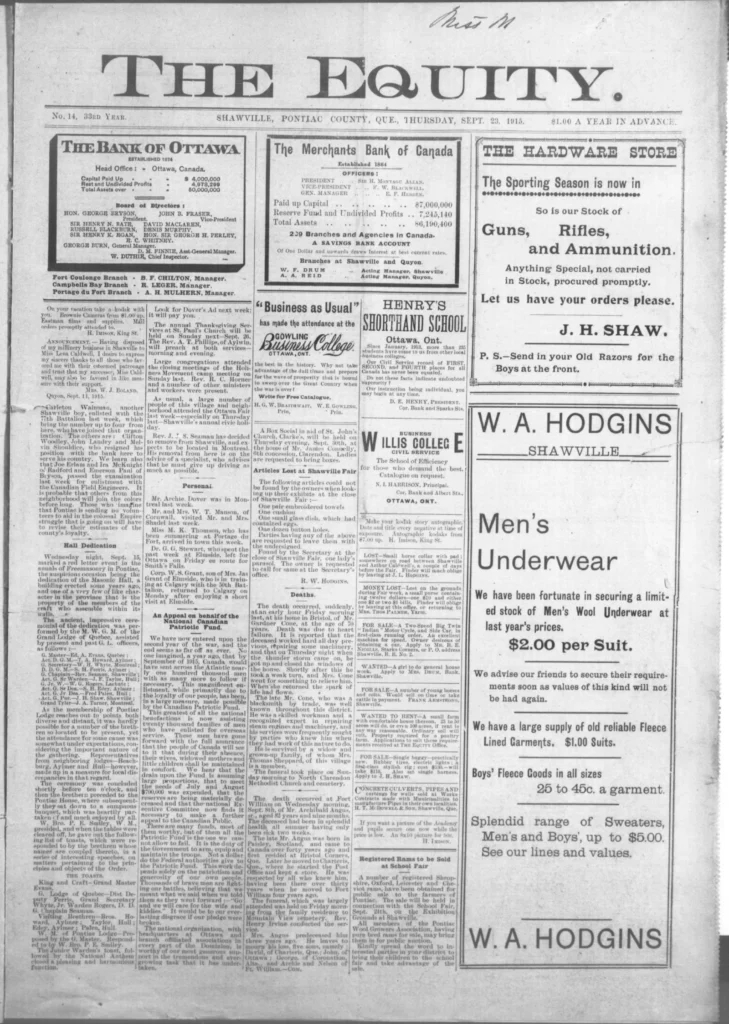
Throughout the summer and early fall of 1915, The Equity continued to run advertisements proclaiming “Business as Usual,” , but the reality of the Great War touched every aspect of life in Pontiac County. The community mobilized steadily on the home front. Homemakers’ Clubs gathered regularly for “knitting bees,” , while lawn socials—such as the one held at Fred Thomas’s residence or at Murrells Hall in early July—were organized with the express purpose of raising funds for the Red Cross.
Departures of local men for the front became a regular occurrence, often marked by public farewells. On a Monday evening in late June, citizens gathered at the Pontiac House to present Dr. Lippiatt with a “substantial purse” in honor of his patriotism as he relinquished a large medical practice to join His Majesty’s medical corps.
In mid-July, Pte. Brock Walsh received a similar purse and a formal address of gratitude before heading overseas. By September 23, the paper noted a steady stream of local boys—including Clifton Woodley, John Landry, and Melvin Shouldice, who resigned his position at the bank—leaving their jobs to enlist in the growing Canadian forces
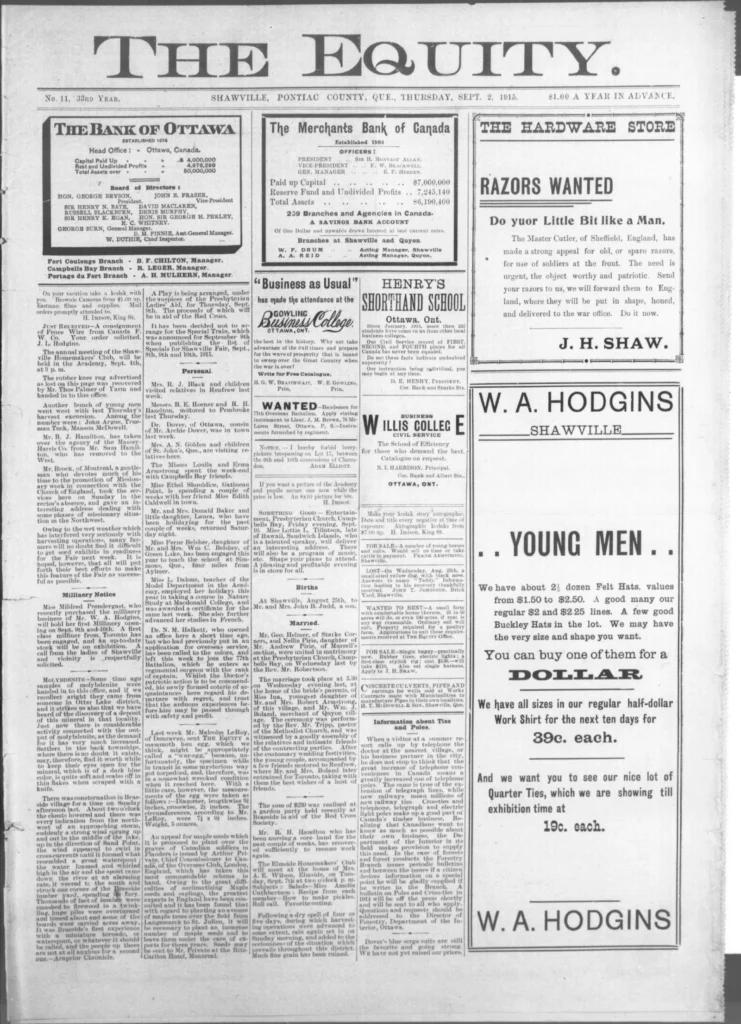
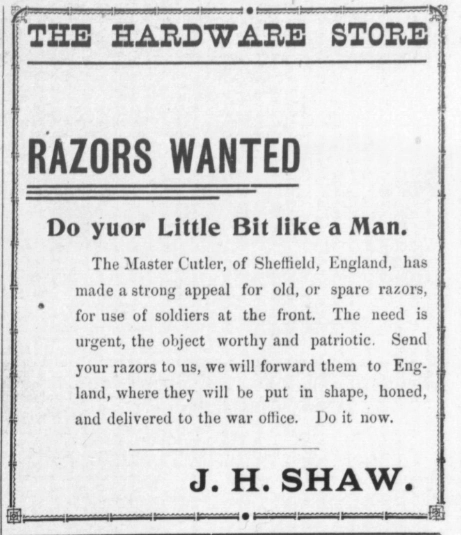
The community found unique ways to support these troops. On September 2, an urgent appeal appeared in The Equity asking citizens to send their “old, or spare razors” to the hardware store, where they would be forwarded to England to be honed and delivered to the war office for the men in the trenches.
In neighboring Arnprior, citizens and mill employees raised funds to purchase three machine guns for the Canadian troops, hoping to raise enough for a fourth. This sparked local frustration; on July 22 and again on August 26, the editors of The Equity pointedly lamented that several well-to-do municipalities in Pontiac could easily afford to supply these much-needed weapons, yet “absolutely nothing, has been done in Pontiac along similar lines.”
The strain of the war also brought to the surface political and cultural divisions between English and French Canada. On July 1, The Equity criticized Joseph Demers, a Liberal Member of Parliament for St. John’s and Iberville, Quebec, for delivering a “tirade” against the Conservative Government over a two-cent war stamp tax on cheques. Demers had argued the tax would “ruin the habitant” by sapping his prosperity, an objection the paper dismissed as partisan.
As the need for national unity and military recruits grew, The Equity published a pointed editorial on August 19 calling directly upon Sir Wilfrid Laurier. Noting the need to combat anti-recruiting sentiments in Quebec, the editors declared that the time had arrived for Laurier to redeem his pledge to “stump Quebec” and that “Canada awaits a stirring appeal from the noted French-Canadian leader to his compatriots.”
The war’s drain on manpower also heavily impacted the agricultural sector. Because a “huge number of Westerners” had gone to war, the demand on the East for harvest hands in 1915 was “greater than ever.” As a result, The Equity noted by September that many local boys from the Ottawa Valley were packing up and heading West to help bring in the bumper crop.
Ultimately, the stark and terrifying realities of the battlefield reached Pontiac through letters and casualty reports. On July 1, the paper published a letter from local soldier Hugh E. Brownlee, serving with the Canadian Expeditionary Force in France.
“Dear Brother,—I am still getting along all right. We have been out in the reserve trenches for a few days, but we go back into the firing line tomorrow night. We have had some pretty hard fighting since we came over here and have lost quite a number of men. If it were not for the German artillery we would soon finish them up. They hardly ever wait for a hand to hand fight when we make a charge. But those big guns are awful. You can see men and trenches go one hundred feet in the air. The big shells will blow a hole in the ground twenty feet deep and fifty wide, and when both sides get to going with about two hundred guns, and we are in between them, it is a pretty exciting place.
I have three or four holes in my cap and my nose skinned, but no holes in me yet. When we capture a trench it is thick with dead Germans, and sometimes we can’t get them all buried for a couple of days. It has to be all done at night, and both sides keep sending up star shells, and you can only show yourself for about two minutes when up goes a light and you have to drop and lay still till it goes out, unless you want about fifty holes in you from a machine gun.
The Germans pay particular attention to the Red Cross men, carrying out our wounded, and they also shell our hospitals whenever they can locate them. But we give them back lots of their own medicine, for prisoners we capture say their losses are frightful.
The war can’t end any too soon for me. I have seen enough fighting to last me a long time. This is a fine country, but it is certainly blown to pieces badly for ten or fifteen miles along the firing line.
Well, Joe, I have no more news. You see we are not supposed to give out too much information; so good-bye.
Your affectionate brother,
H. E. BROWNLEE.
No. 641, No. 4 Co., 8th Batt.,
1st Canadian Exp. Force.
Unfortunately, Hugh Brownlee was killed in action on November 12th, 1916 near Souchez, France.
Yet, amidst the grim news, there were moments of profound relief: on July 8, The Equity reported that Archie Hobin, who had been officially reported “killed in action” weeks earlier, had sent a postcard to his sister revealing he was actually alive, though wounded and a prisoner of war in Germany.
Soldiers Mentioned in The Equity
These names have been extracted from copies of The Equity by AI and may have mistakes. Please let us know if you catch any at jon@theequity.ca.
| Mentioned | Soldier / Personnel | Status / Details |
|---|---|---|
| Jul 1, 1915 | Hugh E. Brownlee | 8th Battalion, 1st C.E.F.; serving in France. Brother of Joseph Brownlee of Radford. |
| Jul 1, 1915 | Archie Hobin | Previously reported killed; sister received a postcard confirming he is a W.O.P. in Germany. |
| Jul 1 / 8, 1915 | Dr. Lippiatt | Shawville physician; relinquished his practice to join the medical corps for overseas service. |
| Jul 8, 1915 | David Hodgins | 48th Battalion; son of Wm. H. Hodgins. Enlisted in Vancouver and embarked at Montreal. |
| Jul 15 / 22, 1915 | Pte. Brock Walsh | Presented with a purse and formal address by Shawville citizens before leaving for the front. |
| Jul 15, 1915 | Dr. David McFarlane | Son of Capt. McFarlane of the Norway Belle; joined the colors. |
| Jul 15, 1915 | Lt. Dr. Norman Mee | Son of Mr. and Mrs. Harry Mee; joined the colors. |
| Jul 29 / Aug 12 | Lt. Henry H. Argue | Field Ambulance Corps; eldest son of H. T. Argue. Training at Niagara camp. |
| Jul 29, 1915 | Frank Armstrong | No. 5 Field Ambulance, C.E.F.; training at Shorncliffe Camp in England. |
| Jul 29, 1915 | Walter Graham | Local boy serving overseas; reported to be in England. |
| Jul 29, 1915 | Anthony Rosis | First man in his section to enlist; Driver with 2nd Field Co. in the trenches of Flanders. |
| Aug 5, 1915 | Pte. McMillan | From Portage du Fort; victim of gas poisoning at the front, returned home to recuperate. |
| Aug 5, 1915 | Pte. Christie Hughes | 38th Royal Canadians; assigned to garrison duty in Bermuda. |
| Aug 5, 1915 | Pte. George Harris | 38th Royal Canadians; assigned to garrison duty in Bermuda. |
| Aug 12, 1915 | Wilfrid Tucker | 42nd Battalion; son of Rev. Dr. Tucker. Enlisted and went to the front. |
| Aug 12, 1915 | Frank McGill | Appointed to the Canadian Aviation Corps; expected to sail for England shortly. |
| Sep 2, 1915 | Pte. Ernest G. Allen | Formerly of Morehead; training in the 77th Battalion at Rockliffe. |
| Sep 9 / 23, 1915 | C. Woodley & J. Landry | Enlisted together with the 60th Battalion in Ottawa. |
| Sep 23, 1915 | Melvin Shouldice | Resigned from the local bank to enlist with the 60th Battalion. |
| Sep 23, 1915 | Joe Erlam | From Radford; passed medical exam to enlist with the Canadian Field Engineers. |
| Sep 23, 1915 | Ira McKnight | From Radford; passed medical exam to enlist with the Canadian Field Engineers. |
| Sep 23, 1915 | Emerson Paul | From Bryson; passed medical exam to enlist with the Canadian Field Engineers. |
| Sep 23, 1915 | Dr. J. A. Grant | From Elmside; training at Calgary with the 50th Battalion. |
| Sep 30, 1915 | Harold Armstrong | Enlisted with the 73rd Highlanders of Montreal after a farewell visit home. |
Listen to our Podcast!
We’ve used Artificial Intelligence to summarize what was covered in The Equity during this part of the Great War. Click the play button to listen.
Timelines: April - June 1915
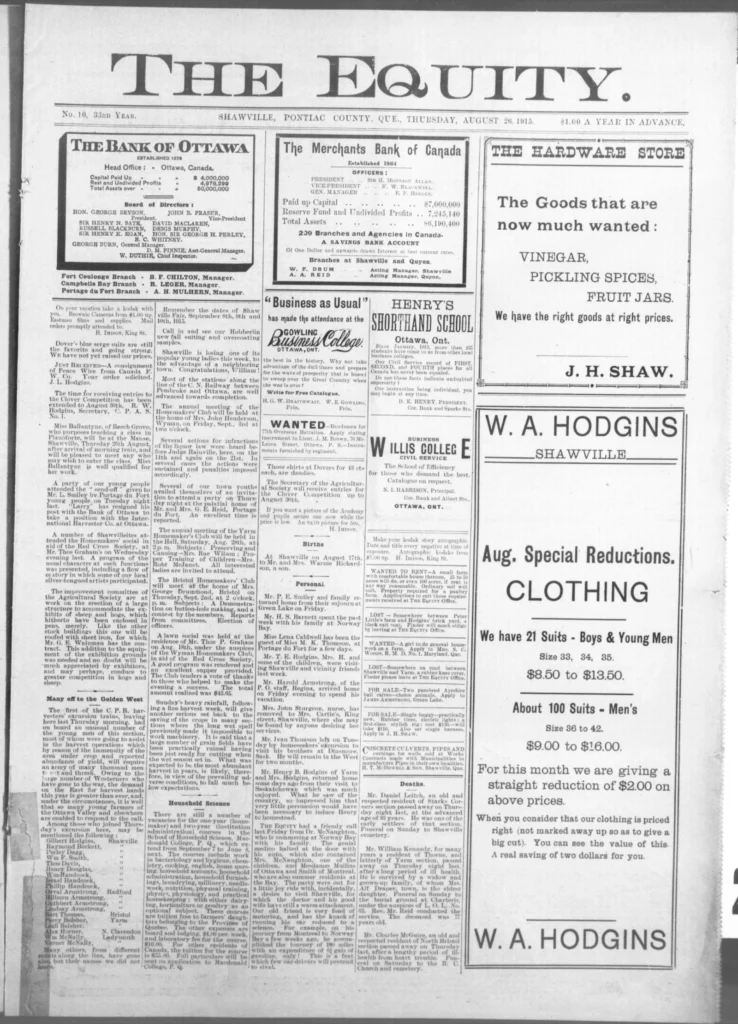
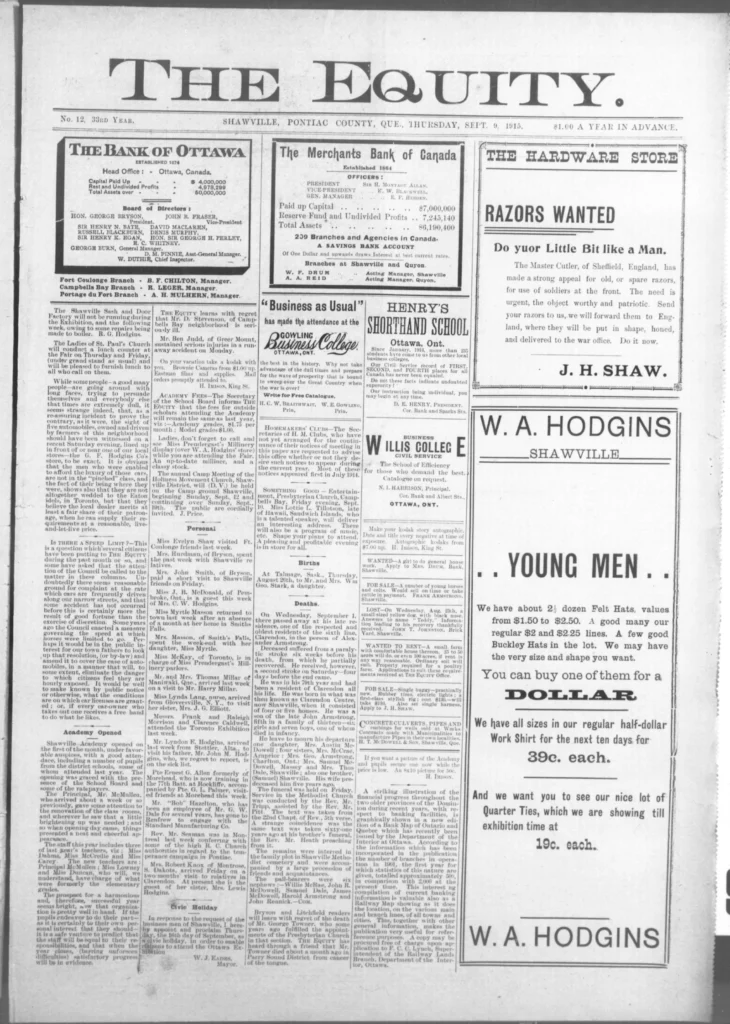
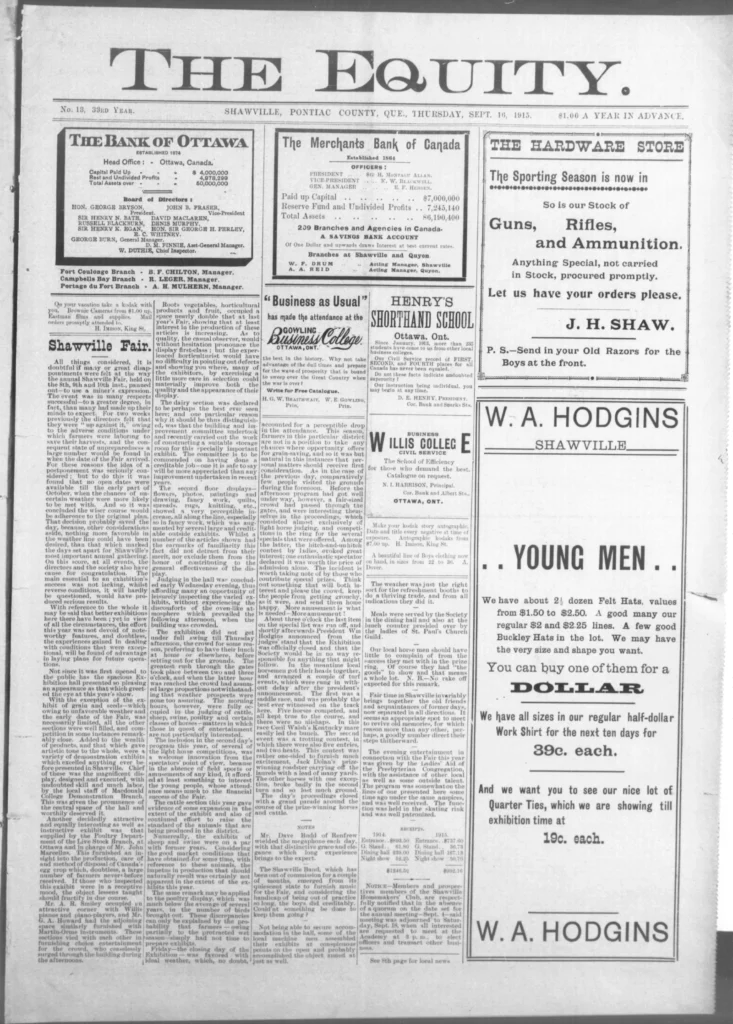
Below are the original copies of The Equity from this part of the War. Click any of them to download a PDF copy.