The winter of 1917 brought with it both the familiar hardships of the cold season and the deepening weight of war. Nearly three years into the conflict, the pages of The Equity reflected a community straining under the twin burdens of sacrifice and endurance.
Each issue mixed patriotic exhortations with the realities of loss and rising costs. Editorials left no doubt about the national purpose: Canada’s fate was bound to that of the British Empire, and “the prosecution of the war to a victorious conclusion” remained the singular goal. For the people of the Pontiac, that meant giving more, saving more, and hoping more — even as faith and fatigue grew harder to balance.
The war’s toll continued to touch the county in intimate and painful ways. The story of Private Lee Hodgins weighed especially heavy on readers — first reported dead, then declared alive but gravely wounded, before the initial sad truth was finally confirmed.
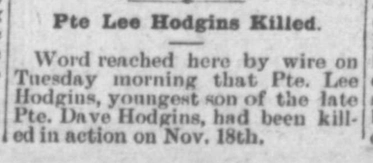
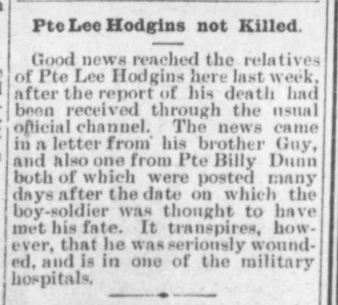
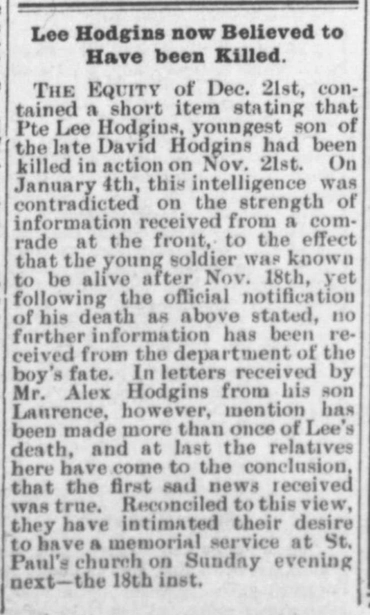
The February 22, 1917, issue of The Equity served as a final, somber closure to the months of uncertainty, featuring a front-page portrait of Lee alongside his father, Private Dave Hodgins. It was in this memorial tribute that the community learned the most staggering detail of his service: Lee was not the nineteen-year-old man his enlistment papers suggested, nor even the sixteen-year-old he claimed to be during his medical exam. He had been killed in action at the age of just 14 years and 9 months, making him one of the youngest soldiers from the region to fall in the Great War.


It was in the February 22, 1917 issue of The Equity that the community learned the most staggering detail of his service: Lee was not the nineteen-year-old man his enlistment papers suggested, nor even the sixteen-year-old he claimed to be during his medical exam. He had been killed in action at the age of just 14 years and 9 months, making him one of the youngest soldiers from the region to fall in the Great War.
The presence of “boy-soldiers” like Lee was a reality of the Canadian Expeditionary Force. While the official enlistment age was eighteen, many underage recruits were driven by a mixture of youthful adventure, intense patriotism, or a desire to follow family members into service. For Lee, the military environment was aware of his youth to some degree; during his physical in Ottawa, the medical officer, Captain Halkett, explicitly noted he was “fit as a boy,” even as he recorded his height at a modest 5 feet 6 inches and a weight of 125 pounds. Despite these notes of his physical immaturity, he was processed through the 77th Battalion and sent to the front lines with the 87th Battalion (Canadian Grenadier Guards).
Life for a fourteen-year-old in the trenches would have been a jarring transition from the farm life Lee knew in Shawville. He would have navigated the same grueling conditions as men twice his age—enduring the damp, rat-infested trenches of France and the constant threat of shellfire. His records show he was a diligent soldier, assigning $20.00 of his monthly pay back home to his guardian, James Dagg. Ultimately, the “fog of war” that led to the conflicting reports in The Equity was a byproduct of the chaotic nature of the Somme sector where the 87th was active.
Yet amidst sorrow, there were moments of relief. In March, Private Henry Howard became the first of the community’s soldiers to return home from the War. Shortly after he reached the front lines, he was involved in an accident where he suffered a badly fractured leg, which incapacitated him from further military service.
When he arrived back at the local station on a Saturday evening, he received a warm hero’s welcome from a large, cheering crowd of citizens. As he stepped off the train coach, two stalwart citizens seized him and carried him to a waiting sleigh to join his family. Before the sleigh was driven off, Councillor Shore delivered a short address of welcome and presented Pte. Howard with a $25.00 cheque on behalf of the townspeople.
Private Howard was also returning home to meet his daughter for the first time. Just a few weeks prior to his return, his wife gave birth to a daughter in Shawville on February 13, 1917.
Economic strain was an inescapable part of daily life. Prices for food and basic goods climbed relentlessly — tea up nearly ten cents per pound, footwear expected to rise another twenty percent, flour approaching ten dollars a barrel. Wage-earners struggled to meet the costs of necessities, as weekly expenses had grown far beyond prewar levels. The Equity offered advice on thrift and ingenuity, encouraging readers to insulate their homes better, save fuel, and even repurpose worn felt hats into slippers — “taking a rise out of the high cost of living.”
Agriculture remained the heart of both livelihood and loyalty. Farmers were reminded constantly that they, too, were soldiers — “the men who feed the Empire.” Minister of Agriculture Martin Burrell’s call to “strive to increase the food supply of England and France” echoed through the Pontiac.
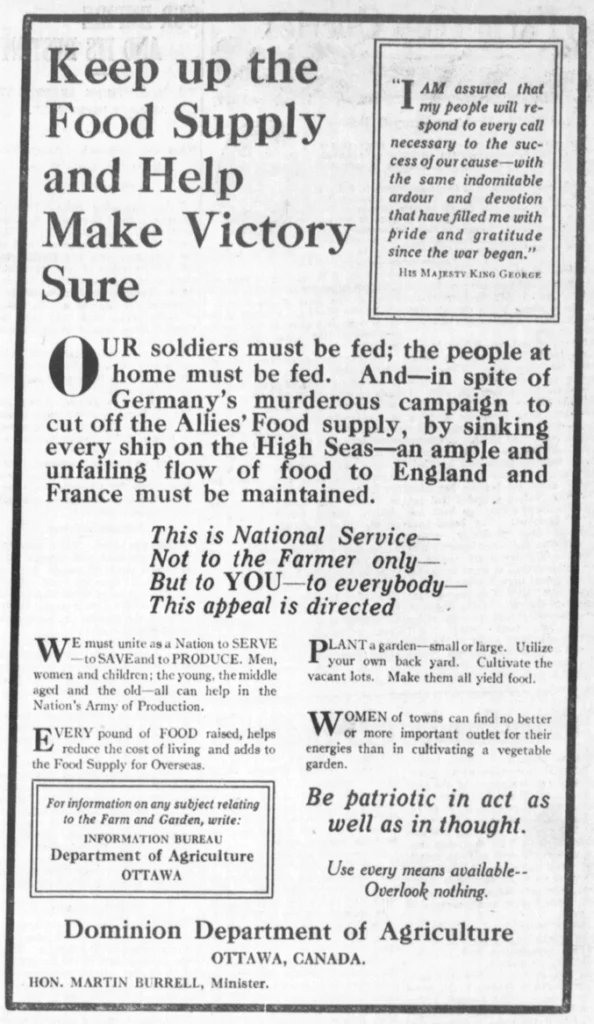
At the Shawville Seed Fair, speakers stressed the importance of using good seed and boosting yields of wheat and potatoes, even as farmers faced shortages caused by crop rust in the West. The government quietly intervened to purchase and distribute seed grain, ensuring spring planting would not falter. Farming advice filled the paper — on soil, on livestock, on rotation — all framed as part of the war effort. In this season of hardship, the plow was as vital as the rifle.
At home, community and governance worked in tandem to sustain morale. The Pontiac County Council voted $5,000 toward Patriotic and Red Cross purposes, while the Homemakers’ Clubs redoubled their efforts, producing pyjamas, hospital shirts, and knitted wool garments for soldiers overseas. Even leisure was viewed through the lens of wartime virtue: editorials praised Canadian sport for fostering the “virile manhood” necessary for the Empire’s defense, though most teams now fielded only younger boys — their older brothers long gone to war.
Beneath these outward expressions of unity, the political temperature was beginning to rise. The debate over National Service — and the looming question of conscription — cast a long shadow across the Dominion. Premier Norris of Manitoba declared that opponents of National Service “should be called traitors,” while Sir Wilfrid Laurier’s resistance to the plan was condemned as pandering to anti-war sentiment in Quebec.
In the Pontiac, where English and French residents worked and worshipped side by side, the tension was felt quietly but unmistakably. Editorials warned that a vote for Laurier was “a vote for Bourassa,” a pointed reference to the nationalist leader’s fierce opposition to the war.
By March, the tone of the newspaper was one of weary determination. Losses were mourned, but the larger purpose was never doubted. Readers were urged to endure inflation, plant more, save harder, and give generously. “Germany,” one editorial concluded, “can threaten, but she cannot win.” Though joy was scarce and the future uncertain, the people of the Pontiac pressed on, their sense of duty unbroken.
As the ice began to thaw and letters from overseas spoke of preparations for new offensives in France, the community braced for another year of war. The early months of 1917 had proven that the struggle was far from over — but also that the will to endure, even amid loss and division, remained strong. The coming spring would bring triumphs abroad and new fractures at home, as the question of conscription threatened to test the country’s unity like never before.
Soldiers Mentioned in The Equity
These names have been extracted from copies of The Equity by AI and may have mistakes. Please let us know if you catch any at jon@theequity.ca.
| Mentioned | Soldier / Personnel | Status / Details |
|---|---|---|
| Jan 4 / Feb 22, 1917 | Pte. Lee Elburn Hodgins | Son of David Hiram Hodgins. Enlisted at age 14. Confirmed killed in action Nov 18, 1916, aged 14 years and 9 months. |
| Jan 4, 1917 | Mr. Kilday | Returned soldier; noted spending a weekend visiting friends in town. |
| Jan 11 / Feb 8, 1917 | Pte. D. Woodsbery | 207th Battalion (Ottawa). Placed a notice regarding a lost homing pigeon that left Shawville. |
| Jan 11, 1917 | Cpl. Norman Thomas | Recommended for the Military Medal after capturing Germans and escaping safely after his comrades were killed. |
| Jan 11, 1917 | Capt. Dykes Bredin | Commanding officer of Cpl. Thomas; led the volunteer venture and also recommended for the Military Medal. |
| Jan 25, 1917 | Pte. D. R. Hornbe | 222nd Battalion. Wrote a letter describing his troopship voyage and positive impressions of England. |
| Jan 25, 1917 | Pte. W. (Billy) Brooke | POW at Saltau, Germany. Sentenced to 12 years for mutiny after allegedly refusing to make munitions. |
| Feb 1, 1917 | Wilfrid Tripp | "Town boy" who joined the 74th Battery in Kingston; scheduled for training in Ottawa. |
| Feb 1, 1917 | Hally Horner | "Town boy" who traveled with Wilfrid Tripp to join the 74th Battery. |
| Feb 15, 1917 | Sergt. J. C. Mann | 249th Battalion. Arrested for bigamy (allegedly marrying four women) and sentenced to two years. |
| Feb 15, 1917 | Pte. Harold Armstrong | Wrote of a narrow escape after being buried alive by a "Jack Johnson" shell explosion. |
| Feb 22, 1917 | Pte. David H. Hodgins | Father of Lee Elburn Hodgins. 48th Battalion; killed March 11, 1916, after five months in the trenches. |
| Feb 22, 1917 | Pte. Laurence Hodgins | Brother of Lee Hodgins. Serving at the front; wrote the letters confirming his brother's death. |
| Feb 22 / Mar 15, 1917 | Capt. F. C. Smyth | 149th Battalion. Visited family in Shawville prior to departing for overseas service. |
| Feb 22 / Mar 22, 1917 | Pte. Willie Crick | 38th Battalion. Initially reported doing well, but later confirmed seriously wounded in severe fighting. |
| Feb 22, 1917 | Private S. Harris | Mentioned as getting along well at the front alongside Willie Crick. |
| Mar 1, 1917 | Pte. Loren P. Hodgins | 130th Battalion. Enlisted March 1916; killed in action Feb 22, 1917. |
| Mar 1, 1917 | Carleton R. Wainman | 77th Battalion. Missing since June 1916; status updated to "Believed to have been killed." |
| Mar 15, 1917 | Corporal Paul Landry | Promoted to Corporal; later listed among the wounded in official casualty lists. |
| Mar 22, 1917 | Pte. Henry Howard | First invalided soldier to reach home (fractured leg). Welcomed at the station with a $25 cheque. |
| Mar 22, 1917 | Austin, Alfred, & Gordon Smith | Three brothers; enlisted together in the Royal Naval Canadian Volunteer Reserve. |
| Mar 22, 1917 | Pte. Clifton Woodley | POW in Germany for 22 months; wrote that camp conditions had recently improved. |
| Mar 29, 1917 | Lts. Reid & Manning | 235th and 240th Battalions. Arrived in Shawville on a recruiting and patriotic fundraising mission. |
| Mar 29, 1917 | Pte. E. Amy | Wounded for a second time according to recent casualty lists. |
| Mar 29, 1917 | L-Corp. Ernest Geo. Allen | Montreal Highland Regiment. Served seven months in trenches; listed among the wounded. |
Listen to our Podcast!
We’ve used Artificial Intelligence to summarize what was covered in The Equity during this part of the Great War. Click the play button to listen.
Timelines: January - March 1917
Below are the original copies of The Equity from this part of the War. Click any of them to download a PDF copy.